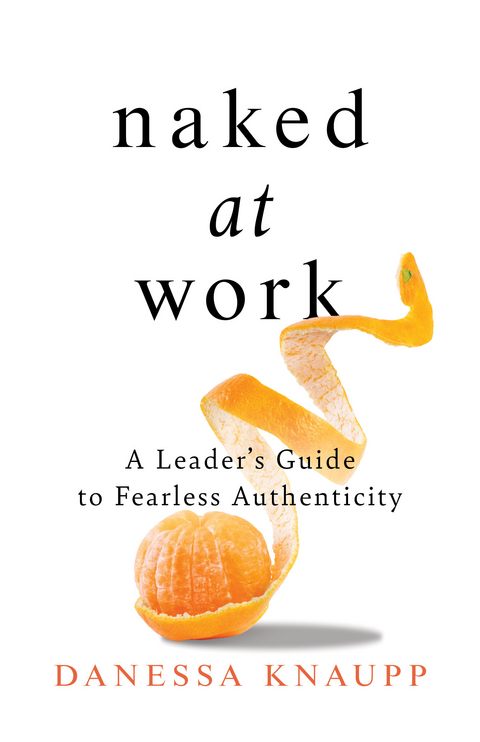
Naked at Work (eBook)
200 Seiten
Lioncrest Publishing (Verlag)
978-1-5445-0746-0 (ISBN)
Think about what kind of leader you could be if you knew, with absolute certainty, that you were the best person for the job. Now, think about all the reasons you can't be that leader. The stories you carry, your failures, the realities of your organization-everything that's in your way. The truth? You can be the strong, inspirational leader you imagine by leading authentically. But you have to peel back the facade and get naked. Many books tout the benefits of authenticity, but none explains exactly how to lead authentically or detail the rewards and risks of that choice. Naked at Work does both, making the case for authentic leadership and detailing the proven, step-by-step process used in elite executive coaching. This book will embolden you to own your unique story and use that real, imperfect experience to drive your personal and team performance. Using real examples from executives in large companies, the latest leadership theory and data, and her own track record of spectacular failures, Danessa Knaupp shows leaders how to get brave, get naked, and be the leaders they've always imagined.
Chapter 1
1. There’s No Perfect Leader
“Perhaps those who are best suited to power are those who have never sought it. Those who…have leadership thrust upon them, and take up the mantle because they must, and find to their own surprise that they wear it well.”
—J.K. Rowling, Harry Potter and the Deathly Hallows
My mother once called me a spectacular failure.
She uttered the words on a particularly dark professional day. I’d built a business I loved from the ground up and invested everything I had in it. I’d mortgaged the house and spent days and weeks away from my young sons and was now watching it all fall apart.
I was sitting at my kitchen table, sunlight streaming through the window and illuminating the sheaf of financial documents spread out in front of me. I was studying them intently for the fifteenth time. While I was hoping to see something new, I knew the truth. There was no way out. The business owed too much and was making far too little to sustain itself. I had been borrowing to make our payroll and had stopped paying myself months before. We owed our banker, our landlord, and our suppliers, and all were losing patience.
“I’m going to have to declare bankruptcy,” I told her.
Facing bankruptcy was a particularly painful moment for me. I’d left a long, successful career in financial services to start this business. I had deep experience with a corporation’s view of consumer bankruptcy and, up until now, I felt that only people who planned poorly or made rash decisions or suffered from terrible unforeseen catastrophes ended up in this spot. Bankruptcy wasn’t something people like me did. Bankruptcy was a last-ditch effort for the desperate, and yet here I was. The full weight of what declaring bankruptcy would mean for my employees, my business, my professional reputation, and my young family paralyzed me. I sat at that table, tears slipping down my face and spattering my spreadsheets, long after the sun dipped beneath the trees and the day dimmed. It was one of the saddest moments of my life.
I carried that memory with me, as detailed and real as it had been that day, long after I moved on from that heartbreaking spot. It became part of my identity. Long after I returned to banking, rose through another set of corporate ranks, and amassed another rich and accomplished résumé, I could feel the despair of that day sitting heavy, quiet, and omnipresent in the pit of my stomach.
I would walk into glass conference rooms at the tops of skyscrapers and look at the other leaders in the room, assessing them.
Had they spectacularly failed too?
Did they fall years behind in the corporate race because they’d chased a dream that turned out to be a very expensive flight of fancy?
Had they ever lost a bet they’d been so sure of that they’d mortgaged their house and then watched the movers wrap their dishes?
I was sure they hadn’t. The other people around the conference table had been to prestigious MBA programs, published white papers on customer behavior, and spent a year in Europe studying our industry from the other side of the ocean. They were smart, accomplished, and successful.
We weren’t the same. They were leaders, and leaders were of a certain breed, one that didn’t fall flat on its face and stay stuck in the mud. Leaders win. Leaders succeed. I had stumbled, meandered, and ultimately lost. We were cut from vastly different cloths.
I held this hypothesis for some time. Until I didn’t.
To be sure, some leaders follow a straight and predictable path.
Rose Marcario, the CEO of Patagonia, graduated top of her class. She got her undergraduate degree in finance, earned an MBA, and spent fifteen years at a private equity firm. She joined Patagonia in 2008 as the COO and CFO, and in less than five years was promoted to CEO. In the time Rose has been with Patagonia, she’s tripled the firm’s profits. She serves on several boards and has built a culture that functions as a beacon of social responsibility for other companies. Rose Marcario fit my mold of a well-qualified, confident leader.
Sundar Pichai is another prominent leader with what at first glance seems a direct path to the C-suite. Sundar is the CEO of Google and an alumnus of both Stanford and Wharton. He’s responsible for the development and distribution of the ubiquitous Google Drive and has been instrumental in shaping how the world thinks about search and document storage.
He also grew up in a two-bedroom apartment in India.
His family of four didn’t have a car and, as a child, Sundar often rode the bus for several hours a day. In 1984, when he was twelve, the family installed their first telephone, after a five-year wait. Sundar remembers the day their first refrigerator arrived. When he received a scholarship to study for his master’s at Stanford, his family withdrew nearly a year’s income from savings to pay for his plane ticket to California. When he first interviewed at Google, he was asked what he thought of Gmail. He’d never seen it.
When I learned this about Sundar, I wondered what he thought about when he first walked into the glass conference rooms at Google. Did he think about how he measured up to the others around the table? Did he compare his childhood self, on the bus or playing soccer in the park in Chennai, to the childhood selves of the other leaders? Did his path feel somehow less than those of his peers? He hadn’t had the advantages of private school and a game-day carpool. How did he reconcile his beginning with theirs?
I’ve since learned he did think about it. He describes his overwhelming early days in California: “I didn’t understand the internet. The change was too much for me. I think I was a little lost.” As well educated and prepared as he is to lead, as much as he’s accomplished, Sundar Pichai, at least once, compared himself to his peers and found himself lacking.
The same is true for Rose Marcario. In 2006, she quit her private equity job after a crisis of conscience. She couldn’t reconcile her role in the private equity firm with her values. She traveled to Rishikesh, India, and spent weeks meditating on the banks of the Ganges. She returned to the United States feeling more centered but still very much unemployed.
I’ve seen this experience, at some level, with nearly every leader I’ve coached. All have moments when they feel disconnected, disingenuous, and alone. All wonder if they are enough.
We are each privy to our full set of experiences, every misstep and failure and occasional success. That history is never perfect. Each of us at some point believes we aren’t the right or best choice for what’s ahead.
I worked with a young leader in private equity who struggled with reconciling her difference from her peers. Emily is a bright, engaging woman with a powerful track record of achievement. A graduate of both Harvard University and Harvard Business School, she left Boston to join an elite private equity firm in California. She was promoted early and often and was soon sitting on the forty-fourth floor in a corner office. She is polished, confident, and attractive. She’s perfect, at first glance.
During our first meeting, she confessed she was exhausted.
“I’m trying to keep up, but I don’t think I can. Everyone else has more time to focus on sourcing and researching deals than I do. My toddler is teething, and he’s up most of the night. I can’t stay awake when I work late at my laptop. I just keep dozing off, and I know I’m falling behind.”
Emily had looked at her peers and realized three things: First, they were all male. Second, none had children or other significant family responsibilities. Third, they each worked all day, every day. She believed that to be successful in this environment, she had to look and sound like the people around her.
Emily worked hard to remove all traces of her son from her work life. When he was born, she was checking email shortly after they left the hospital and was back in the office within six weeks. She rarely talked about him and had a deep list of nannies on call to help her stay late and start early.
“I can’t afford to be different,” she told me.
We later learned Emily’s peers and manager were strongly hoping she’d be exactly that.
Shortly after she returned to work from parental leave, her team had to deliver a pitch in New York. The three-hour meeting required six team members to fly cross-country and return in one twenty-four-hour period. Emily, nursing an infant, couldn’t figure out how to make that work and, after agonizing about her decision, asked if the team would consider a virtual option for the meeting. Could they pitch via video?
The team agreed, and the pitch went well. It was a long shot, though, and the client ultimately selected a firm...
| Erscheint lt. Verlag | 24.3.2020 |
|---|---|
| Sprache | englisch |
| Themenwelt | Wirtschaft ► Betriebswirtschaft / Management ► Unternehmensführung / Management |
| ISBN-10 | 1-5445-0746-1 / 1544507461 |
| ISBN-13 | 978-1-5445-0746-0 / 9781544507460 |
| Informationen gemäß Produktsicherheitsverordnung (GPSR) | |
| Haben Sie eine Frage zum Produkt? |
 EPUB (Ohne DRM)
Größe: 1,8 MB
Digital Rights Management: ohne DRM
Dieses eBook enthält kein DRM oder Kopierschutz. Eine Weitergabe an Dritte ist jedoch rechtlich nicht zulässig, weil Sie beim Kauf nur die Rechte an der persönlichen Nutzung erwerben.
Dateiformat: EPUB (Electronic Publication)
EPUB ist ein offener Standard für eBooks und eignet sich besonders zur Darstellung von Belletristik und Sachbüchern. Der Fließtext wird dynamisch an die Display- und Schriftgröße angepasst. Auch für mobile Lesegeräte ist EPUB daher gut geeignet.
Systemvoraussetzungen:
PC/Mac: Mit einem PC oder Mac können Sie dieses eBook lesen. Sie benötigen dafür die kostenlose Software Adobe Digital Editions.
eReader: Dieses eBook kann mit (fast) allen eBook-Readern gelesen werden. Mit dem amazon-Kindle ist es aber nicht kompatibel.
Smartphone/Tablet: Egal ob Apple oder Android, dieses eBook können Sie lesen. Sie benötigen dafür eine kostenlose App.
Geräteliste und zusätzliche Hinweise
Buying eBooks from abroad
For tax law reasons we can sell eBooks just within Germany and Switzerland. Regrettably we cannot fulfill eBook-orders from other countries.
aus dem Bereich