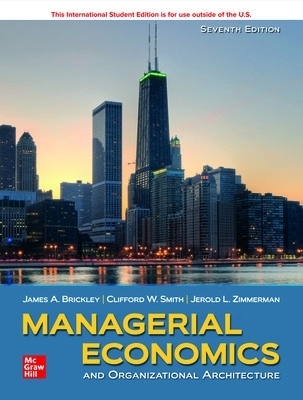
ISE Managerial Economics & Organizational Architecture
McGraw-Hill Education (Verlag)
978-1-260-57121-9 (ISBN)
Brickley paired with Connect Economics provides assignable,auto-gradable versions of test bank content. Assignable content is fully integrated with the eBook. Students are also able to search, highlight, and take notes within the ReadAnywhere eBook and complete adaptive reading assignments offline. Connect provides instructors with powerful reporting tools allowing them to plan, track, and analyze student performance across learning outcomes.
Research and teaching interests in the economics of organizations, corporate governance and compensation policy, corporate finance, franchising and banking. From 1989 to 1991, he was chairman of the Finance Department and research director at he University of Utah's Garn Institute of Finance. Professor Brickley was chairman of he Committee on MBA Programs from 1994-1997. Clifford W. Smith is the Louise & Henry Epstein EmeritusProfessor at the University of Rochester. He is currently chairman of the boardof Home Properties, a multifamily real estate investment trust (REIT) withoperations primarily along the East Coast of the United States, and wasformerly chair of the compensation committee, chair of the governancecommittee, and lead director. Smith has served as president of the Risk TheorySociety, president of the Financial Management Association National Honor Society,vice president for Global Services of the Financial Management AssociationInternational, vice president of the International Economics and FinanceSociety, a member of the board of advisors of the International Association ofFinancial Engineers, and a member of the board of directors of the FinancialManagement Association and the Southern Finance Association. Students in theExecutive MBA Program have given him their Superior Teaching Award 21 times;students in the MBA Program have given him their Superior Teaching Award 16times. In 2003, he received the FMA Fellows Award by the Financial ManagementAssociation International. He was named Distinguished Scholar by the SouthernFinance Association in 2000, and Distinguished International Visiting Scholarby the British Accounting Association in 1991. In 1986, he was given the firstSpecial Award for a Perfect Teaching Rating by the School, in 1983, he waschosen a University Mentor in recognition of his scholarship and teaching. Research and teaching interests involve financial and managerial accounting. He and Professor Ross L. Watts received American Institute of Certified Public Accountants Awards in 1979 and 1980 for their joint papers. He received the American Accounting Association award for Seminal Contribution to Accounting Literature in 2004. He was the 1978 winner of the Competitive Manuscript Award, sponsored by the American Accounting Association, for his paper, "The Costs and Benefits of Cost Allocation." His research, which has come to be called "positive theories of accounting," seeks to understand the costs and benefits of various accounting procedures. He and Watts co-authored a book, Positive Accounting Theory, published by Prentice-Hall in 1986.
Part 1: Basic Concepts
Chapter 1 Introduction
Chapter 2 Economists’ View of Behavior
Chapter 3 Exchange and Markets
Part 2: Managerial Economics
Chapter 4 Demand
Chapter 5 Production and Cost
Chapter 6 Market Structure
Chapter 7 Pricing with Market Power
Chapter 8 Economics of Strategy: Creating and Capturing Value
Chapter 9 Economics of Strategy: Game Theory
Chapter 10 Incentive Conflicts and Contracts
Part 3: Designing Organizational Architecture
Chapter 11 Organizational Architecture
Chapter 12 Decision Rights: The Level of Empowerment
Chapter 13 Decision Rights: Bundling Tasks into Jobs and Sub-units
Chapter 14 Attracting and Retaining Qualified Employees
Chapter 15 Incentive Compensation
Chapter 16 Individual Performance Evaluation
Chapter 17 Divisional Performance Evaluation
Capstone Case Study on Organizational Architecture: Arthur Andersen LLP
Part 4: Applications of Organizational Architecture
Chapter 18 Corporate Governance
Chapter 19 Vertical Integration and Outsourcing
Chapter 20* Leadership: Motivating Change within Organizations
Chapter 21 Understanding the Business Environment: The Economics of Regulation
Chapter 22 Ethics and Organizational Architecture
Chapter 23* Organizational Architecture and the Process of Management Innovation
| Erscheinungsdatum | 25.11.2020 |
|---|---|
| Zusatzinfo | 144 Illustrations |
| Verlagsort | OH |
| Sprache | englisch |
| Maße | 191 x 249 mm |
| Gewicht | 1120 g |
| Themenwelt | Wirtschaft ► Volkswirtschaftslehre ► Mikroökonomie |
| ISBN-10 | 1-260-57121-1 / 1260571211 |
| ISBN-13 | 978-1-260-57121-9 / 9781260571219 |
| Zustand | Neuware |
| Informationen gemäß Produktsicherheitsverordnung (GPSR) | |
| Haben Sie eine Frage zum Produkt? |
aus dem Bereich