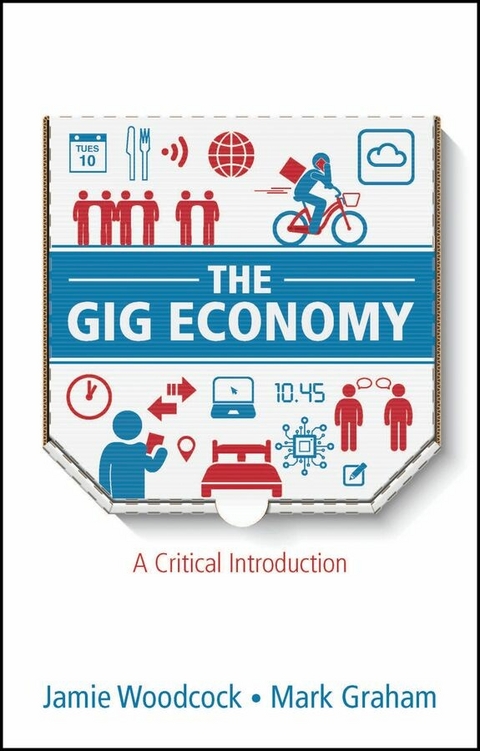
The Gig Economy (eBook)
John Wiley & Sons (Verlag)
978-1-5095-3637-5 (ISBN)
All of a sudden, everybody's talking about the gig economy. From taxi drivers to pizza deliverers to the unemployed, we are all aware of the huge changes that it is driving in our lives as workers, consumers and citizens.
This is the first comprehensive overview of this highly topical subject. Drawing upon years of research, stories from gig workers, and a review of the key trends and debates, Jamie Woodcock and Mark Graham shed light on how the gig economy came to be, how it works and what it's like to work in it. They show that, although it has facilitated innovative new services and created jobs for millions, it is not without cost. It allows businesses and governments to generate value while passing significant risk and responsibility onto the workers that make it possible. This is not, however, an argument for turning back the clock. Instead, the authors outline four strategies that can produce a fairer platform economy that works for everyone.
Woodcock and Graham's critical introduction will be essential reading for students, scholars and general readers interested in the massive shifts that characterize our modern digital economy.
Jamie Woodcock is a Researcher at the Oxford Internet Institute at the University of Oxford
Mark Graham is Professor of Internet Geography at the Oxford Internet Institute at the University of Oxford
All of a sudden, everybody s talking about the gig economy. From taxi drivers to pizza deliverers to the unemployed, we are all aware of the huge changes that it is driving in our lives as workers, consumers and citizens. This is the first comprehensive overview of this highly topical subject. Drawing upon years of research, stories from gig workers, and a review of the key trends and debates, Jamie Woodcock and Mark Graham shed light on how the gig economy came to be, how it works and what it s like to work in it. They show that, although it has facilitated innovative new services and created jobs for millions, it is not without cost. It allows businesses and governments to generate value while passing significant risk and responsibility onto the workers that make it possible. This is not, however, an argument for turning back the clock. Instead, the authors outline four strategies that can produce a fairer platform economy that works for everyone. Woodcock and Graham s critical introduction will be essential reading for students, scholars and general readers interested in the massive shifts that characterize our modern digital economy.
Jamie Woodcock is a Researcher at the Oxford Internet Institute at the University of Oxford Mark Graham is Professor of Internet Geography at the Oxford Internet Institute at the University of Oxford
Acknowledgements
Introduction
Chapter 1: Where did the gig economy come from?
Chapter 2: How does the gig economy work?
Chapter 3: What is it like to work in the gig economy?
Chapter 4: How are workers reshaping the gig economy?
Conclusion: What's next for the gig economy?
Appendix: Draft Convention on Platform Work
Notes
References
"Challenging and important, giving voice to workers on the front line of our growing gig economy, this book is a must read for trade unionists, policymakers and everyone with an interest in making work better amidst rapid technological change."
Frances O'Grady, Trades Union Congress General Secretary
"At a time when governments the world over turn away from workers, scholar-activists Woodcock and Graham offer a critical introduction to the global gig economy. They investigate innovative ways in which new forms of unions can help to tackle the Trojan Horse of gig labour."
Trebor Scholz, Director, Institute for the Cooperative Digital Economy at The New School
"[A] vital new contribution."
Economic & Political Weekly
Introduction
Everybody is talking about the gig economy. From newscasters to taxi drivers to pizza deliverers to the unemployed, we are all aware of the changes to our jobs, our professions, our economies and our everyday lives wrought by the gig economy. There are now an estimated 1.1 million people in the UK working in the gig economy, delivering food, driving taxis and offering other services – this is as many people as work for the National Health Service (Balaram et al., 2017). Eleven per cent of workers in the UK have earned income from working on digital labour platforms (Huws and Joyce, 2016), while 8 per cent of Americans worked on a ‘gig’ platform in 2016, rising to 16 per cent for the 18–29 age bracket (Smith, 2016). An increasingly common feature of the gig economy is the use of digital labour platforms – tools that allow employers to access a pool of on-demand workers. It is predicted that by 2025, one-third of all labour transactions will be mediated by digital platforms (Standing, 2016). Around the world, the number of people who have found work via platforms is estimated to be over 70 million (Heeks, 2017). Even more headline-grabbing are the numbers released in a 2015 study by McKinsey:
Up to 540 million people could benefit from online talent platforms by 2025. As many as 230 million could find new jobs more quickly, reducing the duration of unemployment, while 200 million who are inactive or employed part time could gain additional hours through freelance platforms. As many as 60 million people could find work that more closely suits their skills or preferences, while an additional 50 million could shift from informal to formal employment. (Manyika et al., 2015)
We have written this book as a critical introduction for those who want to find out more about how work is changing today. Throughout the book we draw on examples from our own research, stories from workers themselves, and the key debates in the field. Work is not just an interesting concept or debating point, but also something that most of us have to do. The conditions under which we find and undertake work can therefore tell us much about society around us – including issues of power, technology and who benefits in the economy. We wrote this book as engaged researchers, not only to document the rise of the gig economy, but also to critically explore how it is being changed right now by both workers and platforms, as well as how it could be transformed in future.
The focus of this book is on the precarious and fractured forms of work that have become known as ‘gigs’ (that is casual, piecemeal work) within the so-called ‘gig economy’. These include things like delivery, taxis and domestic work. We also focus specifically on platform work, in which gigs are mediated digitally via platforms like Uber and Deliveroo. While ‘gigs’ have always existed across many sectors of the economy, the gig economy enabled by digital platforms is growing rapidly, and increasingly replacing non-platform gig work. By focusing on the platform, we can begin to understand how other kinds of precarious work are being reshaped, but also how this has already begun to affect the rest of the economy. In other words, we are in an important historical moment: one in which we are witnessing an unprecedented normalization of the platform-based labour model. It is therefore crucial to not just describe it, but also to shape it so that it can become more just and fair.
What do we mean by the gig economy?
The ‘gig’ in the term ‘gig economy’ refers back to the short-term arrangements typical of a musical event. An aspiring musician might celebrate getting a gig, or tell a friend that they have got a gig in the back room of a pub or other venue. This is of course no guarantee that they will get to perform regularly. There might be the chance of a repeat performance if they play particularly well, or are particularly popular – or it may just be a one-off. They might get paid – either a fixed fee, a share of the ticket price, or payment in kind (some free drinks perhaps). Their expenses might get covered. But also, they might not.
There are clearly some parallels here with the work we have already discussed. The tasks that underpin the gig economy are also typically short, temporary, precarious and unpredictable, and gaining access to more of them depends on good performance and reputation. However, work in the gig economy, as we will show, is very different to musical gigs. With much gig work, there is little possibility of career advancement – particularly if you are stuck doing endless tasks rather than ‘a job’. What the term ‘gig economy’ captures is an economic transformation in which work in many sectors is becoming temporary, unstable and patchworked. It entails workers spending less time at one job, a risk of time spent without income, workers undertaking more jobs (possibly at the same time), and unpaid time spent searching for tasks or gigs.
In this book, we use the term ‘gig economy’ to refer to labour markets that are characterized by independent contracting that happens through, via, and on digital platforms. The kind of work that is offered is contingent: casual and non-permanent work. It may have variable hours and little job security, involve payment on a piece-work basis, and lack any options for career development. This relationship is sometimes termed ‘independent contracting’, ‘freelancing’ or ‘temporary work’ (‘temp’ for short). While the term has traditionally been used to refer to a broader range of activities that happen in both digitally mediated and non-mediated ways (such as bike messengers and cab drivers), we focus in this book on digital platforms because of the scale they involve. The platform is the digital base upon which the gig firm is built. It provides ‘tools to bring together the supply of, and demand for, labour’ (Graham and Woodcock, 2018: 242), including the app, digital infrastructure and algorithms for managing the work. As Nick Srnicek (2017: 48) has argued:
Platforms, in sum, are a new type of firm; they are characterized by providing the infrastructure to intermediate between different user groups, by displaying monopoly tendencies driven by network effects, by employing cross-subsidization to draw in different user groups, and by having designed a core architecture that governs the interaction possibilities.
Platforms have become central to our social activities. They bring together users, capture and monetize data, as well as needing to scale to be effective. Indeed, they are now starting to mediate just about every imaginable economic activity, and they tend to do so through gig economy models. Many digital platforms have a low entry requirement and deliberately recruit as many workers as possible, often to create an oversupply of labour power, and therefore guarantee a steady supply of workers on demand to those who need them. In a world where people are talking about ‘Uber’ as a verb: ‘the Uber for dog walking’, ‘the Uber for doctors’, and even ‘the Uber for drugs’, it is important to understand both the histories and futures of this emerging – and increasingly normalized – model of work. The gig economy naturally has immediate effects on gig workers, but as it develops it will affect work more broadly in profound ways.
The rise of the ‘gig economy’ has become symbolic of the way that work is changing. The term refers to the increase in short-term contracts rather than permanent or stable jobs. It has been touted by many as offering much greater flexibility for workers, employers and customers, rather than the stifling nature of some traditional employment contracts. Employers can choose when and how they want to hire workers. And clients and customers can reap the benefits of this flexibility: getting food delivered quickly, hiring a web developer and ordering a taxi on demand has never been easier. Workers can supposedly choose what to do, how, when, where and for whom. Many are able to find jobs and income previously hard to obtain.
The gig economy, however, also has a dark side. Emerging evidence is pointing towards a range of negative outcomes for workers: low pay, precarity, stressful and dangerous working conditions, one-sided contracts and a lack of employment protection (Wood et al., 2019b). This can result in ‘a raw deal’ for workers, which in the US context can also be seen as an attempt to ‘replace the New Deal’ (Hill, 2017: 4). Some platforms have replaced previous kinds of work – for example, minicabs being replaced by Uber – whereas others are creating new kinds of jobs – the training of machine learning systems by image tagging and data entry, for instance. In all cases, existing working practices are being transformed. The so-called ‘standard employment relationship’ is being undermined through fragmented work and increased casualization. Activities that were previously considered to be a formal or standard job can be mediated through platforms to try and bypass rules, standards and traditions that have protected working standards. One example of this is the new platform being proposed for the UK’s National Health Service that would have nurses bid for shifts under the guise of offering flexibility rather than being provided with more stable contracts.1
We focus on two kinds of work in this book. The first is...
| Erscheint lt. Verlag | 17.1.2020 |
|---|---|
| Sprache | englisch |
| Themenwelt | Wirtschaft ► Volkswirtschaftslehre ► Makroökonomie |
| Wirtschaft ► Volkswirtschaftslehre ► Wirtschaftspolitik | |
| Schlagworte | Airbnb • Cultural Studies • Deliveroo • Digital Culture • Digital Culture & the Information Age • Digital Economy • Digitale Kultur im Informationszeitalter • digital labour • digital platforms • digital work • Economics • Gig economy • gig workers • Kulturwissenschaften • Labor Unions • Platform Capitalism • platforms • political economics • Political Economy • Politische Ökonomie • resistance • Sharing Economy • Sociology • Sociology of Organizations & Work • Soziologie • Soziologie am Arbeitsplatz • Strikes • Trade unions • Uber • Volkswirtschaftslehre • Work • Workers’ Rights |
| ISBN-10 | 1-5095-3637-X / 150953637X |
| ISBN-13 | 978-1-5095-3637-5 / 9781509536375 |
| Informationen gemäß Produktsicherheitsverordnung (GPSR) | |
| Haben Sie eine Frage zum Produkt? |
 EPUB (Adobe DRM)
Kopierschutz: Adobe-DRM
Adobe-DRM ist ein Kopierschutz, der das eBook vor Mißbrauch schützen soll. Dabei wird das eBook bereits beim Download auf Ihre persönliche Adobe-ID autorisiert. Lesen können Sie das eBook dann nur auf den Geräten, welche ebenfalls auf Ihre Adobe-ID registriert sind.
Details zum Adobe-DRM
Dateiformat: EPUB (Electronic Publication)
EPUB ist ein offener Standard für eBooks und eignet sich besonders zur Darstellung von Belletristik und Sachbüchern. Der Fließtext wird dynamisch an die Display- und Schriftgröße angepasst. Auch für mobile Lesegeräte ist EPUB daher gut geeignet.
Systemvoraussetzungen:
PC/Mac: Mit einem PC oder Mac können Sie dieses eBook lesen. Sie benötigen eine
eReader: Dieses eBook kann mit (fast) allen eBook-Readern gelesen werden. Mit dem amazon-Kindle ist es aber nicht kompatibel.
Smartphone/Tablet: Egal ob Apple oder Android, dieses eBook können Sie lesen. Sie benötigen eine
Geräteliste und zusätzliche Hinweise
Buying eBooks from abroad
For tax law reasons we can sell eBooks just within Germany and Switzerland. Regrettably we cannot fulfill eBook-orders from other countries.
aus dem Bereich