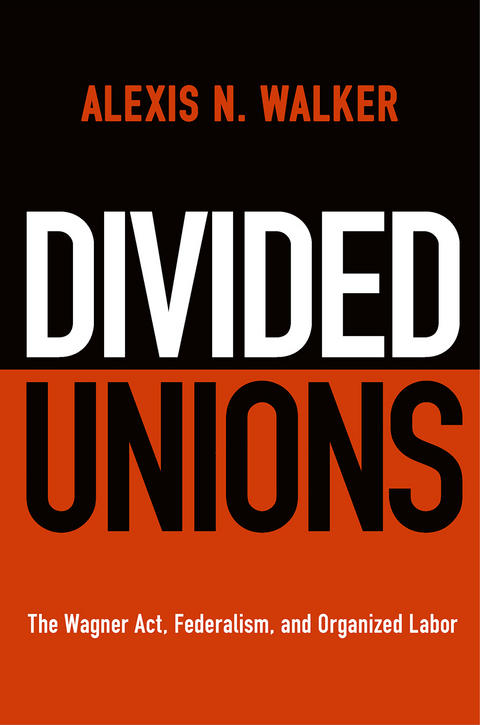
Divided Unions (eBook)
200 Seiten
University of Pennsylvania Press (Verlag)
978-0-8122-9666-2 (ISBN)
A comparative history of public and private sector unions from the Wagner Act of 1935 until today
The 2011 battle in Wisconsin over public sector employees' collective bargaining rights occasioned the largest protests in the state since the Vietnam War. Protestors occupied the state capitol building for days and staged massive rallies in downtown Madison, receiving international news coverage. Despite an unprecedented effort to oppose Governor Scott Walker's bill, Act 10 was signed into law on March 11, 2011, stripping public sector employees of many of their collective bargaining rights and hobbling government unions in Wisconsin. By situating the events of 2011 within the larger history of public sector unionism, Alexis N. Walker demonstrates how the passage of Act 10 in Wisconsin was not an exceptional moment, but rather the culmination of events that began over eighty years ago with the passage of the Wagner Act in 1935.
Although explicitly about government unions, Walker's book argues that the fates of public and private sector unions are inextricably linked. She contends that the exclusion of public sector employees from the foundation of private sector labor law, the Wagner Act, firmly situated private sector law at the national level, while relegating public sector employees' efforts to gain collective bargaining rights to the state and local levels. She shows how private sector unions benefited tremendously from the national-level protections in the law while, in contrast, public sector employees' efforts progressed slowly, were limited to union-friendly states, and the collective bargaining rights that they finally did obtain were highly unequal and vulnerable to retrenchment. As a result, public and private sector unions peaked at different times, preventing a large, unified labor movement. The legacy of the Wagner Act, according to Walker, is that labor remains geographically concentrated, divided by sector, and hobbled in its efforts to represent working Americans politically in today's era of rising economic inequality.
Alexis N. Walker teaches political science at Saint Martin's University.
Chapter 1. Introduction
Chapter 2. The Wagner Act: A Critical Exclusion
Chapter 3. After Wagner (1936-1960): Life Without Collective Bargaining Rights
Chapter 4. 1961: The Public Sector's Watershed Moment
Chapter 5. The 1970s: Labor Out of Alignment
Chapter 6. The Late 1970s to the 2010s: Labor on the Decline
Chapter 7. The 2010s: The Modern Assault Against Public Sector Unions
Chapter 8. Conclusion: The Consequences of Labor's Enduring Divide
Appendix: Interview Method Description
Notes
Bibliography
Index
Acknowledgments
| Erscheint lt. Verlag | 13.12.2019 |
|---|---|
| Reihe/Serie | American Governance: Politics, Policy, and Public Law | American Governance: Politics, Policy, and Public Law |
| Zusatzinfo | 8 illus. |
| Verlagsort | Philadelphia |
| Sprache | englisch |
| Themenwelt | Sachbuch/Ratgeber ► Beruf / Finanzen / Recht / Wirtschaft ► Geld / Bank / Börse |
| Geisteswissenschaften ► Geschichte ► Regional- / Ländergeschichte | |
| Recht / Steuern ► Arbeits- / Sozialrecht ► Arbeitsrecht | |
| Recht / Steuern ► EU / Internationales Recht | |
| Wirtschaft | |
| Schlagworte | American History • American labor law • American labor laws history • American Studies • collective bargaining rights • Human Rights • Law • Political Science • private sector unions • Public Policy • public sector unions • Wagner Act • Wisconsin act 10 |
| ISBN-10 | 0-8122-9666-4 / 0812296664 |
| ISBN-13 | 978-0-8122-9666-2 / 9780812296662 |
| Informationen gemäß Produktsicherheitsverordnung (GPSR) | |
| Haben Sie eine Frage zum Produkt? |
 EPUB (Adobe DRM)
Kopierschutz: Adobe-DRM
Adobe-DRM ist ein Kopierschutz, der das eBook vor Mißbrauch schützen soll. Dabei wird das eBook bereits beim Download auf Ihre persönliche Adobe-ID autorisiert. Lesen können Sie das eBook dann nur auf den Geräten, welche ebenfalls auf Ihre Adobe-ID registriert sind.
Details zum Adobe-DRM
Dateiformat: EPUB (Electronic Publication)
EPUB ist ein offener Standard für eBooks und eignet sich besonders zur Darstellung von Belletristik und Sachbüchern. Der Fließtext wird dynamisch an die Display- und Schriftgröße angepasst. Auch für mobile Lesegeräte ist EPUB daher gut geeignet.
Systemvoraussetzungen:
PC/Mac: Mit einem PC oder Mac können Sie dieses eBook lesen. Sie benötigen eine
eReader: Dieses eBook kann mit (fast) allen eBook-Readern gelesen werden. Mit dem amazon-Kindle ist es aber nicht kompatibel.
Smartphone/Tablet: Egal ob Apple oder Android, dieses eBook können Sie lesen. Sie benötigen eine
Geräteliste und zusätzliche Hinweise
Buying eBooks from abroad
For tax law reasons we can sell eBooks just within Germany and Switzerland. Regrettably we cannot fulfill eBook-orders from other countries.
aus dem Bereich