


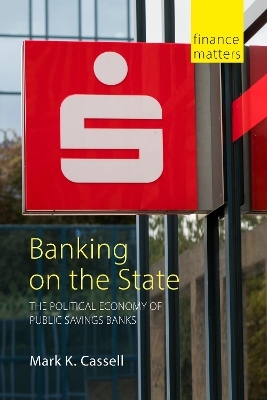
Banking on the State
The Political Economy of Public Savings Banks
Seiten
2020
Agenda Publishing (Verlag)
978-1-78821-195-6 (ISBN)
Agenda Publishing (Verlag)
978-1-78821-195-6 (ISBN)
Mark Cassell explores the unique entity that is the German public banking system and the lessons it offers to banking systems worldwide.
Germany’s public savings banks – Sparkassen – are a remarkable and puzzling phenomena. No other advanced industrial country relies as heavily on such small, public financial institutions to fuel its economy and how is it that such small institutions can drive one of the biggest and most successful economies in the world?
In theory, their diminutive size should hinder their ability to function in an environment where they compete with the capital and muscle of major international banks. Yet at the height of the financial crisis, when other banks drastically reduced lending, new loans made by Sparkassen increased as they continued to provide liquidity and lend to start-up firms. How have they managed to survive the economic turmoil and global pressures of the last few decades? What has enabled them to stay at the heart of the German economy? In a period of neoliberal “too-big-to-fail” thinking, how have these relics of an ordoliberal past managed to flourish?
Mark Cassell answers these and many other questions in his exploration of the unique entity that is Germany’s public savings bank system and the lessons it offers to banking systems worldwide.
Germany’s public savings banks – Sparkassen – are a remarkable and puzzling phenomena. No other advanced industrial country relies as heavily on such small, public financial institutions to fuel its economy and how is it that such small institutions can drive one of the biggest and most successful economies in the world?
In theory, their diminutive size should hinder their ability to function in an environment where they compete with the capital and muscle of major international banks. Yet at the height of the financial crisis, when other banks drastically reduced lending, new loans made by Sparkassen increased as they continued to provide liquidity and lend to start-up firms. How have they managed to survive the economic turmoil and global pressures of the last few decades? What has enabled them to stay at the heart of the German economy? In a period of neoliberal “too-big-to-fail” thinking, how have these relics of an ordoliberal past managed to flourish?
Mark Cassell answers these and many other questions in his exploration of the unique entity that is Germany’s public savings bank system and the lessons it offers to banking systems worldwide.
Mark K. Cassell is Professor of Political Science at Kent State University. He is the author of How Governments Privatize: The Politics of Divestment in the United States and Germany.
1. Introduction2. Context3. The Puzzle4. Economic explanations5. Administrative explanations6. Political explanations7. Conclusion
| Erscheinungsdatum | 10.05.2021 |
|---|---|
| Reihe/Serie | Finance Matters |
| Verlagsort | Newcastle upon Tyne |
| Sprache | englisch |
| Maße | 156 x 234 mm |
| Themenwelt | Wirtschaft ► Volkswirtschaftslehre ► Wirtschaftspolitik |
| ISBN-10 | 1-78821-195-2 / 1788211952 |
| ISBN-13 | 978-1-78821-195-6 / 9781788211956 |
| Zustand | Neuware |
| Informationen gemäß Produktsicherheitsverordnung (GPSR) | |
| Haben Sie eine Frage zum Produkt? |
Mehr entdecken
aus dem Bereich


aus dem Bereich
Wohlstand, Wachstum, Wettbewerb
Buch | Softcover (2025)
Kohlhammer (Verlag)
CHF 68,90
mit Marx, Menger und Marshall durch die Grundlagen der Ökonomie
Buch | Hardcover (2025)
De Gruyter Oldenbourg (Verlag)
CHF 62,90
Wurzeln und Perspektiven
Buch | Softcover (2025)
Kohlhammer (Verlag)
CHF 44,75


