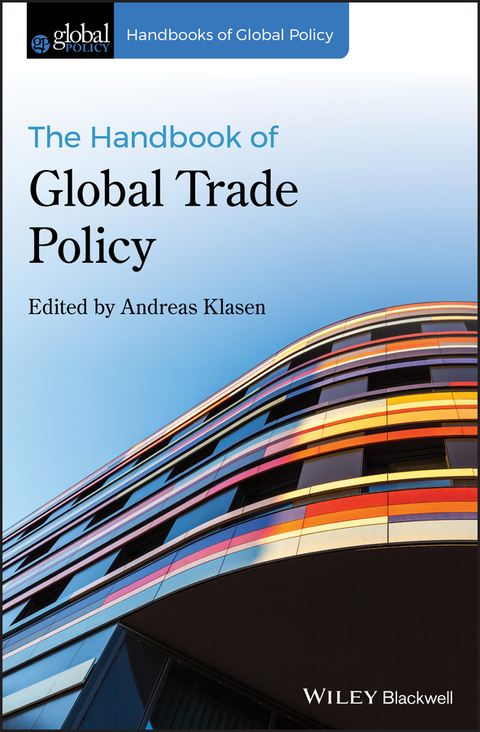
The Handbook of Global Trade Policy (eBook)
John Wiley & Sons (Verlag)
978-1-119-16742-6 (ISBN)

Provides a state-of-the-art overview of international trade policy research
The Handbook of Global Trade Policy offers readers a comprehensive resource for the study of international trade policy, governance, and financing. This timely and authoritative work presents contributions from a team of prominent experts that assess the policy implications of recent academic research on the subject. Discussions of contemporary research in fields such as economics, international business, international relations, law, and global politics help readers develop an expansive, interdisciplinary knowledge of 21st century foreign trade.
Accessible for students, yet relevant for practitioners and researchers, this book expertly guides readers through essential literature in the field while highlighting new connections between social science research and global policy-making. Authoritative chapters address new realities of the global trade environment, global governance and international institutions, multilateral trade agreements, regional trade in developing countries, value chains in the Pacific Rim, and more. Designed to provide a well-rounded survey of the subject, this book covers financing trade such as export credit arrangements in developing economies, export insurance markets, climate finance, and recent initiatives of the World Trade Organization (WTO). This state-of-the-art overview:
- Integrates new data and up-to-date research in the field
- Offers an interdisciplinary approach to examining global trade policy
- Introduces fundamental concepts of global trade in an understandable style
- Combines contemporary economic, legal, financial, and policy topics
- Presents a wide range of perspectives on current issues surrounding trade practices and policies
The Handbook of Global Trade Policy is a valuable resource for students, professionals, academics, researchers, and policy-makers in all areas of international trade, economics, business, and finance.
Dr Andreas Klasen is Professor of International Business and Head of the Institute for Trade and Innovation (IfTI) at Offenburg University, Germany, as well as Visiting Professor at Northumbria University, UK and Honorary Fellow at Durham University, UK. He is co-editor with Fiona Bannert of The Future of Foreign Trade Support (Wiley Blackwell 2015). He was previously Partner and Head of Economics & Policy at PricewaterhouseCoopers and Managing Director of the German Export Credit and Investment Insurance Agency. Dr Klasen's research focuses on trade, innovation, economic development and business ethics.
Provides a state-of-the-art overview of international trade policy research The Handbook of Global Trade Policy offers readers a comprehensive resource for the study of international trade policy, governance, and financing. This timely and authoritative work presents contributions from a team of prominent experts that assess the policy implications of recent academic research on the subject. Discussions of contemporary research in fields such as economics, international business, international relations, law, and global politics help readers develop an expansive, interdisciplinary knowledge of 21st century foreign trade. Accessible for students, yet relevant for practitioners and researchers, this book expertly guides readers through essential literature in the field while highlighting new connections between social science research and global policy-making. Authoritative chapters address new realities of the global trade environment, global governance and international institutions, multilateral trade agreements, regional trade in developing countries, value chains in the Pacific Rim, and more. Designed to provide a well-rounded survey of the subject, this book covers financing trade such as export credit arrangements in developing economies, export insurance markets, climate finance, and recent initiatives of the World Trade Organization (WTO). This state-of-the-art overview: Integrates new data and up-to-date research in the field Offers an interdisciplinary approach to examining global trade policy Introduces fundamental concepts of global trade in an understandable style Combines contemporary economic, legal, financial, and policy topics Presents a wide range of perspectives on current issues surrounding trade practices and policies The Handbook of Global Trade Policy is a valuable resource for students, professionals, academics, researchers, and policy-makers in all areas of international trade, economics, business, and finance.
Dr Andreas Klasen is Professor of International Business and Head of the Institute for Trade and Innovation (IfTI) at Offenburg University, Germany, as well as Visiting Professor at Northumbria University, UK and Honorary Fellow at Durham University, UK. He is co-editor with Fiona Bannert of The Future of Foreign Trade Support (Wiley Blackwell 2015). He was previously Partner and Head of Economics & Policy at PricewaterhouseCoopers and Managing Director of the German Export Credit and Investment Insurance Agency. Dr Klasen's research focuses on trade, innovation, economic development and business ethics.
Notes on Contributors viii
Introduction 1
1 Quo Vadis, Global Trade? 3
Andreas Klasen
Part I Foreign Trade in the 21st Century 23
2 The Global Trade Environment - A New Reality 25
Martina Hoppner
3 On the Remeasurement of International Trade in the Age of Digital Globalisation 47
Steffen Groning, Cyrus de la Rubia, and Thomas Straubhaar
4 Services Trade, Structural Transformation and the SDG 2030 Agenda 79
Mina Mashayekhi
5 Cities and Trade 118
Thomas Hoehn
6 Strategic Trade as a Means to Global Influence 143
Rebecca Harding and Jack Harding
Part II Global Governance and International Institutions 173
7 Is There a Future for Multilateral Trade Agreements? 175
Judith Goldstein and Elisabeth van Lieshout
8 Finance That Matters: International Finance Institutions and Trade 201
Steven Beck and Alisa DiCaprio
9 How Banking Regulators and Trade Ministers are Singing from Different Songbooks 221
Diana Smallridge and Jennifer Henderson
10 Trade and Illicit Flows: A Case Involving the United States, China and Mexico 251
Nikos Passas
Part III Global Trade and Regional Development 269
11 Regional Integration: The Next Wave 271
Marion Jansen, Sebastian Klotz, and Jasmeer Virdee
12 United States: What to Expect from a Protective US Trade Policy 308
Erdal Yalcin, Gabriel Felbermayr, and Marina Steininger
13 Trade and Developing-Country Exporters: The Case of Latin American and Caribbean Countries 328
Banu Demir
14 Sailing Against the Storm of Protectionism: The Role of the EU in Shaping Global Trade Policy 351
Lucian Cernat and Omar Alam
15 Trade, Global Value Chains and Inclusive Growth in Asia and the Pacific 379
Yasuyuki Sawada, Cyn-Young Park, Fahad H. Khan, and Cindy Jane Justo
16 Institutional Capacity, Trade and Investment in African Economies 418
Roseline Wanjiru and Karla Simone Prime
Part IV Financing Trade 439
17 Financing Trade: The Role of the WTO and Recent Initiatives 441
Marc Auboin
18 How Trade Finance Works 468
Alexander Malaket
19 Export Credit Arrangements in Capital-Scarce Developing Economies 494
Benedict Okey Oramah
20 Export Credit Insurance Markets and Demand 536
Simone Krummaker
21 Climate Finance, Trade and Innovation Systems 555
Fiona Bannert
Index 578
Notes on Contributors
Omar Alam was working at the European Commission’s Directorate‐General for Trade at the time of writing. He previously worked in the private sector, where he specialised in EU affairs and EU‐Asia political and trade relations. His research interests include global trade policy and the inter‐linkages between trade, geopolitics and development. He currently works in the UK Civil Service.
Marc Auboin is Economic Counsellor at the World Trade Organization (WTO), responsible for the institution’s trade and finance agenda, including trade finance, and for WTO relations with the International Monetary Fund (IMF) and World Bank. Previously he held several positions at the IMF, was Deputy‐Secretary General of the Monetary Committee of the European Union and worked for the French Treasury. Mr Auboin holds a PhD in economics and published extensively on trade finance issues in academic books and articles. He runs the WTO Expert Group on Trade Finance.
Fiona Bannert is Financing Partnerships Specialist at the Asian Development Bank. Previously, she was a Manager with PricewaterhouseCoopers advising the German Export Credit Agency in various roles in Hamburg and Berlin from 2010 to 2017. Her current research is focused on climate finance, economic development, trade and public policy. Her publications include among others The Future of Foreign Trade Support (co‐editor with Andreas Klasen, 2015). Fiona has two Master’s degrees from the University of Munich, Germany, and Nottingham University, UK.
Steven Beck is the Head of Trade and Supply Chain Finance at the Asian Development Bank (ADB). He built ADB’s multibillion trade finance business. He also created the Trade Finance Register of the International Chamber of Commerce, which compiles the only global statistics on trade finance default and loss rates. He created the ADB study that, for the first time, quantified trade finance market gaps and their impact on economic growth and jobs. His career began with roles as a Special Assistant to the Canadian Minister for International Trade and as a Senior Manager at the Canadian Imperial Bank of Commerce (CIBC). He left CIBC to help start up the Black Sea Trade & Development Bank. Mr Beck is on the Advisory Board of the International Chamber of Commerce (ICC) Banking Commission and the World Trade Board. He has an MA from Fletcher School, Tufts University, and a BA from Queen’s University in Canada.
Lucian Cernat is the Chief Trade Economist of the European Commission. Until 2008, he held various positions at the United Nations in Geneva dealing with trade and development issues. He has authored more than 20 publications on the development impact of trade policies, World Trade Organization negotiations, European Union preferential market access, regional trade agreements, competition policy and corporate governance. Prior to his UN experience, he has been a trade diplomat with the Romanian Ministry of Foreign Affairs. Cernat obtained a PhD from the University of Manchester and a Postgraduate Diploma from Oxford University.
Banu Demir is an Assistant Professor of Economics at Bilkent University in Ankara, a Research Affiliate at the Centre for Economic Policy Research in London and a Research Affiliate at the CESifo Institute in Munich. She was a Visiting Assistant Professor at the Department of Economics, Princeton University, for the academic year 2016–2017. She also worked as a Research Analyst at the Poverty Reduction and Economic Management (PREM) unit at the World Bank between 2006 and 2008. She holds a DPhil from the University of Oxford, an MA from Bilkent University and a BSc from Middle East Technical University, all in economics. Her research interests lie in the areas of international trade and development, with a focus on trade financing and transportation costs.
Alisa DiCaprio is the Head of Trade and Supply Chain at R3 in New York City. In addition to strategy, she also covers trade governance and global standards initiatives. She joined from the Asian Development Bank where she was a Senior Economist working on digital trade, trade finance and innovation. She has also worked in both the public and private sectors on export promotion, trade negotiations and labour issues. She co‐chairs the Bankers Association for Finance and Trade (BAFT) Innovation Council and is a Vice Chair of the US Department of Commerce’s Trade Finance Advisory Council. She has worked in Cambodia, Chile, Finland, Japan, the Philippines, Thailand and the United States. Her PhD is from MIT, and she holds a BA and an MA from Johns Hopkins University.
Gabriel Felbermayr is President of the Kiel Institute for the World Economy. He concurrently holds a chair in economics and economic policy at Kiel University and is a member of the Scientific Advisory Board of the German Federal Ministry of Economics and Energy. Previously, he was an Associate Consultant with McKinsey & Co., Assistant Professor at the University of Tübingen, held a chair in international economics at the University of Hohenheim (Stuttgart) and led the ifo Center for International Economics at the University of Munich, where he also served as a full professor in international economics. His research and advisory activities focus on questions of economic global governance, European economic integration and German economic policy.
Judith Goldstein is the Janet M. Peck Professor of International Communication at Stanford University. She is also the Chair of the Department of Political Science and Senior Fellow at the Stanford Center for Economic Policy and the Freeman Spogli Institution and has held the Kaye University Fellow in Undergraduate Education. Goldstein has a BA in political science and Near Eastern languages from University of California, Berkeley, a Master’s in international affairs from Columbia University and an MA and PhD in political science from UCLA. She has written and/or edited five books and numerous articles, many of which centre on issues of globalisation, international law and the World Trade Organization.
Steffen Gröning is a lecturer in economics and freelance consultant. He holds a Bachelor degree in economics and a Master’s degree in international economics. He completed his studies at the University of Göttingen, Germany, UC San Diego, California, USA, and the Universidad Torcuato di Tella, Buenos Aires, Argentina. Focusing his research on econometrics, international trade relations and institutional economics, he received his Dr rer. pol. in 2011 at the University of Hamburg, where he was a postdoctoral fellow at the chair of international economics.
Jack Harding is Head of Political Risk at Coriolis Technologies. He has nearly ten years’ experience in political risk analysis and forecasting for financial institutions. He is the co‐author of The Weaponization of Trade: The Great Unbalancing of Policy and Economics (with Rebecca Harding, 2017). Alongside his work for Coriolis, he is studying for a PhD at the University of Glasgow, where he is examining British, French and German responses to terrorism post‐2001. He holds a distinction in his MA in intelligence and international security from King’s College London, where his work on German intelligence operations earned him the prize for best MA dissertation. He has taught political science at Sciences Po (Reims Campus) and recently co‐organised a North Atlantic Treaty Organization (NATO) conference on military exercises held in Brussels.
Rebecca Harding is an independent economist specialising in trade and trade finance and is Chief Executive Officer (CEO) of Coriolis Technologies, providing data as a service to the trade finance and banking sectors. She is also a Fellow at the Institute for Trade and Innovation at Offenburg University. She is the co‐author of The Weaponization of Trade: the Great Unbalancing of Policy and Economics (with Jack Harding, 2017). Until February 2017, she was the Chief Economist of the British Bankers’ Association. Her senior roles also include CEO of Delta Economics, Senior Fellow at London Business School, Head of Corporate Research at Deloitte and Chief Economist at the Work Foundation. Ms Harding was also a Specialist Advisor to the Treasury Select Committee and Chief Economic Advisor to the All Party Parliamentary Group on Entrepreneurship.
Jennifer Henderson is a Senior Consultant for International Financial Consulting Ltd., with extensive experience in the field of trade and development finance. She has lived and worked around the world focusing on strategy, institutional development and impact measurement; advising governments, development banks and export credit agencies. A key theme in her publications and work to date has been examining how public sector institutions might catalyse private sector activities to maximize development or social‐economic impact. She studied economics and international relations at the Australian National University and will complete her Master’s in public policy from Cambridge University in 2020.
Thomas Hoehn is an experienced economist with a background in applied economic research, business consulting, regulation and public policy advice. He was a Visiting Professor at Imperial College Business School between 2003 and 2009 and Director of the Intellectual Property Research Centre at Imperial College until 2013. He previously held teaching and research positions at the University of Zurich and the London School of Economics. From 2009 to 2017 Tom was a...
| Erscheint lt. Verlag | 6.12.2019 |
|---|---|
| Reihe/Serie | Handbooks of Global Policy |
| HGP - Handbooks of Global Policy | HGP - Handbooks of Global Policy |
| Sprache | englisch |
| Themenwelt | Sozialwissenschaften ► Politik / Verwaltung ► Staat / Verwaltung |
| Wirtschaft ► Volkswirtschaftslehre ► Makroökonomie | |
| Schlagworte | Economics • Economics of Globalization • Global financing • Globalisierung • global trade economics • global trade guide • global trade policy • global trade research • International Economics & Trade • Internationale Ökonomie u. internationaler Handel • Internationaler Handel • international financing </p> • International Trade • international trade guide • international trade policy • international trade research • <p>global trade • Öffentliche Wirtschaft u. Finanzwesen • Ökonomie • Ökonomie der Globalisierung • Political Science • Politikwissenschaft • Public Policy Economics & Finance • Volkswirtschaftslehre |
| ISBN-10 | 1-119-16742-6 / 1119167426 |
| ISBN-13 | 978-1-119-16742-6 / 9781119167426 |
| Informationen gemäß Produktsicherheitsverordnung (GPSR) | |
| Haben Sie eine Frage zum Produkt? |
 EPUB (Adobe DRM)
Kopierschutz: Adobe-DRM
Adobe-DRM ist ein Kopierschutz, der das eBook vor Mißbrauch schützen soll. Dabei wird das eBook bereits beim Download auf Ihre persönliche Adobe-ID autorisiert. Lesen können Sie das eBook dann nur auf den Geräten, welche ebenfalls auf Ihre Adobe-ID registriert sind.
Details zum Adobe-DRM
Dateiformat: EPUB (Electronic Publication)
EPUB ist ein offener Standard für eBooks und eignet sich besonders zur Darstellung von Belletristik und Sachbüchern. Der Fließtext wird dynamisch an die Display- und Schriftgröße angepasst. Auch für mobile Lesegeräte ist EPUB daher gut geeignet.
Systemvoraussetzungen:
PC/Mac: Mit einem PC oder Mac können Sie dieses eBook lesen. Sie benötigen eine
eReader: Dieses eBook kann mit (fast) allen eBook-Readern gelesen werden. Mit dem amazon-Kindle ist es aber nicht kompatibel.
Smartphone/Tablet: Egal ob Apple oder Android, dieses eBook können Sie lesen. Sie benötigen eine
Geräteliste und zusätzliche Hinweise
Buying eBooks from abroad
For tax law reasons we can sell eBooks just within Germany and Switzerland. Regrettably we cannot fulfill eBook-orders from other countries.
aus dem Bereich