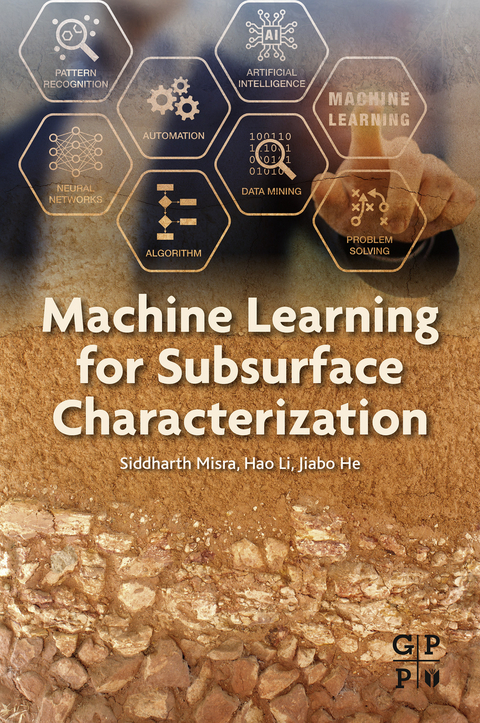
Machine Learning for Subsurface Characterization (eBook)
440 Seiten
Elsevier Science (Verlag)
9780128177372 (ISBN)
Siddharth Misra is currently associate professor at the Harold Vance Department of Petroleum Engineering, Texas A&M University, College Station, Texas. His research work is in the area of data-driven predictive models, machine learning, geosensors, and subsurface characterization. He earned a PhD in petroleum engineering from the University of Texas and a bachelor of technology in electrical engineering from the Indian Institute of Technology in Bombay. He received the Department of Energy Early Career Award in 2018 to promote geoscience research.
Machine Learning for Subsurface Characterization develops and applies neural networks, random forests, deep learning, unsupervised learning, Bayesian frameworks, and clustering methods for subsurface characterization. Machine learning (ML) focusses on developing computational methods/algorithms that learn to recognize patterns and quantify functional relationships by processing large data sets, also referred to as the "e;big data."e; Deep learning (DL) is a subset of machine learning that processes "e;big data"e; to construct numerous layers of abstraction to accomplish the learning task. DL methods do not require the manual step of extracting/engineering features; however, it requires us to provide large amounts of data along with high-performance computing to obtain reliable results in a timely manner. This reference helps the engineers, geophysicists, and geoscientists get familiar with data science and analytics terminology relevant to subsurface characterization and demonstrates the use of data-driven methods for outlier detection, geomechanical/electromagnetic characterization, image analysis, fluid saturation estimation, and pore-scale characterization in the subsurface. - Learn from 13 practical case studies using field, laboratory, and simulation data- Become knowledgeable with data science and analytics terminology relevant to subsurface characterization- Learn frameworks, concepts, and methods important for the engineer's and geoscientist's toolbox needed to support
| Erscheint lt. Verlag | 12.10.2019 |
|---|---|
| Sprache | englisch |
| Themenwelt | Informatik ► Theorie / Studium ► Künstliche Intelligenz / Robotik |
| Naturwissenschaften ► Physik / Astronomie | |
| Technik ► Elektrotechnik / Energietechnik | |
| Technik ► Umwelttechnik / Biotechnologie | |
| Wirtschaft | |
| ISBN-13 | 9780128177372 / 9780128177372 |
| Informationen gemäß Produktsicherheitsverordnung (GPSR) | |
| Haben Sie eine Frage zum Produkt? |
 EPUB (Adobe DRM)
Kopierschutz: Adobe-DRM
Adobe-DRM ist ein Kopierschutz, der das eBook vor Mißbrauch schützen soll. Dabei wird das eBook bereits beim Download auf Ihre persönliche Adobe-ID autorisiert. Lesen können Sie das eBook dann nur auf den Geräten, welche ebenfalls auf Ihre Adobe-ID registriert sind.
Details zum Adobe-DRM
Dateiformat: EPUB (Electronic Publication)
EPUB ist ein offener Standard für eBooks und eignet sich besonders zur Darstellung von Belletristik und Sachbüchern. Der Fließtext wird dynamisch an die Display- und Schriftgröße angepasst. Auch für mobile Lesegeräte ist EPUB daher gut geeignet.
Systemvoraussetzungen:
PC/Mac: Mit einem PC oder Mac können Sie dieses eBook lesen. Sie benötigen eine
eReader: Dieses eBook kann mit (fast) allen eBook-Readern gelesen werden. Mit dem amazon-Kindle ist es aber nicht kompatibel.
Smartphone/Tablet: Egal ob Apple oder Android, dieses eBook können Sie lesen. Sie benötigen eine
Geräteliste und zusätzliche Hinweise
Buying eBooks from abroad
For tax law reasons we can sell eBooks just within Germany and Switzerland. Regrettably we cannot fulfill eBook-orders from other countries.
aus dem Bereich