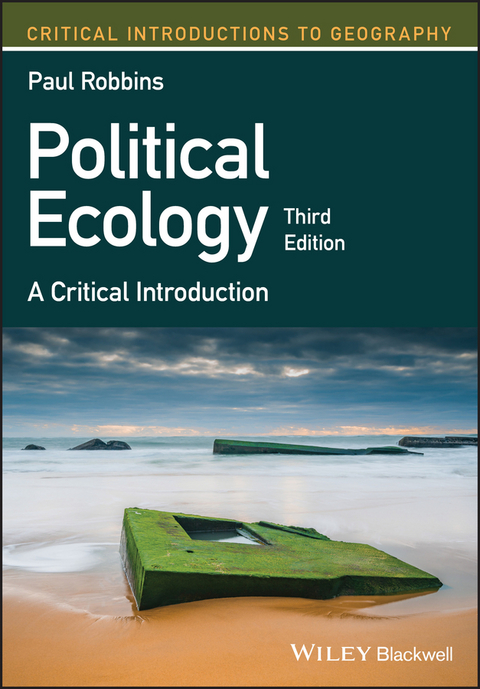
Political Ecology (eBook)
John Wiley & Sons (Verlag)
978-1-119-16746-4 (ISBN)
An accessible, focused exploration of the field of political ecology
The third edition of Political Ecology spans this sprawling field, using grounded examples and careful readings of current literature. While the study of political ecology is sometimes difficult to fathom, owing to its breadth and diversity, this resource simplifies the discussion by reducing the field down into a few core questions and arguments. These points clearly demonstrate how critical theory can make pragmatic contributions to the fields of conservation, development, and environmental management.
The latest edition of this seminal work is also more closely focused, with references to recent work from around the world. Further, Political Ecology raises critical questions about 'traditional' approaches to environmental questions and problems. This new edition:
- Includes international work in the field coming out of Europe, Latin America, and Asia
- Explains political ecology and its tendency to disrupt the environmental research and practice by both advancing and undermining associated fields of study
- Contains contributions from a wide range of diverse backgrounds and expertise
- Offers a resource that is written in highly-accessible, straightforward language
- Outlines the frontiers of the field and frames climate change and the end of population growth with the framework of political ecology
An excellent resource for undergraduates and academics, the third edition of Political Ecology offers an updated edition of the guide to this diverse, quickly growing field that is at the heart of how humans shape the world and, in turn, are shaped by it.
Paul Robbins is the dean of the Nelson Institute for Environmental Studies at the University of Wisconsin-Madison, USA, where he guides the institute in serving as a world leader in addressing rapid global environmental change. With writing focused on diverse interdisciplinary audiences and the broader public, he is author of the award-winning book Lawn People: How Grasses, Weeds, and Chemicals Make Us Who We Are (2007), widely recognized as one of the most accessible books on the environmental politics of daily life.
Paul Robbins is the dean of the Nelson Institute for Environmental Studies at the University of Wisconsin-Madison, USA, where he guides the institute in serving as a world leader in addressing rapid global environmental change. With writing focused on diverse interdisciplinary audiences and the broader public, he is author of the award-winning book Lawn People: How Grasses, Weeds, and Chemicals Make Us Who We Are (2007), widely recognized as one of the most accessible books on the environmental politics of daily life.
Cover 1
Title Page 5
Copyright Page 6
Contents 7
Preface to the Third Edition 8
Acknowledgments 10
Introduction 13
The Goals of the Text 16
The Rest of the Book 17
Chapter 1 Political versus Apolitical Ecologies 20
What is Political Ecology? 22
Challenging apolitical ecologies 23
Common assumptions and modes of explanation 28
Five Dominant Narratives in Political Ecology 29
Big questions and theses 30
The target of explanation 32
Chapter 2 A Tree with Deep Roots 34
The Determinist Context 35
A political ecological alternative 36
The Building Blocks 37
Critical approaches in early human–environment research 37
From sewer socialism to mitigating floods: hazards research 41
The nature of society: cultural ecology 44
Beyond land and water: the boundaries of cultural ecology 53
Chapter 3 The Critical Tools 57
Common Property Theory 59
Marxist Political Economy 62
Historical materialism 63
Dependency, accumulation, and degradation 66
Lessons from a broadly defined political economy 68
The Producer is the Agent of History: Peasant Studies 68
Chayanov and the peasant producer 70
Scott and the moral economy 71
Feminist Political Ecology 73
Breaking Open the Household: Feminist Development Studies 74
New Feminist Political Ecologies 76
Performativity and intersectionality 76
Everyday and emotional political ecologies 77
The ubiquity of feminist ecologies 78
Critical environmental history 78
Whose History and Science? Postcolonial Studies and Power/Knowledge 80
Power/knowledge 83
Critical science and ethics 84
Emerging Concerns: Cities, Subjects, and Objects 85
The urban graft 85
Urban metabolism 86
Environmental justice 87
Governmentality and the Creation of Subjects 88
Objects, Actor-networks, and the Problem of Materiality 89
Symmetry: networks and companions 90
Towards Political Ecology 92
Note 93
Chapter 4 Political Ecology Emerges 94
Political Ecology is not a Theory or a Method 96
Political Ecology is a Community of Practice 97
Political Ecology is the Quality of a Text 98
Winning and Losing 100
Chains of explanation 101
Human–Non-Human Dialectics 104
Starting from, or Ending in, a Contradiction 105
Claims about the State of Nature and Claims about Claims about the State of Nature 106
The Power of Political Ecology: The Hatchet and the Seed 108
The hatchet: political ecology as critique 109
The seed: political ecology as equity and sustainability research 110
Chapter 5 Challenges in Ecology 111
The Focus on Human Impact 114
Defining and Measuring Degradation 114
Loss of natural productivity 115
Loss of biodiversity 118
Loss of usefulness 118
Socio-environmental destruction: creating or shifting risk ecology 119
Limits of Degradation: Variability, State?and?Transition and Ecological Novelty 120
Variability of ecological systems 120
State and transition 122
Ecological novelty 124
Methodological Imperatives in Political Analysis of Environmental Change 127
From destruction to production 128
Chapter 6 Challenges in Social Construction 130
Why Bother to Argue that Nature (or Forests or Land Degradation …) is Constructed? 131
Debates and motivations 132
Hard and soft constructivism 135
“Barstool” Biologists and “Hysterical Housewives”: Attacking and Defending Local Environmental Knowledge 139
Eliciting environmental construction 140
Methodological Issues in Political Analysis of Environmental Construction 145
From Production to Co?Production 146
Chapter 7 Challenges in Explanation 149
Meetings in the Forest 149
The Challenge of Land Change Science 150
What is land change science? 150
Lessons for political ecology 151
Limits and incompatibilities of this approach 153
The Challenge of Causal Explanation 154
Lessons for political ecology 156
Limits and incompatibilities of the approach 158
Towards a Dialogue in Co?Production 159
Chapter 8 Degradation and Marginalization 161
The Argument 163
Degradation and reversibility 164
Accumulation and declining margins 164
The Evidence 164
Soil degradation and cotton production in West Africa 165
Amazonian deforestation 166
Migrant farm labor in the United States 170
Evaluating the Thesis 172
Research Example: Common Property Disorders in Rajasthan 175
Eliciting rules of use 176
Recording environmental practices and response to authority 177
Determining ecological outcomes 178
Chapter 9 Conservation and Control 180
The Argument 181
Coercion, governmentality, and internalization of state rule 182
Disintegration of moral economy 183
The constructed character of natural wilderness 183
Territorialization of conservation space 184
The Evidence 185
New England fisheries conservation 185
Fire in Madagascar 189
Evaluating the Thesis 192
Riven bureaucracies and efficacious species 192
Truth and reconciliation in conservation 195
In the Field: The Biogeography of Power in the Aravalli 196
A classic case of conservation and control? 196
Establishing historical patterns of access 197
Understanding contemporary land uses and enclosure impacts 198
Tracking unintended consequences 199
Chapter 10 Environmental Conflict 202
The Argument 203
Social structure as differential environmental access and responsibility 203
Property institutions as politically partial constructions 204
Environmental development and classed, gendered, raced imaginaries 206
The Evidence 207
Agricultural development in the Gambia 207
Gambia and the gendered land/labor nexus 208
Land conflict in the US west 210
Evaluating the Thesis 212
Stock characters and standard scripts 213
Research Example: Gendered Landscapes and Resource Bottlenecks in the Thar 214
Determining differential land uses and rights 214
Tracking changes in availability 215
Evaluating divergent impacts 216
Chapter 11 Environmental Subjects and Identities 218
The Argument 219
Moral economies and peasant resistance 220
Environmental hegemony and interpellation 221
The Evidence 223
Mayan identity and ecology 223
Andean livelihood movements 226
Modernization and identity 227
Evaluating the Thesis 228
Making identity by making a living 228
Are environmental subjects democratic ones? 230
In the Field: “Lawn People” as Environmental Subjects in the United States 231
Chapter 12 Political Objects and Actors 235
The Argument 236
Collaborators: dynamic actor networks 236
Insurgents: uncooperative materiality 238
The Evidence 239
Agricultural biotechnology 239
Bear conservation 242
Evaluating the Thesis 243
What counts as evidence of non?human agency? 244
The banality of the obviously material 244
In the Field: Do Mosquitoes Manage Bureaucracies? 245
Chapter 13 Political Ecologies of the Future? 248
Less is More: Degrowth 250
More is Less: Modernist Ecosocialism 252
Neither More nor Less: The Shadows of Utopia and Dystopia 253
In the Meantime … 255
Bibliography 257
Index 292
EULA 305
| Erscheint lt. Verlag | 8.10.2019 |
|---|---|
| Reihe/Serie | Critical Introductions to Geography |
| Critical Introductions to Geography | Critical Introductions to Geography |
| Sprache | englisch |
| Themenwelt | Naturwissenschaften ► Biologie ► Ökologie / Naturschutz |
| Naturwissenschaften ► Geowissenschaften ► Geografie / Kartografie | |
| Sozialwissenschaften ► Politik / Verwaltung ► Staat / Verwaltung | |
| Sozialwissenschaften ► Soziologie ► Makrosoziologie | |
| Wirtschaft ► Volkswirtschaftslehre ► Wirtschaftspolitik | |
| Schlagworte | A Critical Introduction to political ecology • Arizona and political ecology • central thinkers of political ecology • challenges facing political ecology • core concepts to political ecology • develop world examples of political ecology • Environmental Geography • Environmental Sociology • foundations of environmental injustice and destruction • future of political ecology</p> • Geographie • Geography • Gesellschaftliche Bewegungen, Bürgerbewegungen • history of the development of political ecology • India and political ecology • <p>Guide to Political Ecology • Mexico and political ecology • Political Science • Politikwissenschaft • resource to a critical introduction to political ecology • resource to political ecology • rural examples of political ecology • Social Movements / Activism • Sociology • Soziologie • text to a critical introduction to political ecology • text to political ecology • Tijuana and political ecology • Umweltgeographie • Umweltsoziologie • underdeveloped world examples of political ecology • urban examples of political ecology |
| ISBN-10 | 1-119-16746-9 / 1119167469 |
| ISBN-13 | 978-1-119-16746-4 / 9781119167464 |
| Informationen gemäß Produktsicherheitsverordnung (GPSR) | |
| Haben Sie eine Frage zum Produkt? |
 PDF (Adobe DRM)
Kopierschutz: Adobe-DRM
Adobe-DRM ist ein Kopierschutz, der das eBook vor Mißbrauch schützen soll. Dabei wird das eBook bereits beim Download auf Ihre persönliche Adobe-ID autorisiert. Lesen können Sie das eBook dann nur auf den Geräten, welche ebenfalls auf Ihre Adobe-ID registriert sind.
Details zum Adobe-DRM
Dateiformat: PDF (Portable Document Format)
Mit einem festen Seitenlayout eignet sich die PDF besonders für Fachbücher mit Spalten, Tabellen und Abbildungen. Eine PDF kann auf fast allen Geräten angezeigt werden, ist aber für kleine Displays (Smartphone, eReader) nur eingeschränkt geeignet.
Systemvoraussetzungen:
PC/Mac: Mit einem PC oder Mac können Sie dieses eBook lesen. Sie benötigen eine
eReader: Dieses eBook kann mit (fast) allen eBook-Readern gelesen werden. Mit dem amazon-Kindle ist es aber nicht kompatibel.
Smartphone/Tablet: Egal ob Apple oder Android, dieses eBook können Sie lesen. Sie benötigen eine
Geräteliste und zusätzliche Hinweise
Buying eBooks from abroad
For tax law reasons we can sell eBooks just within Germany and Switzerland. Regrettably we cannot fulfill eBook-orders from other countries.
aus dem Bereich