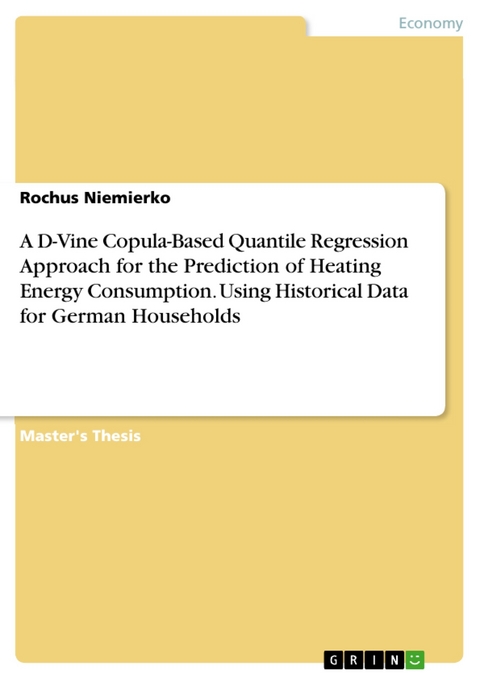
A D-Vine Copula-Based Quantile Regression Approach for the Prediction of Heating Energy Consumption. Using Historical Data for German Households (eBook)
Energetic retrofitting of residential buildings is poised to play an important role in the achievement of ambitious global climate targets. A prerequisite for purposeful policy-making and private investments is the accurate prediction of energy consumption. Building energy models are mostly based on engineering methods quantifying theoretical energy consumption. However, a performance gap between predicted and actual consumption has been identified in literature. Data- driven methods using historical data can potentially overcome this issue. The D-vine copula-based quantile regression model used in this study achieved very good fitting results based on a representative data set comprising 25,000 German households. The findings suggest that quantile regression increases transparency by analyzing the entire distribution of heating energy consumption for individual building characteristics. More specifically, the analyses reveal the following exemplary insights. First, for different levels of energy efficiency, the rebound effect exhibits cyclical behavior and significantly varies across quantiles. Second, very energy-conscious and energy-wasteful households are prone to more extreme rebound effects. Third, with regards to the performance gap, heating energy demand of inefficient buildings is systematically underestimated, while it is overestimated for efficient buildings.
Therefore, The remainder of this thesis is organized as follows. Section 2 presents a concise categorization of building energy models. Section 3 presents existing data-driven methods used for the pre-diction of heating energy consumption in the residential sector. Next, Section 4 elaborates on vine copula-based quantile regression. This is followed by a description of the data employed in Section 5. Section 6 presents the empirical results and Section 7 provides the practical im-plications and contribution of the quantile regression approach introduced. Finally, the conclu-sions and limitations of this thesis are discussed in Section 8.
| Erscheint lt. Verlag | 23.9.2019 |
|---|---|
| Verlagsort | München |
| Sprache | englisch |
| Themenwelt | Wirtschaft ► Volkswirtschaftslehre |
| Schlagworte | Copula • D-Vine Copula • Energetic Retrofitting • Energieeffizienz • heating energy • performance gap • Quantile Regression • Rebound Effect |
| ISBN-10 | 3-346-02051-7 / 3346020517 |
| ISBN-13 | 978-3-346-02051-2 / 9783346020512 |
| Informationen gemäß Produktsicherheitsverordnung (GPSR) | |
| Haben Sie eine Frage zum Produkt? |
 PDF (Ohne DRM)
Digital Rights Management: ohne DRM
Dieses eBook enthält kein DRM oder Kopierschutz. Eine Weitergabe an Dritte ist jedoch rechtlich nicht zulässig, weil Sie beim Kauf nur die Rechte an der persönlichen Nutzung erwerben.
Dateiformat: PDF (Portable Document Format)
Mit einem festen Seitenlayout eignet sich die PDF besonders für Fachbücher mit Spalten, Tabellen und Abbildungen. Eine PDF kann auf fast allen Geräten angezeigt werden, ist aber für kleine Displays (Smartphone, eReader) nur eingeschränkt geeignet.
Systemvoraussetzungen:
PC/Mac: Mit einem PC oder Mac können Sie dieses eBook lesen. Sie benötigen dafür einen PDF-Viewer - z.B. den Adobe Reader oder Adobe Digital Editions.
eReader: Dieses eBook kann mit (fast) allen eBook-Readern gelesen werden. Mit dem amazon-Kindle ist es aber nicht kompatibel.
Smartphone/Tablet: Egal ob Apple oder Android, dieses eBook können Sie lesen. Sie benötigen dafür einen PDF-Viewer - z.B. die kostenlose Adobe Digital Editions-App.
Buying eBooks from abroad
For tax law reasons we can sell eBooks just within Germany and Switzerland. Regrettably we cannot fulfill eBook-orders from other countries.
aus dem Bereich