


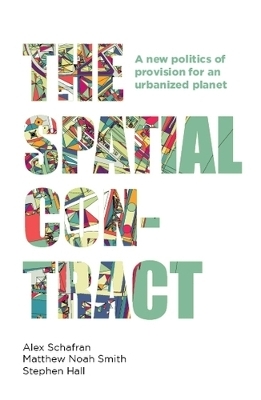
The Spatial Contract
A New Politics of Provision for an Urbanized Planet
Seiten
2020
Manchester University Press (Verlag)
978-1-5261-4336-5 (ISBN)
Manchester University Press (Verlag)
978-1-5261-4336-5 (ISBN)
This book is about how a new form of social contract, which we call the spatial contract, can help revitalize the economies of the basic things that matter – the core systems which build and provision the settlements human beings call home. -- .
Housing. Water. Energy. Transport. Food. Education. Health care. These are the core systems which make human life possible in the 21st century. Few of us are truly self-sufficient – we rely on the systems built into our cities and towns of all shapes and sizes in order to survive, let alone thrive.
Despite how important these systems are, and how much we rely on them, contemporary politics and mainstream economics in most of the world largely ignore these core systems. Politicians debate what they think will get them elected; economists value what they think drives growth.
This book joins the growing chorus of activists, academics and innovators who think that we should be focusing on what matters, on the parts of our economy in which most of us work and upon which all of us depend for survival. We help push this movement along by suggesting a series of concrete steps we can take to build what we call the “Spatial Contract”. The spatial contract is a form of social contract that pays attention to a simple fact: in order for humans to be free, we rely on these basic systems that enable us to act. At the heart of the spatial contract is an agreement to channel that action into ensuring these systems are built, maintained and available to all who need them, in big cities and small towns all around the world.
This book is relevant to both United Nations Sustainable Development Goals 7 and 9, Affordable and clean energy and Industry, innovation and infrastructureThis book is relevant to United Nations Sustainable Development Goal 9, Industry, innovation and infrastructure -- .
Housing. Water. Energy. Transport. Food. Education. Health care. These are the core systems which make human life possible in the 21st century. Few of us are truly self-sufficient – we rely on the systems built into our cities and towns of all shapes and sizes in order to survive, let alone thrive.
Despite how important these systems are, and how much we rely on them, contemporary politics and mainstream economics in most of the world largely ignore these core systems. Politicians debate what they think will get them elected; economists value what they think drives growth.
This book joins the growing chorus of activists, academics and innovators who think that we should be focusing on what matters, on the parts of our economy in which most of us work and upon which all of us depend for survival. We help push this movement along by suggesting a series of concrete steps we can take to build what we call the “Spatial Contract”. The spatial contract is a form of social contract that pays attention to a simple fact: in order for humans to be free, we rely on these basic systems that enable us to act. At the heart of the spatial contract is an agreement to channel that action into ensuring these systems are built, maintained and available to all who need them, in big cities and small towns all around the world.
This book is relevant to both United Nations Sustainable Development Goals 7 and 9, Affordable and clean energy and Industry, innovation and infrastructureThis book is relevant to United Nations Sustainable Development Goal 9, Industry, innovation and infrastructure -- .
Matthew Noah Smith is Associate Professor in philosophy in the Northeastern University Department of Philosophy and Religion Alex Schafran is an urban planner and geographer, and the author of The Road to Resegregation: Northern California and the Failure of Politics Stephen Hall is University Academic Fellow in the School of Earth and Environment at the University of Leeds -- .
Introduction
1 Freedom, reliance and the spatial contract
2 Seeing like a system
3 Seeing like a settlement
4 Reliance and exploitation
Conclusion: Building a healthy spatial contract -- .
| Erscheinungsdatum | 10.05.2021 |
|---|---|
| Reihe/Serie | Manchester Capitalism |
| Zusatzinfo | 6 tables |
| Verlagsort | Manchester |
| Sprache | englisch |
| Maße | 129 x 198 mm |
| Gewicht | 313 g |
| Themenwelt | Naturwissenschaften ► Geowissenschaften ► Geografie / Kartografie |
| Sozialwissenschaften ► Politik / Verwaltung ► Politische Theorie | |
| Wirtschaft ► Volkswirtschaftslehre ► Wirtschaftspolitik | |
| ISBN-10 | 1-5261-4336-4 / 1526143364 |
| ISBN-13 | 978-1-5261-4336-5 / 9781526143365 |
| Zustand | Neuware |
| Informationen gemäß Produktsicherheitsverordnung (GPSR) | |
| Haben Sie eine Frage zum Produkt? |
Mehr entdecken
aus dem Bereich



aus dem Bereich
Buch | Hardcover (2024)
Schweizerbart'sche, E. (Verlag)
CHF 33,55
Sammlung vermessungstechnischer Aufgaben mit ausführlichen Lösungen
Buch | Softcover (2025)
Wichmann, H (Verlag)
CHF 37,80
über eine faszinierende Welt zwischen Wasser und Land und warum sie …
Buch | Hardcover (2023)
dtv (Verlag)
CHF 33,55


