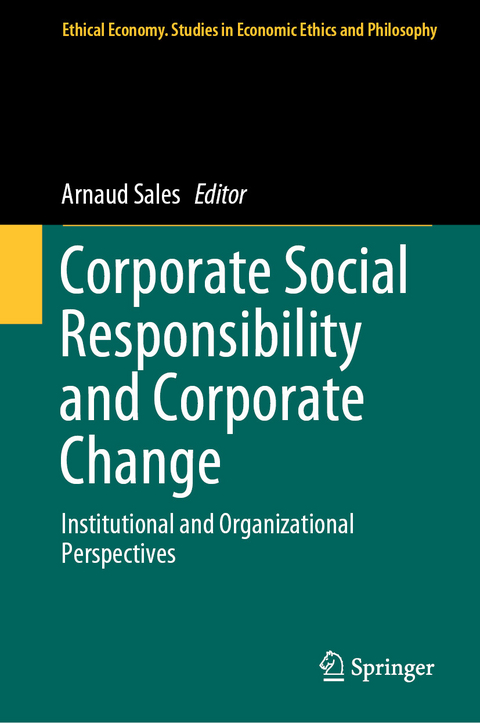
Corporate Social Responsibility and Corporate Change (eBook)
289 Seiten
Springer-Verlag
978-3-030-15407-3 (ISBN)
This wide-ranging book examines the new dynamics of corporate social responsibility (CSR) and the impact they have had on the transformation of business corporations. Written by an international group of distinguished experts in management and organization studies, economics and sociology, the book leads one to theoretically and practically rethink CSR, a movement that has developed into a strong and rich institutional domain since the mid 1990s. Through 14 chapters, the book shows the complexity, diversity and progression of the institutional work performed by a large number of individual and organizational actors in specialized networks to develop this strategic field. Central to this book are: the core issues associated with the field of CSR; recent advances in the development, dissemination and implementation of public and private standards of social responsibility; the pressing challenges of developing sustainable strategies of value creation in the face of global warming and underdevelopment; and finally, examples of how CSR has been implemented and institutionalized within business organizations with special attention to the role played by a variety of social actors in organizational change. Conceived as a movement, corporate social responsibility spearheads a transformation project challenging traditional and outmoded forms of corporate governance that frequently pose troublesome ethical issues. From this standpoint, Corporate Social Responsibility and Corporate Change will serve as a reference point for academics, researchers, managers and practitioners.
Acknowledgements 7
Contents 9
Editor and Contributors 11
List of Figures 13
List of Tables 14
List of Boxes 15
Introduction and Theoretical Perspectives 16
1 The Institutionalization of the Domain of Corporate Social Responsibility 17
Introduction 18
Responsibility of Human and Corporate Actors 19
Section I—Morphogenesis of the CSR Institutional Domain 21
The Institutional Referents for CSR Practices and Creativity 22
The Institutional Cognitive Repertoire of CSR 23
The CSR Institutional Normative Repertoire and Its Actors 24
The Institutional Procedural Elements and CSR Implementation 28
Section II—An Overview of the Contributions of this Collection 32
Part I Theoretical perspectives 32
Part II Recent Public and Private Initiatives in Corporate Social Responsibility 38
Part III Corporate Strategies and Current Issues of Responsibility 41
PART 4 Implementing CSR: Social Actors’ Role in Organizational Change 46
References 49
2 CSR and the Neoliberal Imagination 56
Introduction 56
Neoliberalism: A Foucauldian Reading 59
Varieties of Liberalism in CSR 61
Classical Liberalism and CSR 63
Neoliberalism and CSR 64
Between Ideology and Practice 66
Conclusion 68
References 69
3 From Shareholders to Stakeholders: Portraying an Ambiguous Corporation 73
Introduction 73
The Corporation as an Object: The Ownable Firm 75
The Corporation as a Relationship: Who is in, Who is Out? 78
The Corporation as an Institution: Objectives and Control 82
References 87
4 Reconsidering the Legitimacy and Efficiency of Corporate Strategies: A Case for Organizational Democracy 89
Introduction 89
Legitimacy and Efficiency Problems for Business Firms as a Result of Increased Complexity and Dynamics 91
Reconciling Efficiency and Legitimacy by Communication 95
Implementing Organizational Democracy 99
Democratizing Corporate Governance 100
Creating Structures for Discourse Throughout the Organization 102
Conclusion 103
References 104
5 Ethics in Leadership: Carving Out the Ethical Core in Current Leadership Theories 109
Introduction 109
Theoretical Background and Analysis 111
Meta-Framework: Locus, Transmission, and Reception of Leadership 111
Transformational Leadership 113
Authentic Leadership 114
Ethical Leadership 116
The Ethical Core in Transformational, Authentic, and Ethical Leadership 117
Developing Ethics in Leaders 119
Going Further: Stakeholder Perspectives in Leadership 121
Discussion 123
References 124
The New Dynamics of Corporate Social Responsibility Standards: Public and Private Initiatives 129
6 (Re-)enter the State: Business and Human Rights Dynamics as Shapers of CSR Norms and Institutions 130
Introduction 131
The UN Guiding Principles and OECD’s Guidelines for MNEs 134
Transnational Law and Business & Human Rights in the Public–Private Interface
Transnational Law Elements in the UN Guiding Principles and OECD’s Guidelines 138
National Contact Points: Supporting the Implementation of the Guiding Principles—and Beyond 139
Due Diligence 140
Conclusion 141
References 142
7 ISO 26000 Gets Taken Around: Diffusion Work as Crucial Link Between Standard Creation and Adoption 145
Introduction 146
An Institutional Perspective on CSR Standards Diffusion 147
Diffusion as Institutional Work 149
Case and Methods 150
The Case of the Diffusion of ISO 26000 150
Case Methodology 151
Actors and Activities in the Early Diffusion of ISO 26000 152
ISO and International Diffusion Activities 152
National Standardization Body 153
Government 154
Business Associations 155
Consultants 156
Scientists 156
Analysis 157
Insiders as Main Diffusers at the National Level 157
Types of Diffusion 159
Persuasion in Favor and Against ISO 26000 161
A Take on the Initial Diffusion Trend 163
Conclusion 165
References 166
Corporate Strategies and Current Issues 169
8 Developing Global Institutional Frameworks for Corporate Sustainability in the Context of Climate Change: The Impact upon Corporate Policy and Practice 170
Introduction 171
The Impact of Climate Change on Institutional Paradigms 171
Compounding International Social and Environmental Initiatives 175
Institutional Transformation: The Imperatives of Sustainability 179
Conclusions 181
References 182
9 Gaining Mutual Benefits Through Business-non-profit Partnership in Base-of-the-Pyramid Markets: A Relational View 185
Introduction 186
Value Creation in Business-non-profit Partnerships at the BOP 188
Value Creation for the Corporation 189
Value Creation for the BOP 190
The Relational View 192
The Relational View on Business-non-profit Partnerships at the BOP 195
Relation-Specific Assets in BOP Partnerships 195
Knowledge-Sharing Routines in BOP Partnerships 199
Complementary Resource Endowments 200
Effective Governance 203
Conclusions and Outlook 205
References 207
10 The Double-Edged Sword of Financial Incentive Schemes 212
Introduction: Why It Is Time to Account for Performance Management Systems in CSR? 212
Using Incentive Schemes to Increase Employee Performance in Organizations 215
Organizations Try to Align Individual and Organizational Goals 215
How Incentive Schemes Influence Motivation and Behavior of Individual 216
Incentives Can also Lead to Unethical Behavior 217
Unconscious Processes Lead to the Crowding Out of Personal, Moral Responsibility 217
Employees Are Tempted to Consciously Behave Unethically 218
Conclusion: Incentive Schemes Can Massively Compromise How Responsibly an Organization Acts 219
Integration: Avenues for Future Research on Incentive Schemes and CSR 220
Incorporating the Science of Incentives Can Improve Our Understanding of How CSR Works 221
Management Science and Managerial Practice Can Benefit from a Deeper CSR Perspective 221
References 223
11 Corporate Strategies to Defend Social Irresponsibility: A Typology of Symbolic and Substantive Tactics 227
Introduction 227
Theoretical Background: How Companies Avert Social Responsibility Issues 230
A Typology of Strategies to Avert Social Responsibility Issues 233
Proactive Discursive Defense 234
Proactive Material Defense 235
Reactive Discursive Defense 237
Reactive Material Defense 238
Discussion 239
Conclusion 242
References 243
Implementing CSR: Social Actors’ Role in Organizational Change 246
12 Implementing Corporate Social Responsibility as Institutional Work: Exploring the Day-to-Day Activities of CSR Managers in Multinational Corporations 247
Introduction 248
Agency and Institutional Work 250
CSR Managers as Agents of Institutional Change 251
Research Methods 252
Data Collection, Analysis, and Interpretation 252
Qualitative Data Analysis 253
Findings: CSR Managers as Agents of Institutional Work 253
Discussion 258
Limitations, Future Research, and Conclusion 259
References 260
13 Is CSR Crowding Out Charity? A Case Study of CSR Implementation in a German Company 263
Introduction 263
Theory and Research Question 264
Methods 265
Findings 267
Interpretation of CSR and Implementation Motives 267
Developing a CSR Strategy 269
Implementation Effect 271
Discussion 271
References 272
14 From Crisis to CSR Leadership: A Case Study of Successful Implementation Under External Pressures 275
Introduction 275
Methodology 277
Organizational Learning and CSR Integration Processes 278
A Radical Low-Cost Production Model and the Emergence of the Crisis 279
Pre-crisis Indifference 279
Public Campaign and Defensive Attitude During the Crisis 280
Avoidance Practices 280
Defiance Practices 281
Starting the Reforms: Dialog, Compromise, and Compliance 282
Changes in Leadership, CSR Integration, and Organizational Transformation of the Firm 283
New Executive Positions 284
Connecting the Corporation with Its Environment and Developing a CSR Network 284
The Post-reform Period: Strategic Integration and Assertive CSR Leadership 285
Strategic Integration 285
Learning Limits 287
Conclusion 288
References 291
| Erscheint lt. Verlag | 10.5.2019 |
|---|---|
| Reihe/Serie | Ethical Economy | Ethical Economy |
| Zusatzinfo | XVII, 289 p. 7 illus., 1 illus. in color. |
| Sprache | englisch |
| Themenwelt | Geisteswissenschaften ► Philosophie ► Allgemeines / Lexika |
| Geisteswissenschaften ► Philosophie ► Ethik | |
| Wirtschaft | |
| Schlagworte | agents and institutions • Business Ethics • Corporate Social Responsibility • Ethics of Organizations • Global Governance Mechanisms • private transnational authorities |
| ISBN-10 | 3-030-15407-6 / 3030154076 |
| ISBN-13 | 978-3-030-15407-3 / 9783030154073 |
| Informationen gemäß Produktsicherheitsverordnung (GPSR) | |
| Haben Sie eine Frage zum Produkt? |
 PDF (Wasserzeichen)
DRM: Digitales Wasserzeichen
Dieses eBook enthält ein digitales Wasserzeichen und ist damit für Sie personalisiert. Bei einer missbräuchlichen Weitergabe des eBooks an Dritte ist eine Rückverfolgung an die Quelle möglich.
Dateiformat: PDF (Portable Document Format)
Mit einem festen Seitenlayout eignet sich die PDF besonders für Fachbücher mit Spalten, Tabellen und Abbildungen. Eine PDF kann auf fast allen Geräten angezeigt werden, ist aber für kleine Displays (Smartphone, eReader) nur eingeschränkt geeignet.
Systemvoraussetzungen:
PC/Mac: Mit einem PC oder Mac können Sie dieses eBook lesen. Sie benötigen dafür einen PDF-Viewer - z.B. den Adobe Reader oder Adobe Digital Editions.
eReader: Dieses eBook kann mit (fast) allen eBook-Readern gelesen werden. Mit dem amazon-Kindle ist es aber nicht kompatibel.
Smartphone/Tablet: Egal ob Apple oder Android, dieses eBook können Sie lesen. Sie benötigen dafür einen PDF-Viewer - z.B. die kostenlose Adobe Digital Editions-App.
Buying eBooks from abroad
For tax law reasons we can sell eBooks just within Germany and Switzerland. Regrettably we cannot fulfill eBook-orders from other countries.
aus dem Bereich