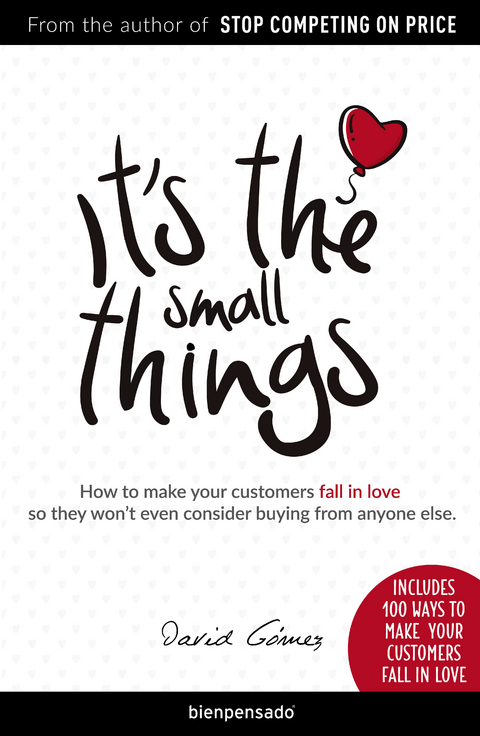
It's the small things (eBook)
333 Seiten
Bien Pensado (Verlag)
978-3-96610-004-5 (ISBN)

David Gomez is Director of Bien Pensado, a sales training company. Before starting Bien Pensado in 2009, David worked in sales and marketing for several multinational companies such as Coca-Cola, Dupont, Varta Rayovac, Avery Dennison and Latin Group of Advertising (Glp). He has published several books in Spanish: Detalles que Enamoran in 2017; Bueno, Bonito y Carito (Stop Competing on Price) in 2016; El día que David venció a Goliat (The Day David Defeated Goliath) in 2014; and Facebook Toolbox in 2011. David is currently an international speaker and trainer. For more than 20 years he has helped hundreds of companies to differentiate from competition. David holds a Bachelor's degree in Business Administration with a major on Marketing, is also a Consumer Behavior Specialist and earned his Mba from Icesi-Tulane University. David was born in Cali, Colombia, in 1970. Lives in Bogota with his wife and two children.
David Gomez is Director of Bien Pensado, a sales training company. Before starting Bien Pensado in 2009, David worked in sales and marketing for several multinational companies such as Coca-Cola, Dupont, Varta Rayovac, Avery Dennison and Latin Group of Advertising (Glp). He has published several books in Spanish: Detalles que Enamoran in 2017; Bueno, Bonito y Carito (Stop Competing on Price) in 2016; El día que David venció a Goliat (The Day David Defeated Goliath) in 2014; and Facebook Toolbox in 2011. David is currently an international speaker and trainer. For more than 20 years he has helped hundreds of companies to differentiate from competition. David holds a Bachelor's degree in Business Administration with a major on Marketing, is also a Consumer Behavior Specialist and earned his Mba from Icesi-Tulane University. David was born in Cali, Colombia, in 1970. Lives in Bogota with his wife and two children.
CHAPTER 1: NOBODY CARES ABOUT WHAT YOU SELL
Customers are not paying attention to what you say. You must change your pitch. You need to start building relationships.
Indifference and non-existent loyalty are consequences of companies’ lack of differentiation and their failure to build meaningful relationships with their customers and prospects. This is evident in all aspects, beginning with the trouble they have communicating effectively.
So many brands no longer know how to make sure people see their advertising. They use video screens in public restrooms, pop-ups on news sites, fake covers on magazines, TV commercials in the middle of the game, spam, unsolicited phone calls, flyers enclosed with utility bills, ads scattered all over the newspaper, sponsored tweets, retargeting (that annoying ad that chases you through different website pages), and other tactics.
Customers are sick and tired
Why do you pay for the premium version of Spotify to avoid advertising? Why do you run away from people selling vacation plans, cell phones, or perfumes outside stores in shopping malls?
Because you are suspicious. Because that type of salesperson is more concerned with meeting a quota than actually helping you. Because most advertising doesn’t add any value. Ok, that’s not breaking news. What keeps surprising me, though, is that so many brands continue to do it. They insist on proposing to customers on the very first date. There’s very little wooing, seducing, and romancing – if any at all.
Customers aren’t attracted to companies that only want to sell to them. They appreciate brands and people who care about them, help them solve a problem, and make their lives easier. They don’t want to be seen as walking wallets. They’re interested in genuine, honest, straightforward relationships.
Consumers are sick and tired of being referred to as a “captive audience” in any event or site with boundaries (concert, theater, university cafeteria, airplane, cab, etc.). Captive should be understood as confined to a space where whether they like it or not, they have to see the message in front of them.
It’s clear that advertiser money makes many things we enjoy possible. Without advertisers, open radio and television wouldn’t be free. That’s obvious. It’s necessary to “sell” to the audiences to get these services financed. That’s not the problem. The underlying problem is what advertisers have done historically to their audiences that have led to those audiences not wanting to pay attention. The one-directional advertiser messages are based on the sender’s interests and rarely on the receiver’s. There are plenty of senders, while receivers are now scarce.
Even prospecting has been done the wrong way. Some companies still give their salespeople a list of businesses and tell them to start calling. That’s not prospecting – that’s having the wrong focus. Salespeople aren’t welcome when they show up or call unexpectedly, offering products or services prospects haven’t requested. The salesperson isn’t the real problem, though. The real problem is when and how he appears on the scene.
We have given more importance to product features and benefits than to relationship building. That’s where the big opportunity lies: in reconnecting with people.
We need to change the way we interact
Years ago, in an attempt to migrate from the obvious focus on selling, the term advisor was coined to describe the salesperson as someone who was advising, instead. However, I sometimes think that the term was the only thing that changed, as the behavior continues to be very similar. It’s a new term that gives the position a higher status, but doesn’t always translate into helping and really advising the customer.
The way brands interact with their customers needs to change. Standing in public shouting through a megaphone: “Look at me, I’m important! Come and buy from me!” isn’t very appealing anymore. The goal is to start a conversation and really think about the customer’s interests. Here’s how that happens:
Move from interrupting to being helpful – Commercial communication has historically been based on the interruption model. Brands need to migrate instead to solving problems, providing information customers are looking for, and constructing messages based on what’s relevant for their audiences rather than what’s relevant to the brand. One example of this is the training and useful information for business owners and entrepreneurs that many companies now provides through their blogs.
Shift from a brand story to a people story – The idea is to move the center of attention from the brand toward the client. It’s not just about telling stories from the brand and the business, but telling stories from people, too. In a time of total transparency and hyper-informed customers, a lack of authenticity can be seen from hundreds of miles away. Dove’s “You are more beautiful than you think” campaign is an example of how to tell peoples’ stories.
Migrate from mass communication to personal conversation – The advantage of mass communication is its reach; the disadvantage is that it’s impersonal and less massive every time. Online advertising and social media have made it possible to chat with your audiences basing on their attitudinal profiles, preferences, and interests. This kind of communication is based on who they are, what they do, what they like, what they’re looking for, what causes they support, and who they interact with. It’s the principle of native advertising that has started to migrate into consumer conversations.
“YOU NEED YOUR CUSTOMERS MORE THAN THEY NEED YOU.”
- HARLEY MANNING & KERRY BODINE, OUTSIDE IN
Selling is a romance
Just as you don’t propose on the first date, a customer isn’t going to buy from you just because they saw your advertising. It would be premature; they lack information needed to make the decision.
A business relationship is similar to a couple’s relationship. Both parts decide to make a life together based on their expectations and what each has to offer. The more clarity and sincerity there is, the less likely it is that there will be a divorce.
Principles shared by both sales and love
There’s a romance stage – Before deciding to get married, couples move through a romantic process where they get to know each other and determine whether they belong together. Before asking a customer to buy from you, the customer needs to be certain that you are the right company, product, service, brand, or professional. Slick advertising isn’t enough to convince an increasingly skeptical customer. Before proposing, you need to invite the other one to the movies, eat out, meet your family; you let him or her see why you are the best choice. That’s precisely the role of trade shows, social media, blog posts, and public relations. Expecting customers to buy from you the very first time they see you is what makes advertising ineffective.
It needs to be nurtured continuously – As in personal relationships, the love that’s not taken care of every day dies a bit every day. It’s shocking to see how many companies forget about their customers once they’ve won them over. They put more effort into attracting prospects and convincing them to become customers than they do nurturing those who already know, buy from, and trust them. Love should happen every day.
It’s not to be taken for granted – Don’t allow complacency to take over your relationship. The fact that someone is your customer today doesn’t guarantee that they will still be your customer tomorrow. You need to keep earning their love. Stay in shape, be thoughtful, express your love constantly. That’s why the previous romance stage is so important in the relationship. If customers buy from you just because you gave them a good price, there’s a high probability of losing them to competitors when those companies offer a better discount.
It’s a matter of trust – It’s difficult to make a sale if you haven’t built trust yet. You may be a great person, your product may be wonderful, and your service may be unparalleled. Nevertheless, that won’t amount to anything if the customer doesn’t know or trust you yet. Even with low-cost and low-risk products or services, customers need to know that they are making the right decision. Nobody wants to make a mistake and have something to regret later.
Till death do you part – It's exhausting to have to go out and find new customers every day, starting a new relationship from scratch, presenting your qualifications, and convincing the prospect that you really are a good option. Prosperous businesses understand customer value over time and strive to keep a healthy relationship until death do them part.
It’s a relationship of trust
As in love, sales are generated by steadily cultivating a relationship and...
| Erscheint lt. Verlag | 1.5.2019 |
|---|---|
| Verlagsort | Vachendorf |
| Sprache | englisch |
| Themenwelt | Sachbuch/Ratgeber ► Beruf / Finanzen / Recht / Wirtschaft ► Wirtschaft |
| Wirtschaft | |
| Schlagworte | Customer Experience • Customer Journey • Customer service • CX • delight customers • memorable experiences • small things |
| ISBN-10 | 3-96610-004-5 / 3966100045 |
| ISBN-13 | 978-3-96610-004-5 / 9783966100045 |
| Informationen gemäß Produktsicherheitsverordnung (GPSR) | |
| Haben Sie eine Frage zum Produkt? |
 EPUB (Wasserzeichen)
DRM: Digitales Wasserzeichen
Dieses eBook enthält ein digitales Wasserzeichen und ist damit für Sie personalisiert. Bei einer missbräuchlichen Weitergabe des eBooks an Dritte ist eine Rückverfolgung an die Quelle möglich.
Dateiformat: EPUB (Electronic Publication)
EPUB ist ein offener Standard für eBooks und eignet sich besonders zur Darstellung von Belletristik und Sachbüchern. Der Fließtext wird dynamisch an die Display- und Schriftgröße angepasst. Auch für mobile Lesegeräte ist EPUB daher gut geeignet.
Systemvoraussetzungen:
PC/Mac: Mit einem PC oder Mac können Sie dieses eBook lesen. Sie benötigen dafür die kostenlose Software Adobe Digital Editions.
eReader: Dieses eBook kann mit (fast) allen eBook-Readern gelesen werden. Mit dem amazon-Kindle ist es aber nicht kompatibel.
Smartphone/Tablet: Egal ob Apple oder Android, dieses eBook können Sie lesen. Sie benötigen dafür eine kostenlose App.
Geräteliste und zusätzliche Hinweise
Buying eBooks from abroad
For tax law reasons we can sell eBooks just within Germany and Switzerland. Regrettably we cannot fulfill eBook-orders from other countries.
aus dem Bereich