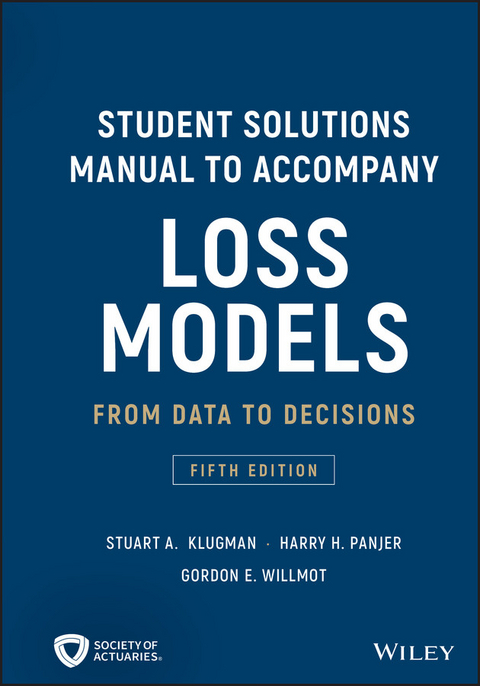
Loss Models: From Data to Decisions, 5e Student Solutions Manual (eBook)
John Wiley & Sons (Verlag)
978-1-119-53806-6 (ISBN)
Loss Models: From Data to Decisions, Fifth Edition continues to supply actuaries with a practical approach to the key concepts and techniques needed on the job. With updated material and extensive examples, the book successfully provides the essential methods for using available data to construct models for the frequency and severity of future adverse outcomes.
The book continues to equip readers with the tools needed for the construction and analysis of mathematical models that describe the process by which funds flow into and out of an insurance system. Focusing on the loss process, the authors explore key quantitative techniques including random variables, basic distributional quantities, and the recursive method, and discuss techniques for classifying and creating distributions. Parametric, non-parametric, and Bayesian estimation methods are thoroughly covered along with advice for choosing an appropriate model. Throughout the book, numerous examples showcase the real-world applications of the presented concepts, with an emphasis on calculations and spreadsheet implementation.
Loss Models: From Data to Decisions, Fifth Edition is an indispensable resource for students and aspiring actuaries who are preparing to take the SOA and CAS examinations. The book is also a valuable reference for professional actuaries, actuarial students, and anyone who works with loss and risk models.
Solutions manual to accompany a text with comprehensive coverage of actuarial modeling techniques The Student Solutions Manual to Accompany Loss Models: From Data to Decisions covers solutions related to the companion text. The manual and text are designed for use by actuaries and those studying for the profession. Readers can learn modeling techniques used across actuarial science. Knowledge of the techniques is also beneficial for those who use loss data to build models for risk assessment.
1 Introduction 1
2 Chapter 2 Solutions 3
Section 2.2 3
3 Chapter 3 Solutions 9
Section 3.1 9
Section 3.2 14
Section 3.3 15
Section 3.4 15
Section 3.5 19
4 Chapter 4 Solutions 23
Section 4.2 23
5 Chapter 5 Solutions 29
Section 5.2 29
Section 5.3 39
Section 5.4 40
6 Chapter 6 Solutions 43
Section 6.1 43
Section 6.5 43
Section 6.6 44
7 Chapter 7 Solutions 47
Section 7.1 47
Section 7.2 48
Section 7.3 50
Section 7.5 54
8 Chapter 8 Solutions 59
Section 8.2 59
Section 8.3 61
Section 8.4 63
Section 8.5 63
Section 8.6 67
9 Chapter 9 Solutions 71
Section 9.1 71
Section 9.2 71
Section 9.3 72
Section 9.4 81
Section 9.6 82
Section 9.7 87
Section 9.8 89
10 Chapter 10 Solutions 95
Section 10.2 95
Section 10.3 99
Section 10.4 99
Section 10.5 103
11 Chapter 11 Solutions 105
Section 11.2 105
Section 11.3 110
Section 11.4 110
Section 11.5 114
Section 11.6 119
Section 11.7 121
12 Chapter 12 Solutions 123
Section 12.7 123
13 Chapter 13 Solutions 129
Section 13.2 129
Section 13.3 138
14 Chapter 14 Solutions 141
Section 14.2 141
Section 14.3 144
Section 14.4 149
Section 14.5 151
Section 14.6 155
Section 14.7 157
Section 14.8 158
15 Chapter 15 Solutions 161
Section 15.3 161
Section 15.4 164
Section 15.5 170
16 Chapter 16 Solutions 177
Section 16.7 177
17 Chapter 17 Solutions 181
Section 17.9 181
18 Chapter 18 Solutions 211
Section 18.5 211
19 Chapter 19 Solutions 219
Section 19.1 219
Section 19.2 220
Section 19.4 221
Section 19.4 221
Chapter 3
Solutions
Section 3.1
- 3.1
- 3.2 For Model 1, , . , and , . , .
For Model 2, , and . and are both infinite, so the skewness and kurtosis are not defined.
For Model 3, and . , , , , , .
For Model 4, and . , , . , , .
For Model 5, and . , , . , , .
- 3.3 The standard deviation is the mean times the coefficient of variation, or 4, and so the variance is 16. From (3.3), the second raw moment is . The third central moment is (using Exercise 3.1) . The skewness is the third central moment divided by the cube of the standard deviation, or .
- 3.4 For a gamma distribution, the mean is . The second raw moment is , and so the variance is . The coefficient of variation is . Therefore . The third raw moment is . From Exercise 3.1, the third central moment is and the skewness is .
- 3.5 For Model 1,
For Model 2,
For Model 3,
For Model 4,
The functions are straight lines for Models 1, 2, and 4. Model 1 has negative slope, Model 2 has positive slope, and Model 4 is horizontal.
- 3.6 For a uniform distribution on the interval from 0 to w, the density function is . The mean residual life is
The equation becomes
with a solution of .
- 3.7 From the definition,
- 3.8
- 3.9 For Model 1, from (3.8),
and from (3.10),
From (3.9),
For Model 2, from (3.8),
and from (3.10),
From (3.9),
For Model 3, from (3.8),
and from (3.10),
For Model 4, from (3.8),
and from (3.10),
- 3.10 For a discrete distribution (which all empirical distributions are), the mean residual life function is
When d is equal to a possible value of X, the function cannot be continuous because there is a jump in the denominator but not in the numerator. For an exponential distribution, argue as in Exercise 3.7 to see that it is constant. For the Pareto distribution,
which is increasing in d. Only the second statement is true.
- 3.11 Application of the formula from the solution to Exercise 3.10 gives
which cannot be correct. Recall that the numerator of the mean residual life is . However, when , the expected value is infinite and so is the mean residual life.
- 3.12 The right truncated variable is defined as , given that . When , this variable is not defined. The kth moment is
- 3.13 This is a single-parameter Pareto distribution with parameters and . The moments are and . The coefficient of variation is .
- 3.14 . . . . Skewness is . Kurtosis is .
- 3.15 The Pareto mean residual life function is
and so .
- 3.16 Sample mean: . Sample variance: . Sample third central moment: . Skewness coefficient: .
Section 3.2
- 3.17 The pdf is . The mean is . The median is the solution to , which is 1.4142. The mode is the value at which the pdf is highest. Because the pdf is strictly decreasing, the mode is at its smallest value, 1.
- 3.18 For Model 2, solve , and so , and the requested percentiles are 519.84 and 1419.95.
For Model 4, the distribution function jumps from 0 to 0.7 at zero and so . For percentiles above 70, solve , and so and .
For Model 5, the distribution function has two specifications. From to , it rises from 0.0 to 0.5, and so for percentiles at 50 or below, the equation to solve is for . For , the distribution function rises from 0.5 to 1.0, and so for percentiles from 50 to 100 the equation to solve is for . The requested percentiles are 50 and 65.
- 3.19 The two percentiles imply
Rearranging the equations and taking their ratio yields
Taking logarithms of both sides gives for .
- 3.20 The two percentiles imply
Subtracting and then taking logarithms of both sides gives
Dividing the second equation by the first gives
Finally, taking logarithms of both sides gives for .
Section 3.3
- 3.21 The sum has a gamma distribution with parameters and . Then . From the central limit theorem, the sum has an approximate normal distribution with mean and variance for a standard deviation of 1,000. The probability of exceeding 6,000 is .
- 3.22 A single claim has mean and variance
The sum of 100 claims has mean 480,000 and variance 9,216,000,000, which is a standard deviation of 96,000. The probability of exceeding 600,000 is approximately
- 3.23 The mean of the gamma distribution is and the variance is . For 100 independent claims, the mean is 500,000 and the variance is 500,000,000 for a standard deviation of 22,360.68. The probability of total claims exceeding 525,000 is
- 3.24 The sum of 2,500 contracts has an approximate normal distribution with mean and standard deviation . The answer is
Section 3.4
- 3.25 While the Weibull distribution has all positive moments, for the inverse Weibull moments exist only for . Thus, by this criterion, the inverse Weibull distribution has a heavier tail. With regard to the ratio of density functions, it is (with the inverse Weibull in the numerator, and with asterisks (*) used to mark its parameters)
The logarithm is
The middle term goes to zero, so the issue is the limit of which is clearly infinite. With regard to the hazard rate, for the Weibull distribution we have
which is clearly increasing when , constant when , and decreasing when . For the inverse Weibull,
The derivative of the denominator is
and the limiting value of this expression is . Therefore, in the limit, the denominator is increasing and thus the hazard rate is decreasing.
Figure 3.1 displays a portion of the density function for Weibull and inverse Weibull distributions with the same mean and variance. The heavier tail of the inverse Weibull distribution is clear.
Figure 3.1 The tails of a Weibull and an inverse Weibull distribution.
- 3.26 Means:
Second moments:
Density functions:
The gamma and lognormal densities are equal when , while the lognormal and Pareto densities are equal when . Numerical evaluation indicates that the ordering is as expected.
- 3.27 For the Pareto distribution,
Thus is clearly increasing and , indicating a heavy tail.
The square of the coefficient of variation is
which is greater than 1, also indicating a heavy tail.
- 3.28
This result assumes that . An application of L'Hôpital's rule shows that this is the same limit as . This limit must be zero, otherwise the integral defining will not converge.
- 3.29
- For ,
Thus,
-
from (a) and (c).
- Using (b),
- Using (d), we have
and so
The derivative is equal to zero only at .
Also, from (b) and (e), , and .
- For ,
- 3.30
- Integration by parts yields
and hence , from which the result follows.
- It follows from (a) that
which gives the result by addition of to both sides.
- Because , from (b),
and the first result follows by division of both sides by . The inequality then follows from .
- Because , the result follows from the inequality in (c), with replaced by in the denominator.
- As in (c), it follows from (b) that
that is,
from which the first result follows by solving for . The inequality then follows from the first result, since .
- Integration by parts yields
Section 3.5
- 3.31 Denote the risk measures by , , and . Note that and
where here is the correlation coefficient, not the risk measure, and must be less than or equal to one. Therefore, . Thus,
which establishes subadditivity.
Because and , , which establishes positive homogeneity.
Because and , , which establishes translation invariance.
For the example given, note that for all possible pairs of outcomes. Also, , , , and . With , , which is greater than , violating monotonicity.
- 3.32 The cdf is , and so the percentile solves and the solution is . Because the exponential...
| Erscheint lt. Verlag | 4.4.2019 |
|---|---|
| Reihe/Serie | Wiley Series in Probability and Statistics |
| Wiley Series in Probability and Statistics | Wiley Series in Probability and Statistics |
| Sprache | englisch |
| Themenwelt | Mathematik / Informatik ► Mathematik ► Statistik |
| Mathematik / Informatik ► Mathematik ► Wahrscheinlichkeit / Kombinatorik | |
| Wirtschaft ► Volkswirtschaftslehre ► Ökonometrie | |
| Schlagworte | Business & Finance • Finance & Investments • Finanz- u. Anlagewesen • Finanz- u. Wirtschaftsstatistik • Mathematics • Mathematik • Mathematik in Wirtschaft u. Finanzwesen • Statistics • Statistics for Finance, Business & Economics • Statistik |
| ISBN-10 | 1-119-53806-8 / 1119538068 |
| ISBN-13 | 978-1-119-53806-6 / 9781119538066 |
| Informationen gemäß Produktsicherheitsverordnung (GPSR) | |
| Haben Sie eine Frage zum Produkt? |
 EPUB (Adobe DRM)
Kopierschutz: Adobe-DRM
Adobe-DRM ist ein Kopierschutz, der das eBook vor Mißbrauch schützen soll. Dabei wird das eBook bereits beim Download auf Ihre persönliche Adobe-ID autorisiert. Lesen können Sie das eBook dann nur auf den Geräten, welche ebenfalls auf Ihre Adobe-ID registriert sind.
Details zum Adobe-DRM
Dateiformat: EPUB (Electronic Publication)
EPUB ist ein offener Standard für eBooks und eignet sich besonders zur Darstellung von Belletristik und Sachbüchern. Der Fließtext wird dynamisch an die Display- und Schriftgröße angepasst. Auch für mobile Lesegeräte ist EPUB daher gut geeignet.
Systemvoraussetzungen:
PC/Mac: Mit einem PC oder Mac können Sie dieses eBook lesen. Sie benötigen eine
eReader: Dieses eBook kann mit (fast) allen eBook-Readern gelesen werden. Mit dem amazon-Kindle ist es aber nicht kompatibel.
Smartphone/Tablet: Egal ob Apple oder Android, dieses eBook können Sie lesen. Sie benötigen eine
Geräteliste und zusätzliche Hinweise
Buying eBooks from abroad
For tax law reasons we can sell eBooks just within Germany and Switzerland. Regrettably we cannot fulfill eBook-orders from other countries.
aus dem Bereich