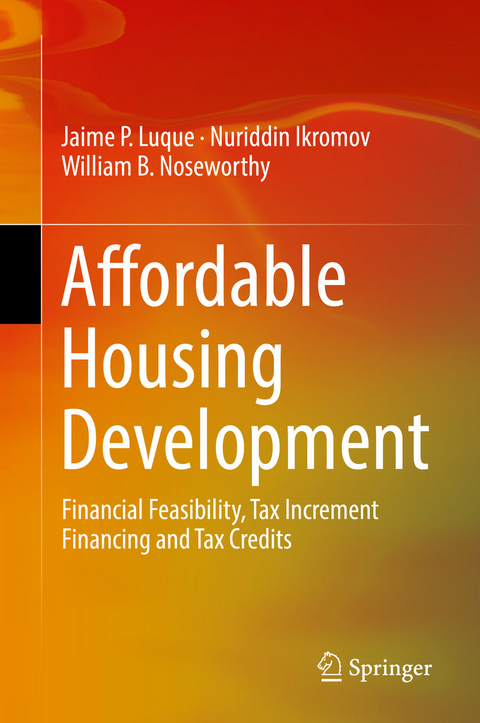
Affordable Housing Development (eBook)
131 Seiten
Springer International Publishing (Verlag)
978-3-030-04064-2 (ISBN)
This book explains the nuts and bolts of affordable housing development. Divided into two complementary sections, the book first provides an overview of the effectiveness of existing federal and state housing programs in the United States, such as the LIHTC and TIF programs. In turn, the book’s second section presents an extensive discussion of and insights into the financial feasibility of an affordable real estate development project. Researchers, policymakers and organizations in the public, private and nonprofit sectors will find this book a valuable resource in addressing the concrete needs of affordable housing development.
“Luque, Ikromov, and Noseworthy’s new book on Affordable Housing Development is a “must read” for all those seeking to address the growing and vexing problem of affordable housing supply. The authors provide important insights and practical demonstration of important financial tools often necessary to the financial feasibility of such projects, including tax-increment financing and the Low-Income Housing Tax Credit. Further, the authors provide important backdrop to the affordability crisis and homelessness. I highly recommend this book to all who seek both to articulate and enhance housing access.”
By Stuart Gabriel, Arden Realty Chair, Professor of Finance and Director, Richard S. Ziman Center for Real Estate at UCLA
"Over several years Jaime Luque, Nuriddin Ikromov and William Noseworthy applied their analytical bent, and no small measure of empathy, to homelessness as actually experienced in Madison, Wisconsin – and they inspired multiple classes of urban economics students to join them. “Homelessness” is a complex web of issues affecting a spectrum of populations, from individuals struggling with addiction or emotional disorders, to families who’ve been dealt a bad hand in an often-unforgiving economy. Read this book to follow Jaime, Nuriddin, and William as they evaluate a panoply of housing and social programs, complementing the usual top-down design perspective with practical analysis of the feasibility of actual developments and their effectiveness. Analytical but written for a broad audience, this book will be of interest to anyone running a low-income housing program, private and public developers, students, and any instructor designing a learning-by-doing course that blends rigor with real-world application to a local problem."
By Stephen Malpezzi, Professor Emeritus, James A. Graaskamp Center for Real Estate, Wisconsin School of Business, University of Wisconsin-Madison, and Dean, Weimer School of the Homer Hoyt Institute.
Jaime Luque holds the BNP Paribas Real Estate Professorship at ESCP Europe Business School. He was previously an Assistant Professor of Real Estate and Urban Economics at the School of Business of the University of Wisconsin-Madison, where this book was written. His academic research has been published in top journals such as the Journal of Economic Theory, the Journal of Public Economics, the Journal of Housing Economics, Economic Theory, Real Estate Economics, and Regional Science and Urban Economics. Jaime is the author of three books for business students: Urban Land Economics (Springer), Rays of Research on Real Estate Development (Business Experts Press), and The Subprime Crisis: Lessons for Business Students (World Scientific Publishing). He is the recipient of the 2017 Ideas Worth Teaching Award by The Aspen Institute Business and Society Program for his educational innovations to address affordable housing development. Nuriddin Ikromov is an Associate Professor of real estate at the College of Business Administration at California State University (Sacramento, USA), and prior to his current position, he was a Visiting Professor at the Wisconsin School of Business. Nuriddin holds a PhD in real estate finance from the Pennsylvania State University (USA) and his research articles have been published in premier academic real estate journals such as Real Estate Economics, and Journal of Real Estate Finance and Economics. He is the recipient of the outstanding teaching award at California State University, Sacramento in 2015. He also served as the faculty director of the Business Honors program at the same school. William Noseworthy is an Assistant Professor in the Department of History at McNeese State University (USA). He was previously a Lecturer at the University of Wisconsin-Madison in the Department of History. With more than a decade’s experience as a researcher and educator dealing with marginalized and low-income populations in the US and Southeast Asia, his research publications address narratives of low-income communities, migrant populations, labor history, land use change, policy, religious minorities, and linguistic minorities.He was a founding member of the editorial board of the Journal of Cham Cultural Studies, a venue for community based research published in Vietnamese. He has also authored many articles and book chapters for ABC-CLIO, ABC-CLIO/Greenwood, and Gale Researcher’s pedagogically focused publications.
Preface 5
Acknowledgements 6
Contents 7
About the Authors 10
Chapter 1: Housing Affordability Crisis: The United States 12
The Case of Madison, Wisconsin 16
References 22
Chapter 2: Homelessness, Housing Public Policy and Urban Planning 24
Principles of Need and Creation of Urban Space 24
Development of Cities 25
Affordable Housing and Public Policy: Who Pays and Who Benefits? 27
Where Do We House the Homeless? 29
The Case of Madison, Wisconsin 32
The City of Madison´s Urban Policy and Development Initiatives 33
Local Policy At the County Level: Initiatives and Challenges 38
Conclusion 40
References 41
Chapter 3: The Low-Income Housing Tax Credit (LIHTC) Program 43
Introduction to LIHTC 43
How the LIHTC Program Is Administered at the State Level 47
WHEDA: How Wisconsin Does LIHTC 49
WHEDA Scoring and LIHTC Applications 51
Preparing for the WHEDA Application: Research 52
How Developers Can Use LIHTC in Practice 52
Establishing Site Control 54
Benefits of a Small Firm 56
Site Control and Zoning: Challenges for the Developer 58
References 59
Chapter 4: The Tax Increment Financing (TIF) Program 60
Introduction to TIF 60
TIF in the United States 61
Criticisms of the TIF Mechanism 62
Creation of Tax Increment Districts 64
The Review Process 67
TIF from the Developer´s Perspective 69
TIF from the Perspective of Policy Makers 71
Conclusion 72
References 73
Chapter 5: Housing the Homeless 74
Porchlight: An Introduction 74
Porchlight´s Considerations Regarding Housing Location and Size 75
Porchlight´s Considerations Regarding Housing Services 77
Emergency Shelters 78
Homeless Veterans 79
Chronic Homelessness 79
Breakdown of Homeless Individuals By Household Type in Madison 80
Free Mobility: Does Madison, WI, Attract Homeless From Other States? 80
Homeless as a Working Class: Barriers to Access Permanent Housing 82
Market Rents and Affordable Housing in Madison 83
The Way to Pay for Services for the Homeless Is to Run Affordable Housing Programs 86
Homeless Children 87
Conclusion 88
Reference 88
Chapter 6: Financial Feasibility Analysis: Planning for the Possible 89
Graaskamp´s Financial Feasibility Model 89
References 95
Chapter 7: Location, Location, Location 96
Numerical Example 98
Development Is Unlikely Without Subsidies 101
Conclusion 101
References 104
Chapter 8: The Critical Role of TIF, LIHTC, and City Grants 105
Financial Feasibility With and Without Subsidies 106
Tax Increment Financing Usually Does Not Make or Break a Project 107
Low-Income Housing Tax Credit Can Make a Huge Difference 110
A Financial Feasibility Model with TIF, LIHTC and City Subsidies 114
Conclusion 117
References 118
Chapter 9: Affordable Housing Development: Further Considerations for Developers 119
Why Non-profit Lenders Are Needed 119
An Example of a Non-profit Lender 120
Going Deeper: Cinnaire as an Example of a Lender 122
Conclusion 126
References 126
Chapter 10: Beyond Financing: The Process of Development 127
Developer´s Perspective 127
Madison and Local Need 129
At the County Level 132
References 134
References 135
| Erscheint lt. Verlag | 1.4.2019 |
|---|---|
| Zusatzinfo | XIV, 131 p. 39 illus., 28 illus. in color. |
| Verlagsort | Cham |
| Sprache | englisch |
| Themenwelt | Wirtschaft ► Betriebswirtschaft / Management ► Finanzierung |
| Betriebswirtschaft / Management ► Spezielle Betriebswirtschaftslehre ► Immobilienwirtschaft | |
| Wirtschaft ► Betriebswirtschaft / Management ► Unternehmensführung / Management | |
| Wirtschaft ► Volkswirtschaftslehre | |
| Schlagworte | Affordable Housing Development • Finance • Household finance • Housing economics • Investment • Investments and Securities • LIHTC • Low Income Housing Tax Credits • real estate economics • Regional Economics • Spatial Feasibility Analysis • Tax Incremental Financing • TIF • Urban Economics • urban planning |
| ISBN-10 | 3-030-04064-X / 303004064X |
| ISBN-13 | 978-3-030-04064-2 / 9783030040642 |
| Informationen gemäß Produktsicherheitsverordnung (GPSR) | |
| Haben Sie eine Frage zum Produkt? |
 PDF (Wasserzeichen)
DRM: Digitales Wasserzeichen
Dieses eBook enthält ein digitales Wasserzeichen und ist damit für Sie personalisiert. Bei einer missbräuchlichen Weitergabe des eBooks an Dritte ist eine Rückverfolgung an die Quelle möglich.
Dateiformat: PDF (Portable Document Format)
Mit einem festen Seitenlayout eignet sich die PDF besonders für Fachbücher mit Spalten, Tabellen und Abbildungen. Eine PDF kann auf fast allen Geräten angezeigt werden, ist aber für kleine Displays (Smartphone, eReader) nur eingeschränkt geeignet.
Systemvoraussetzungen:
PC/Mac: Mit einem PC oder Mac können Sie dieses eBook lesen. Sie benötigen dafür einen PDF-Viewer - z.B. den Adobe Reader oder Adobe Digital Editions.
eReader: Dieses eBook kann mit (fast) allen eBook-Readern gelesen werden. Mit dem amazon-Kindle ist es aber nicht kompatibel.
Smartphone/Tablet: Egal ob Apple oder Android, dieses eBook können Sie lesen. Sie benötigen dafür einen PDF-Viewer - z.B. die kostenlose Adobe Digital Editions-App.
Buying eBooks from abroad
For tax law reasons we can sell eBooks just within Germany and Switzerland. Regrettably we cannot fulfill eBook-orders from other countries.
aus dem Bereich