


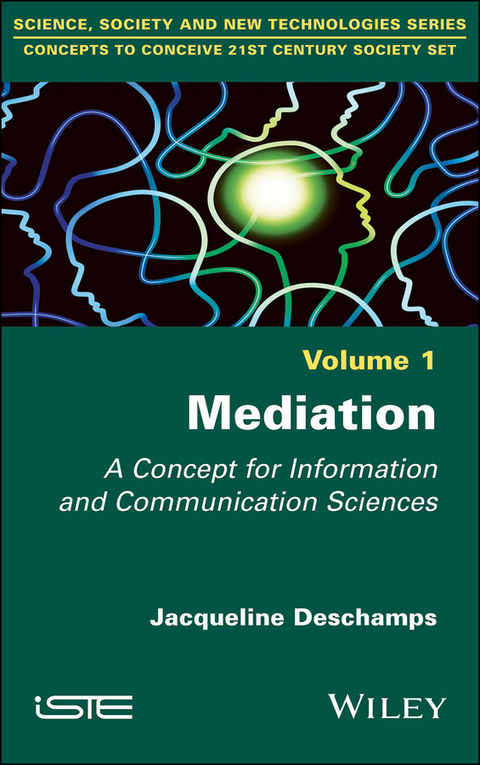
Mediation (eBook)
John Wiley & Sons (Verlag)
978-1-119-57983-0 (ISBN)
Jacqueline Deschamps is a former professor of the Information and Documentation Science (information documentaire) department at the Geneva School of Business Administration (HEG/University of Applied Sciences, Western Switzerland). She is currently continuing her research in ICS.
Preface ix
Introduction xiii
Part 1. Epistemological Foundations 1
Introduction to Part 1 3
Chapter 1. Exploring the Concept 5
1.1. A conceptual approach 6
1.2. The origins 8
1.3. Professional mediation 10
1.4. Mediation and peace 13
Chapter 2. The Constituent Elements of Mediation 17
2.1. The third party 17
2.1.1. From the word to the concept 18
2.1.2. Models and functions of the third party 19
2.1.3. The power and authority of a third party 22
2.1.4. The symbolic third party 24
2.2. Relation 26
2.2.1. A concept present in numerous fields 27
2.2.2. Relation as a process 28
2.2.3. Interactivity 32
2.2.4. The socioeconomics of relation 35
2.3. The subject 37
2.3.1. The subject in philosophy 37
2.3.2. The subject in psychoanalysis 41
2.3.3. The subject in mediation 43
Chapter 3. The Organization of Mediations 45
3.1. Mediation and institution 45
3.1.1. The spirit of institution 46
3.1.2. A historical approach to institutions 46
3.1.3. The human and the institutional spheres 49
3.1.4. Parliamentary mediation 50
3.2. Dispositive and mediation 52
3.2.1. Dispositives in mediation 52
3.2.2. The social dispositive 53
3.2.3. Technological dispositives 54
3.2.4. Legitimizing a dispositive 55
Chapter 4. Time and Mediation 57
4.1. The time of mediations 57
4.1.1. Synchronous and asynchronous mediations 59
4.1.2. Diachronic mediation 61
4.2. Timeless mediation 64
Part 2. Mobilizing the Concept of Mediation in Information and Communication Sciences 67
Introduction to Part 2 69
Chapter 5. Communicational Mediations 73
5.1. Transmitting and accessing knowledge 75
5.2. Scientific communication 78
5.3. Digital mediations 82
5.3.1. Information accessibility 82
5.3.2. The digital mediation of our heritage 85
5.3.3. The digital mediation of libraries 87
Chapter 6. Informational Mediations 89
6.1. Information professionals 89
6.2. Documentary mediation in academia 93
6.3. Competitive intelligence and mediation 95
6.4. Strategic foresight and mediation 97
Chapter 7. Cultural Mediations 101
7.1. Mediation and cultural institutions 102
7.2. Promoting our heritage 106
7.3. Artistic mediation 108
Chapter 8. Organizational Mediations 111
8.1. Organizational theories 112
8.2. Organizations and communication 116
8.3. Other perspectives in organizational communication 118
Chapter 9. Societal Mediations 121
9.1. Political mediation and the public space 122
9.2. Public communication and citizenship 127
9.3. Ecological mediation 128
Conclusion 133
References 139
Index of Cited Authors 153
Index of Terms 157
| Erscheint lt. Verlag | 24.1.2019 |
|---|---|
| Sprache | englisch |
| Themenwelt | Sozialwissenschaften ► Pädagogik |
| Wirtschaft ► Betriebswirtschaft / Management | |
| Schlagworte | authority • Bildungswesen • Business & Management • Communication & Media Studies • Communication & Media Studies Special Topics • Concept • Conflict Resolution & Mediation (Workplace Settings) • constituent • Education • Elements • epistemological • Fields • Foundations • Functions • Information & Library Science • Informations- u. Bibliothekswissenschaft • Introduction • Ix • Kommunikation u. Medienforschung • Konfliktbewältigung am Arbeitsplatz • Mediation • numerous • Part • Party • Power • present • Process • Spezialthemen Kommunikation u. Medienforschung • symbolic third • Third • Wirtschaft u. Management |
| ISBN-10 | 1-119-57983-X / 111957983X |
| ISBN-13 | 978-1-119-57983-0 / 9781119579830 |
| Informationen gemäß Produktsicherheitsverordnung (GPSR) | |
| Haben Sie eine Frage zum Produkt? |
 PDF (Adobe DRM)
Kopierschutz: Adobe-DRM
Adobe-DRM ist ein Kopierschutz, der das eBook vor Mißbrauch schützen soll. Dabei wird das eBook bereits beim Download auf Ihre persönliche Adobe-ID autorisiert. Lesen können Sie das eBook dann nur auf den Geräten, welche ebenfalls auf Ihre Adobe-ID registriert sind.
Details zum Adobe-DRM
Dateiformat: PDF (Portable Document Format)
Mit einem festen Seitenlayout eignet sich die PDF besonders für Fachbücher mit Spalten, Tabellen und Abbildungen. Eine PDF kann auf fast allen Geräten angezeigt werden, ist aber für kleine Displays (Smartphone, eReader) nur eingeschränkt geeignet.
Systemvoraussetzungen:
PC/Mac: Mit einem PC oder Mac können Sie dieses eBook lesen. Sie benötigen eine
eReader: Dieses eBook kann mit (fast) allen eBook-Readern gelesen werden. Mit dem amazon-Kindle ist es aber nicht kompatibel.
Smartphone/Tablet: Egal ob Apple oder Android, dieses eBook können Sie lesen. Sie benötigen eine
Geräteliste und zusätzliche Hinweise
Buying eBooks from abroad
For tax law reasons we can sell eBooks just within Germany and Switzerland. Regrettably we cannot fulfill eBook-orders from other countries.
aus dem Bereich


