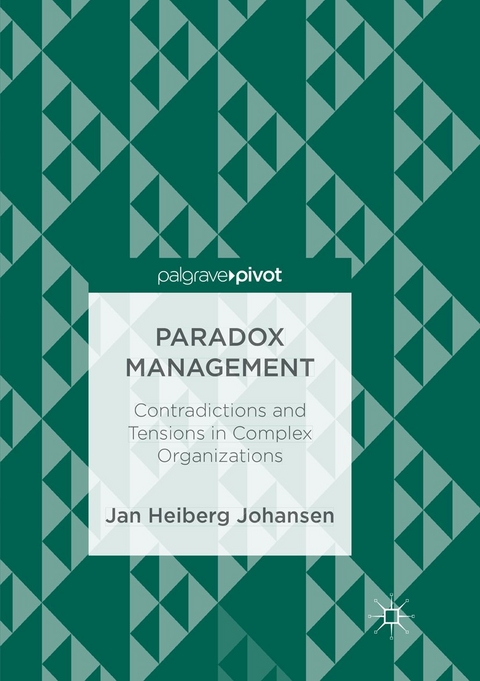
Paradox Management
Springer International Publishing (Verlag)
978-3-030-06919-3 (ISBN)
- Titel ist leider vergriffen;
keine Neuauflage - Artikel merken
Jan Heiberg Johansen, MBA, MA, is the Director of Consulting at the City of Copenhagen's internal consultancy.
lt;p>Chapter 1. Introduction: The Quest for Value. 8
Part I. The external context 17
Chapter 2. The strategic context. The mother of paradox. 20
Scarcity: In need of time, skills and money. 22Environmental change: Confusion logics in management 25
Institutional plurality: New rules of the game challenge value creation. 28
Chapter summary: Challenged organizational boundaries produce paradoxes 33
Chapter 3. The historical context. Contradictory ideals of management 35
Authority and autonomy: Reason as much as you like, but obey. 36
The interest paradigm: Organize to combat paradoxes. 38
The design paradigm: Eliminate paradoxes. 40
The needs paradigm: Build relations to guard against paradoxes. 42
The knowledge paradigm: Inspire to overcome paradoxes. 43
The complexity paradigm: Release the organization. 44
Chapter summary: Paradox theory is a corrective and a supplement to traditional organizational theory 45
Part II. The organizational paradoxes. 49
Chapter 4. The foundation. A new perspective on management in complexity. 50
The paradox concept: The birth and expansion of an alluring concept 53
Contradictions: The root system and wingspan of paradoxes. 58
Tensions: Paradoxes are experienced as tensions. 60
Chapter summary: Paradoxes unite theory positions. 63
Chapter 5. The paradox types. Tensions in organizing, performance, belonging, and learning 65
Organizing: Barriers for the post-bureaucratic organization. 66
Performing: When you reach the cross-road, go to the left and to the right 73
Belonging: You, me, us and them... 79
Learning: Tensions of time. 84
Chapter summary: Paradoxes produce devastating and constructive outcomes 88
Part III. The management tactics. 90
Chapter 6. Paradox tactics: Avoid, activate, transcend. 91
Tactical logics: The organizational ability to create value. 94
Avoidance: Avoid paradoxes. 96
Activation: Activate paradoxes. 103
Transcendence: Transcend paradoxes. 111
Turning points: Renew the organizational ability to create value. 114
Chapter summary: A new language on managing complexity. 117
Chapter 7. Value creation: Paradoxes as a holistic perspective on management 119
The building blocks: The platform of paradox management 119
Management practice: Identify and confront organizational paradoxes. 122
Chapter summary: Value creation through tensions. 125
Concluding remarks. Optimism and skepticism in the quest for value. 127
Index.
| Erscheinungsdatum | 29.01.2019 |
|---|---|
| Zusatzinfo | XV, 193 p. 20 illus. |
| Verlagsort | Cham |
| Sprache | englisch |
| Maße | 148 x 210 mm |
| Gewicht | 283 g |
| Themenwelt | Wirtschaft ► Betriebswirtschaft / Management ► Planung / Organisation |
| Wirtschaft ► Betriebswirtschaft / Management ► Unternehmensführung / Management | |
| Schlagworte | complex organizations • Leadership • Management Theory • paradox management • paradox tactics • Paradox Theory • Value Creation |
| ISBN-10 | 3-030-06919-2 / 3030069192 |
| ISBN-13 | 978-3-030-06919-3 / 9783030069193 |
| Zustand | Neuware |
| Informationen gemäß Produktsicherheitsverordnung (GPSR) | |
| Haben Sie eine Frage zum Produkt? |
aus dem Bereich