Brainsights (eBook)
226 Seiten
Distributed By PublishDrive (Verlag)
978-952-94-1228-0 (ISBN)
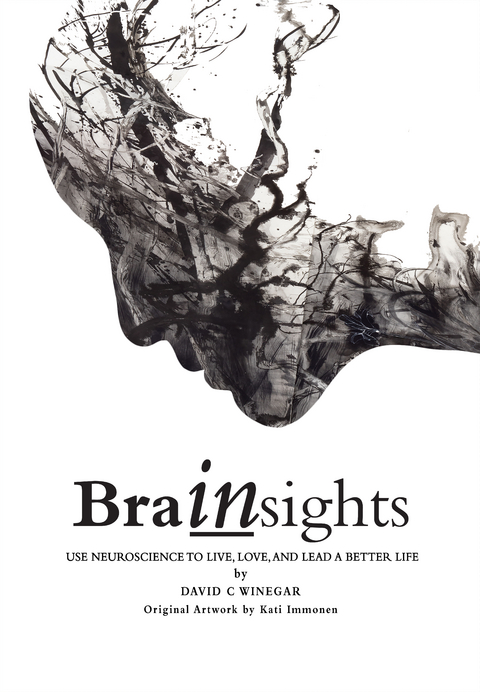
Brainsights will kick open the door to the enigma of our minds by looking at the latest research being carried out by an army of 50 000 neuroscientists. Using that knowledge, I will provide specific strategies to apply it to live, love and lead a better life.
Breakthroughs in the tools and methods for studying the brain in the last 10 years has resulted in an outpouring of insights into human behavior and why we do the things we do. The science has turned on its head long-held beliefs, leaving us with a clearer understanding of how to influence brain-positive behaviors to promote change. Brainsights will help you to:
· Understand how your brain has evolved to process the world
· Re-wire your brain to break habits and foster well-being
· Understand the chemistry of relationships and use it to build more meaningful connections
· Use experience to promote brain growth to shape new capabilities
I will strip away the inherent complexity of the science and steer you to insights that will enrich your relationships, improve your wellbeing, and increase your productivity.
Brainsights is a thinking person's self-help book. It is for those that can't wait to dig into the science, knowing what awaits them is the wisdom to make a difference in their own lives and those of others.
Brainsights will kick open the door to the enigma of our minds by looking at the latest research being carried out by an army of 50 000 neuroscientists. Using that knowledge, I will provide specific strategies to apply it to live, love and lead a better life. New tools and methods for studying the brain have resulted in an outpouring of insights into human behavior. The science has turned on its head long-held beliefs, leaving us with a more clear understanding of how to influence brain-positive behaviors to promote change. Brainsights will help you to Understand how your brain has evolved to process the world Understand the chemistry of relationships and use it to build more meaningful connections Re-wire your brain to break habits and foster well-being Use experience to promote brain growth to shape new capabilitiesI will strip away the inherent complexity of the science and steer you to insights that will enrich your relationships, improve your well being, and grow your productivity. Brainsights is a thinking person's self-help book. It is for those that can't wait to dig into the science, knowing that what awaits them is the wisdom to make a difference in their own lives and those of others. Well referenced with original research, the book is full of practical insights you can use to rewire yourself for success.
Preface 7
How to use this book 8
SIMPLICITY = BEAUTY 10
INTRODUCTION 12
YOUR BRAIN PREFERS TO THINK IT IS 4000 B.C. 17
Two systems make up your brain 17
Your Lizard Brain (S1) 17
Your Logical Brain (S2) 20
Your brain is a crystal ball 21
S1 prioritizes emotion over logic 25
Our world has changed, but our brains have not 25
100 millisecond judgments 26
Everyone has an individual view of the world 31
Priming the brain for experience 33
Culture embeds experience 35
Training yourself to be situationally aware 37
Understanding our memory 44
Three paths to better memory retention 47
Your brain seeks to habituate 56
The habituation proof presentation formula 58
The impact of stress and emotion on memory 59
The myth of learning styles 62
Can we trust our memories? 63
Sleep and memory 65
Gut feelings are real 68
YOUR BRAIN AVOIDS THINKING 76
You S2 Brain is a limited resource 77
Exploitation vs exploration and its Impact 81
Labeling Emotions 87
YOUR BRAIN IS REWARD-DRIVEN 100
Anticipation is a strong reward in itself 101
The role of reward in learning 105
Intrinsic and Extrinsic Reward 106
Reward must be greater than pain 110
YOUR BRAIN IS WIRED FOR SOCIAL CONNECTION 114
Our perceived reactions to fear drive interactions 117
Fight-or-flight impacts our health 123
Understanding stress 125
Uncertainty is the most dangerous stressor 127
Stress makes us stupid 131
Stress reduction through altered brain networks 132
The chemical of tend and befriend 136
Oxytocin and our significant other 138
Oxytocin and pets 140
The role of oxytocin in modern social bonding 141
Oxytocin and work relationships 143
Trust the cornerstone of psychological safety 144
Testosterone’s impact on oxytocin 145
Oxytocin is not purely positive 147
The power of mirror neurons to drive relationships 151
Conversational intelligence the key to brain synchronization 156
Gratitude’s Role in living better 161
Benefits of Practicing Gratitude 166
YOUR BRAIN IS PLASTIC 172
Our first understandings of the brain 173
The history of neurogenesis 177
Proof of plasticity 179
How to stimulate new brain connections 184
The brains need to remove connections 185
Breaking habits by pruning connections 187
Time to get in the game 190
Epilogue 193
Bibliography 202
YOUR BRAIN AVOIDS THINKING
The more skilled at doing something the less energy your brain expends. Built into our brains is economy of action. As Daniel Kahneman described it, there is a general “law of least effect” that applies to cognitive and physical exertion. If there are several ways of achieving the same goal, humans will gravitate towards the course of action that requires the least effort. Humans are lazy by design. (Kahneman 2011)
Doing new things always requires the use of energy. It is only through constant attention and practice can we convert an S2 task over to an automated S1 habit. Your brain wishes to convert everything to a habit because once a habit is formed, the cost of doing it drops.
Think about driving a car. Most of you reading this have gone through the life experience of learning to drive. Do you remember your first driving lesson? It was a mentally intensive experience. If, like me, you learned to drive on a manual transmission car with a gear shift and clutch, even more so. Remember how your mind worked feverishly to take in the stimulus surrounding you. Other cars, pedestrians, bicyclist, lights, noise, smells, and the physically demanding side of coordinating your hands and feet. Push the clutch in, select the gear, put your hands on the wheel, look out for other cars, people, dogs, and children. Let the clutch out, slowly and smoothly until it starts to take, press the accelerator to give it a bit of gas so the engine doesn’t stall. Watch out for obstacles on the road, notice the truck in the middle of the street, the person opening their door in the parked car in front of you. It all combined to produce a mentally taxing experience for your brain. The first few times you likely found yourself exhausted after a single one-hour session.
Fast forward to today and driving is almost entirely automatic. You can drive to work or your local grocery store on autopilot without thought. You might even get there and wonder, how did I do that? All those previously mentally demanding actions have transferred to your S1 brain becoming automatic and habituated, and more importantly, energy efficient. Think how little you would accomplish each day if required to expend as much energy to get to work that you needed for your first driving lesson? This is why your brain automates and why it is a necessary human process.
You S2 Brain is a limited resource
Your S2 brain is a limited resource. It is impossible to engage your thinking mind and focus for extended periods of time. It is too exhausting, and your S1 brain will fight the use of energy by shutting down blood flow to your S2 cognitive brain as quickly as it can.
The most energy-intensive cognitive task for human beings is self-control. Controlling your thoughts to direct your behavior is difficult and unpleasant. Psychologist Roy Baumeister studied cognitive effort and, in a series of experiments, demonstrated that effort of will, or self-control, is tiring.
If you must force yourself to do something, you are less willing or less able to exert self-control when the next task comes. For example, Baumeister found when subjects were asked to watch an emotionally charged film and told to repress their emotions. This act of repression resulted in poor performance on cognitive tests given afterwards. (M Mauraven 2000)
Physical stamina was also found to be negatively affected by the act of suppression. The ability to endure a physically difficult task was greatly reduced after the mental strain of emotional repression. Baumeister termed this phenomenon ‘ego depletion,’ explaining the mind has limited resources and when used up self-control is impaired (M Mauraven 2000).
There has been recently some debate about the validity of ego-depletion. A few studies tried to replicate Baumeister’s experiments but failed to find any evidence for ego depletion (Friese, et al. 2018). Baumeister argued his original protocol was rejected and if followed would have confirmed his original findings. The debate will continue and take years to settle. It is my belief ego-depletion will be eventually confirmed in Baumeister’s favor. One reason I believe it will be confirmed is because of the evolutionary connection.
University of Toronto neuroscientist Michael Inzlicht explains:
“As an organism, we need to meet multiple goals to survive. We’re not solely focused on finding food or finding mates, sleeping, or pursuing our passions in life. We need to do all these things to be a healthy, thriving species. Because these multiple goals compete with one another [for our time], we need a mechanism in place that signals, ‘Hey, stop doing that thing and do something else.’ That mechanism could be fatigue.” (Inzlicht 2018)
Fatigue is the brain running out of mental reserve for continuing a task it determines you are spending too much time on at the expense of others necessary for survival. If you are at work over 12 hours you likely feel tired, even if all you are doing is sitting at a computer typing. This is your brain’s way of telling you that you need to stop and get something to eat and sleep, two things necessary to be healthy and thrive.
What neuroscience tells us about self-control matches with what Baumeister observed, it is brain-taxing and hard to sustain. In three separate fMRI studies published in 2013 neuroscientists required subjects to engage in a mentally taxing task and then complete a “Stroop task”, a standard psychological test to measure reaction time. In all cases, a marked decline in performance on the Stroop task followed mental exertions, confirming the underlying assumptions about ego depletion observed by Baumeister (Elliot T Berkman 2013).
Remembering your brain, and those of others, cannot sustain demanding tasks is important to productivity initiatives. Too often we push ourselves and others from one demanding task to another without allowing adequate time for the brain to recover. Neuroscience studies have shown to function at an optimal level, the brain needs to go into a resting state after demanding tasks (Elliot T Berkman 2013).
Researchers at the University of Southern California found when we are resting our brains are far from idle and unproductive. This downtime is used to make sense of what has been experienced, to surface fundamental unresolved tensions in our lives, and reflect. These moments of introspection give you the ability to solve tough problems (Mary Helen Immordino-Yang 2012).
Have you ever experienced an ‘ah-ha’ moment while in the shower, or walking the dog? Perhaps it was the Sunday crossword puzzle you were working on, or a work-related problem that perplexed you for days, but in the shower the solution popped into your head without effort. You could experience this breakthrough because your brain was in a resting state of processing and able to make sense of new information.
Downtime for the brain is vital for memory. Dozens of studies (Payne 2011) confirm memory depends on sleep. Perhaps you noticed in school those vocabulary terms you struggled to remember the previous day came easily to mind after a good night’s sleep. During sleep, the brain is busy consolidating accumulated data and rehearsing recently learned skills. Committing to memory those experiences determined to be valuable.
Think of the implications for your daily life. How often are we put into demanding tasks and provided little or no time for processing and internalizing what we have experience? It is common for organizations to push people to produce in a limited time frame without allowing time to recover from a task before being put into the next.
For example, in my field of training and development it is not uncommon to send people to trainings in the morning, fill their heads with new information over hours of cognitively demanding tasks, then send them straight back to work in the afternoon. There is no time for information consolidation with the result being the information is quickly deleted from the brain.
If you want to hack your brain to more efficiently internalize what you learn then allowing your brain to rest between tasks is important. It is what is necessary for the creation of the new neural connections to form the pathways allowing you to use what you have learned (Josef Sadowski 2016).
Research has shown that sleep allows the brain to sift through memories and be selective about what it internalizes and remembers. The brain ‘prunes’ connections when you sleep, determining in the process what should be kept and what can be deleted in an effort to wipe the slate clean for the next day’s experiences. The brain’s ‘housekeeping’ at night is indispensable to achieving higher level of brain function.
Babies and children require more sleep. Children are not sleeping more because they are lazy; it is, in fact, the opposite. They need more sleep than adults because their brains are experiencing and learning more. For children, they are busy creating the database of experiences they will use over their entire lives. So much of what happens in a day is new for them. Processing is mentally demanding and necessitates extra sleep to make sense of and construct experiences for future reference. (Howard P. Roffwarg 1966)
When working with others, also know we are not equal in our ability to recover from demanding tasks. The research done so far in this area reveals there is a ‘hangover’ effect that can be longer in less cognitively resilient individuals (Thomas P. K. Breckel 2013).
It is natural for some people to recover more quickly than others and recovery for some tasks will take longer than others. Those tasks that are demanding but you have more experience with, you...
| Erscheint lt. Verlag | 27.1.2019 |
|---|---|
| Sprache | englisch |
| Themenwelt | Sachbuch/Ratgeber ► Beruf / Finanzen / Recht / Wirtschaft |
| Sachbuch/Ratgeber ► Gesundheit / Leben / Psychologie ► Lebenshilfe / Lebensführung | |
| Geisteswissenschaften ► Psychologie ► Allgemeine Psychologie | |
| Geisteswissenschaften ► Psychologie ► Biopsychologie / Neurowissenschaften | |
| Geisteswissenschaften ► Psychologie ► Verhaltenstherapie | |
| Sozialwissenschaften ► Pädagogik | |
| Wirtschaft ► Betriebswirtschaft / Management ► Unternehmensführung / Management | |
| Schlagworte | Leadership • Neuroleadership • Neuroplasticity • Neuroscience • neuroscience for coaches • Self-Help • well-being |
| ISBN-10 | 952-94-1228-2 / 9529412282 |
| ISBN-13 | 978-952-94-1228-0 / 9789529412280 |
| Informationen gemäß Produktsicherheitsverordnung (GPSR) | |
| Haben Sie eine Frage zum Produkt? |
 EPUB (Ohne DRM)
Digital Rights Management: ohne DRM
Dieses eBook enthält kein DRM oder Kopierschutz. Eine Weitergabe an Dritte ist jedoch rechtlich nicht zulässig, weil Sie beim Kauf nur die Rechte an der persönlichen Nutzung erwerben.
Dateiformat: EPUB (Electronic Publication)
EPUB ist ein offener Standard für eBooks und eignet sich besonders zur Darstellung von Belletristik und Sachbüchern. Der Fließtext wird dynamisch an die Display- und Schriftgröße angepasst. Auch für mobile Lesegeräte ist EPUB daher gut geeignet.
Systemvoraussetzungen:
PC/Mac: Mit einem PC oder Mac können Sie dieses eBook lesen. Sie benötigen dafür die kostenlose Software Adobe Digital Editions.
eReader: Dieses eBook kann mit (fast) allen eBook-Readern gelesen werden. Mit dem amazon-Kindle ist es aber nicht kompatibel.
Smartphone/Tablet: Egal ob Apple oder Android, dieses eBook können Sie lesen. Sie benötigen dafür eine kostenlose App.
Geräteliste und zusätzliche Hinweise
Buying eBooks from abroad
For tax law reasons we can sell eBooks just within Germany and Switzerland. Regrettably we cannot fulfill eBook-orders from other countries.
aus dem Bereich