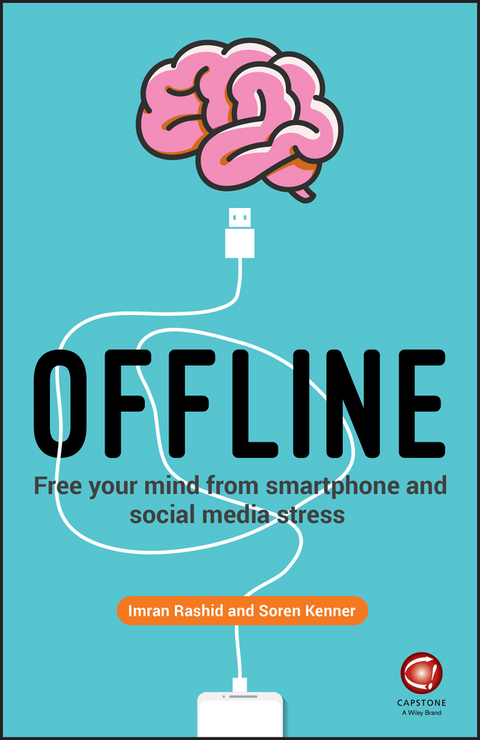
Authors Imran Rashid and Soren Kenner have sparked an international debate by revealing the 'mind hacks' Facebook, Apple, Google, and Instagram use to get you and your children hooked on their products,
In Offline, they deliver an eye-opening research-based journey into the world of tech giants, smartphones, social engineering, and subconscious manipulation, This provocative work shows you how digital devices change individuals and communities for better and worse,
A must-read if you or your kids use smartphones or tablets and spend time browsing social networks, playing online games or even just browsing sites with news and entertainment,
Learn how to recognize 'mind hacks' and avoid the potentially disastrous side-effects of digital pollution, Unplug from the matrix, Learn digital habits that work for you,
Dr, Imran Rashid has a rare background as both an experienced IT-entrepreneur and a qualified family physician, In Rashid's final years of medical specialisation he began to question the way health care was being delivered and whether this could be improved with the integration of current technology trends, This interest lead him through several medtech startups and a general family practice, until he was headhunted to the position he holds today, as Head of Innovation in the largest chain of private hospitals in Denmark, Aleris-Hamlet Private Hospitals, Rashid has used his multidisciplinary knowledge to describe the interaction between the human brain and the smartphone and in doing so provided simple and qualified answers to some of the burning questions in modern society surrounding the impact of technology on our health, The author is also now an independent consultant under the business name Sunddigital,dk
Soren Kenner is an expert in online marketing and a successful entrepreneur, In 1994, he founded Medialog, an integrated marketing agency which he later sold in what remains the largest agency deal in Denmark to this day, Soren then went on to head up McCann MRM EMEA, working with global clients such as Coca-Cola, L'oreal, Microsoft, Mastercard and Nestle, Soren has since founded and co-founded several companies, including online trading company Zecco,com (later TradeKing), online marketing agency Hello Group, Moodagent (audio-fingerprinting), Intivation (solar cells that power cell phones), Sparrow Quantum (single photon light-sources) and Concordium (foundational blockchain technology), Soren Kenner has also co-founded the 'Liberal Alliance' political party in Denmark, and is an accomplished children's author,
Authors Imran Rashid and Soren Kenner have sparked an international debate by revealing the mind hacks Facebook, Apple, Google, and Instagram use to get you and your children hooked on their products. In Offline, they deliver an eye-opening research-based journey into the world of tech giants, smartphones, social engineering, and subconscious manipulation. This provocative work shows you how digital devices change individuals and communities for better and worse.A must-read if you or your kids use smartphones or tablets and spend time browsing social networks, playing online games or even just browsing sites with news and entertainment. Learn how to recognize mind hacks and avoid the potentially disastrous side-effects of digital pollution. Unplug from the matrix. Learn digital habits that work for you.
Dr. Imran Rashid has a rare background as both an experienced IT-entrepreneur and a qualified family physician. In Rashid's final years of medical specialisation he began to question the way health care was being delivered and whether this could be improved with the integration of current technology trends. This interest lead him through several medtech startups and a general family practice, until he was headhunted to the position he holds today, as Head of Innovation in the largest chain of private hospitals in Denmark, Aleris-Hamlet Private Hospitals. Rashid has used his multidisciplinary knowledge to describe the interaction between the human brain and the smartphone and in doing so provided simple and qualified answers to some of the burning questions in modern society surrounding the impact of technology on our health. The author is also now an independent consultant under the business name Sunddigital.dk Soren Kenner is an expert in online marketing and a successful entrepreneur. In 1994, he founded Medialog, an integrated marketing agency which he later sold in what remains the largest agency deal in Denmark to this day. Soren then went on to head up McCann MRM EMEA, working with global clients such as Coca-Cola, L'oreal, Microsoft, Mastercard and Nestle. Soren has since founded and co-founded several companies, including online trading company Zecco.com (later TradeKing), online marketing agency Hello Group, Moodagent (audio-fingerprinting), Intivation (solar cells that power cell phones), Sparrow Quantum (single photon light-sources) and Concordium (foundational blockchain technology). Soren Kenner has also co-founded the "Liberal Alliance" political party in Denmark, and is an accomplished children's author.
Acknowledgments xi
Introduction: Offline 1
Are You Being Digitally Manipulated? 5
Access to Your Attention Has Become a Commodity 8
Technology Is Good. But Use it Carefully! 10
HowThis Book Is Structured 15
Chapter One 17
A Tsunami of Technological Transformation 17
Imperceptible Change 19
Because Your Eyeballs Are Worth It 21
Social Media: The Global Village 23
Tackling the Onslaught of Information 26
Chapter Two 30
A Fire upon the Deep 30
Developing Bigger Brains Was an Evolutionary Gamble 31
The Three Layers of Your Brain 33
Prefiltering and Neuroplasticity: Your Adaptable Brain 45
Is Your Consciousness Time-Shifted? 47
To Be or Not to Be Conscious 49
Out of Control 51
Is Consciousness a Question of Being in the Spotlight? 53
Models Are Not Reality 54
The Hard Question of Consciousness 55
The Social Brain 56
Chapter Three 63
The Billion Dollar Question 63
Dopamine: Sex, Drugs, and Rock 'n' Roll? 65
Oxytocin: Humans Need Humans 67
Does Your Family Suffer from Technoference? 69
Being Able to Defer Gratification Is Crucial 72
What We Actually Do Know about Impulse Control--and About Losing It! 74
Do Smartphones Affect Human Self-Control? 76
Chapter Four 80
The Human Information Factory 82
The Limited Working Memory 82
The Sorting Task 83
Information Processing 84
Would You Dare to Be a Passenger in a Car Driven by a Distracted You? 86
Excuse Me, Do You Have a Minute? 87
Smartphones and Feelings 88
A Quick Pit-Stop before Heading into the Land of Dragons 89
Chapter Five 95
One Great Big Online Market 95
B.J. Fogg and the Stanford Persuasion Lab 96
Let's Take a Look at B.J. Fogg's Model as It Is Being Used Today... 98
Your Phone Is a Slot Machine! 101
What Do the Companies Targeting You See? 103
Your Personality Can Be Predicted with Great Accuracy 107
The Cambridge Analytica Scandal 109
How You Are Captured and Converted 111
Multivariate Testing--Helping Consumers Capture Themselves 113
The StrangeWorld of Tracking Pixels, Cookies and Remarketing 115
All aboard the Consumer Journey Train 118
The Horrible Dark Patterns 120
How Google Skews Your Search Results 121
Chapter Six 125
Stress, Low Self-Esteem, Anxiety and Sleep Disturbances 126
Smartphones and Social Media Can Lead to ADHD in Adolescents 128
Can Use of Social Media Be Addictive? 128
When Addictive Design and Basic Human Social Traits Clash 130
The Effects Are Not Just Physiological or Psychological 132
Echo Chambers and Confirmation Bias 133
When Confirmation Bias Leads to Cognitive Dissonance 138
The Sharp Decline in Empathy 141
The Changing World of Youngsters 144
Cyberbullying 146
In Conclusion: The Road Ahead Is All About the Choices You Make! 148
Chapter Seven 157
Making Changes Is Not Easy! 157
Change Means Doing Things Differently 159
Step 1: Life Stories 160
Step 2: Mapping out Your Habits and How You Spend Your Time 164
Step 3: Identify Triggers & Cues 164
Step 4: Plan Your Countermove and Start Acting 167
Troubleshoot Failure 169
In Summary: It's Not Rocket Science, but it's Not All That Easy Either 170
Teaching Your Children Sensible and Healthy Digital Habits 172
The Underlying Psychological Principles 174
Entering the Zone--Learning to Focus 177
Deliberate Practice 179
In Conclusion: It's Simple, but it's Not Easy 182
Epilogue 187
Index 193
Introduction: Offline
If this book caught your attention, then you're already concerned about the effect digital devices are having on your life. You've read about younger people who have thousands of friends on Facebook but no real-life social skills. You've got a good sense that distraction is not good and that you can waste a lot of time reacting to notifications, unnecessary texts, and selfies your cousin blasts you from Ibiza. You can now order your coffee with an app, thus saving you at least 45 seconds of interaction with a human intermediary. But what have we really gained?
You don't have to be a psychologist to see that smartphones and tablets are changing the way we act and interact with each other, and not necessarily in a good way. But have you considered that smartphones are even changing the way we walk? Think about this: if you compare footage of people walking down a street 20 years ago with what you see today, you'll see that the human gait has changed. Twenty years ago, people walked with their heads mostly up and their eyes focused on the territory before them, scanning side to side for potential dangers, or possibly friends, and not uncommonly a potential romantic partner. (This quaint folk practice was commonly known as “watching where you're going”!) Today, the head is down, the shoulders are forward, the spine folds inward and the lower back juts out. All of these postural adjustments are brought to us by the smartphone we're holding out in front of us as if it were a recently added body part. The funky smartphone dance is already an orthopedical disaster that will soon be felt in the neck and pelvis, but that's not half of it.
First, it hardly needs to be said that a city walk with your eyes glued to your smartphone boosts your chances of getting run over by a car or a truck. That's because your physical environment now is of only secondary concern because your attention is on your device. It's not all that different from walking through a jungle and not paying attention to tigers, or not paying any attention to your tribal members warning you about tigers because you're totally fixated on something that has nothing to do with your immediate environment.
So, to conserve energy, the brain shifts into a primal scan mode that alerts it only to the threat of physical danger––but not even doing that very well. But that's still not even half of it.
Do you feel the chill at your local cafe, where the friendly banter has been replaced by gloomy silence? Meanwhile, the room is jittery with the flash of dozens of small, bright electronic screens. Almost everyone is entirely absorbed by their smartphone or tablet navigating their own private online bubble. At the playground, parents on benches are staring into smartphones while their kids unsuccessfully try to get their attention. Even at restaurants or dinner at home it is not uncommon to see friends and families all glued to their smartphones.
Yes, smartphones and social media deliver a lot of goods, literally and figuratively. But it's also becoming clearer day by day that our digital fixation is depleting our nervous systems individually and collectively. Digital devices have cast a chill over human relationships and interactions that we are only just starting to recognize, let alone understand or counteract. Maybe now is the time for a digital counter-revolution?
Our global adoption of digital technology happened in an extraordinarily short span of time, such that it has summarily outpaced our ability to absorb it on a cultural level as well as a neurological one. Maybe it's time to unplug from the matrix for a while and assess the damage wrought as well as the benefits brought to us by our new digital lifestyle.
We initially decided to write this book because we felt trapped by smartphones constantly clamoring for our attention and constantly pulling us away from what was happening here and now in the real world. But as we probed deeper into the research and observed what was happening around us, we came to understand that the problem extends profoundly beyond time management issues.
That discussion sparked a book in Danish titled SLUK (meaning, “Turn It Off!”) about the effects of being constantly connected and online. The book was on the national bestseller list for 18 months. It sparked a heated debate in Denmark and has led to the establishment of a government panel on stress and digital habits and the decision to fund more research into the area.
What started out as SLUK eventually became this book, Offline, that presents a much deeper look into digital behavior and its consequences. As we began sifting through an ever-growing body of research that connects smartphones and social media with stress, sleep disturbances, concentration issues, decision fatigue, escapism, cognitive bias and so on, we came to realize four things:
- The sheer size of the industry servicing us with smartphones, social media, games, news, and so on. Companies like Apple, Google, Facebook and Amazon are essentially empires with economies that rival those of many countries.
- That in the twenty-first century, the power of attention has become an incredibly important commodity because in essence it fuels all online shopping. The longer these companies can keep your eyeballs glued to the screen looking at their product, the more money they make. This may be good business but may be not so good for you.
- That extended and uncontrolled use of smartphones, social media, online gaming and the like have serious consequences in terms of your ability to focus, concentrate, learn, connect and be in the real world.
- That a significant cause of these issues is the consistent use of “brain hacks,” also known as addictive design, in the technology you use. These “hacks” are designed to install “triggers” that you are not consciously aware of, but which create an urge to be online, to check notifications and mail, or to scroll endlessly through social media newsfeeds.
All leading to a syndrome we have named DFRAG (digital fragmentation syndrome). This term describes a condition where the human experience of time, space and consciousness is constantly fragmented through digital interactions. When humans constantly lose sight of who they are, where they are and what their conscious goal is, we believe this leads to serious biological, psychological and social symptoms. DFRAG is what happens when you start using technology because you want to, but end up using it because you can't resist doing so because a number of triggers have been installed into the more automated thought and behavior patterns in your brain and are now making it difficult for you to function at optimal levels––making it hard to be at your best, whether in terms of family life, your work or your leisure time.
And yes––this is something that we will document as you read on!
Are You Being Digitally Manipulated?
It is hard, if not impossible, to imagine life without the Internet, but perhaps even harder to fathom how very suddenly and very recently this all happened. Amazon was founded in 1994, Google in 1998, Facebook in 2004, YouTube in 2005, Twitter in 2006 and Instagram in 2010.
Today these companies are fixtures in our world and through them everything seems to be just a click or two away. A human being with an internet connection and a credit card can have practically anything delivered with the click of a mouse. There is more to do, more to choose from and many more ways of sharing than ever before.
By 2019 more than 5 billion people will have smartphones and there will be around 1.5 billion tablets in the world. We will be just short of 8 billion people on the planet and almost half of us––3.7 billion––will have internet access. More than one-third of the world's population will be using one or more social networks to keep in touch with friends, exchange ideas, watch videos, play games, take quizzes, join groups, collect likes and post photos.
Soon there will be 6 billion smartphone users in the world. That's pretty much 75% of the total global population.
A funny thing didn't happen on the way to Digital Oz, though. Until recently, nobody really stopped to ask what the mental, physical and social effects of all of this online activity would be. The mere existence of these platforms has been earth-shaking––that much was apparent from the beginning.
However, nobody particularly wanted to ask an uncomfortable question: What happens to your mind when digital marketers start manipulating your brain chemistry through digital devices, which you carry around at all times, always available and always turned on?
It is amazing how unquestioning most of us are with regard to our relationship with our devices.
Think about it for a second: Is your smartphone the first thing you see in the morning and the last thing you see before sleeping? Have you become easier to distract over the past couple of years? Has it become harder to read longer texts than it used to be? Do you check your mail or social media while watching TV or even when driving your car? Do you feel the urge to repeatedly check your phone, even when you know that nothing new has arrived? Have you ever felt vibrations from your pocket and whipped out your phone just to discover that it was just your mind playing tricks on you (a phenomenon known as phantom pocket...
| Erscheint lt. Verlag | 28.12.2018 |
|---|---|
| Sprache | englisch |
| Themenwelt | Sachbuch/Ratgeber ► Beruf / Finanzen / Recht / Wirtschaft ► Bewerbung / Karriere |
| Wirtschaft ► Betriebswirtschaft / Management ► Planung / Organisation | |
| Schlagworte | addicted to smartphone • addicted to technology • ADHD • Amazon</p> • Anxiety • Apple • Behavioural Psychology • brain hack • Business & Management • Business Self-Help • Cognitive Bias • Consciousness • digital addiction • Digital Age • digital pollution • Digital transformation • dopamine • Echo Chamber • Facebook • facebook addiction • FOMO • gaming addiction • Google • Happiness • Harari • how to unplug your brain from technology • impulse control • Instagram • instagram addiction • Internet addiction • internet and violence • iPad • iPhone • Kahneman • lack of empathy • learn to master your impulses • Loss of Control • loss of impulse • <p>Digital world • mind-body balance • Neuroscience • online addiction • Oxytocin • perception of reality • protect your brain from overuse of technology • Ratgeber Wirtschaft • regaining control • reptile brain • Self-Help • Sensory overload • Sleepless • Smartphone Addiction • Snapchat • social media addiction • Stress • technology addiction • technology overload • tinder • unplug your brain • wasting time online • Wirtschaft /Ratgeber • Wirtschaft u. Management • work-life balance |
| ISBN-13 | 9780857087928 / 9780857087928 |
| Informationen gemäß Produktsicherheitsverordnung (GPSR) | |
| Haben Sie eine Frage zum Produkt? |
 EPUB (Adobe DRM)
Kopierschutz: Adobe-DRM
Adobe-DRM ist ein Kopierschutz, der das eBook vor Mißbrauch schützen soll. Dabei wird das eBook bereits beim Download auf Ihre persönliche Adobe-ID autorisiert. Lesen können Sie das eBook dann nur auf den Geräten, welche ebenfalls auf Ihre Adobe-ID registriert sind.
Details zum Adobe-DRM
Dateiformat: EPUB (Electronic Publication)
EPUB ist ein offener Standard für eBooks und eignet sich besonders zur Darstellung von Belletristik und Sachbüchern. Der Fließtext wird dynamisch an die Display- und Schriftgröße angepasst. Auch für mobile Lesegeräte ist EPUB daher gut geeignet.
Systemvoraussetzungen:
PC/Mac: Mit einem PC oder Mac können Sie dieses eBook lesen. Sie benötigen eine
eReader: Dieses eBook kann mit (fast) allen eBook-Readern gelesen werden. Mit dem amazon-Kindle ist es aber nicht kompatibel.
Smartphone/Tablet: Egal ob Apple oder Android, dieses eBook können Sie lesen. Sie benötigen eine
Geräteliste und zusätzliche Hinweise
Buying eBooks from abroad
For tax law reasons we can sell eBooks just within Germany and Switzerland. Regrettably we cannot fulfill eBook-orders from other countries.
aus dem Bereich