


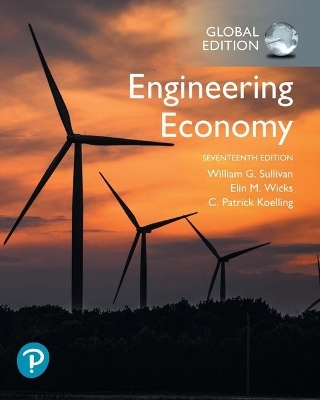
Engineering Economy plus MyLab Engineering with Pearson eText, Global Edition
Pearson Education Limited (Verlag)
978-1-292-26500-1 (ISBN)
- Titel erscheint in neuer Auflage
- Artikel merken
For courses in undergraduate introductory engineering economics.
Understand the importance of engineering economics principles and how to make smart economic choices
Used by engineering students worldwide, this bestselling text provides a sound understanding of the principles, basic concepts, and methodology of engineering economy. Explanations and examples that are student-centered and practical in real-life situations help students develop proficiency in the methods and processes for making rational decisions. Built upon the rich and time-tested teaching materials of earlier editions, the text is extensively revised and updated to reflect current trends and issues. The new edition captures the spirit of environmental sustainability with more than 160 "green" problems, as well as new end-of-chapter problems and group exercises, and includes updates to the new 2017 Federal Tax code revisions.
Reach every student by pairing this text with MyLab Engineering
MyLab (TM) is the teaching and learning platform that empowers you to reach every student. By combining trusted author content with digital tools and a flexible platform, MyLab personalizes the learning experience and improves results for each student.
MyLab Engineering should only be purchased when required by an instructor. Please be sure you have the correct ISBN and Course ID. Instructors, contact your Pearson representative for more information.
Green Content
CHAPTER 1
Introduction to Engineering Economy
1.1 Introduction
1.2 The Principles of Engineering Economy
1.3 Engineering Economy and the Design Process
1.4 Using Spreadsheets in Engineering Economic Analysis
1.5 Try Your Skills
1.6 Summary
CHAPTER 2
Cost Concepts and Design Economics
2.1 Cost Terminology
2.2 The General Economic Environment
2.3 Cost-Driven Design Optimization
2.4 Present Economy Studies
2.5 Case Study–The Economics of Daytime Running Lights
2.6 In Class Exercise
2.7 Try Your Skills
2.8 Summary
Appendix 2-A Accounting Fundamentals
CHAPTER 3
Cost-Estimation Techniques
3.1 Introduction
3.2 An Integrated Approach
3.3 Selected Estimating Techniques (Models)
3.4 Parametric Cost Estimating
3.5 Case Study–Demanufacturing of Computers
3.6 Electronic Spreadsheet Modeling: Learning Curve
3.7 In-Class Exercise
3.8 Try Your Skills
3.9 Summary
CHAPTER 4
The Time Value of Money
4.1 Introduction
4.2 Simple Interest
4.3 Compound Interest
4.4 The Concept of Equivalence
4.5 Notation and Cash-Flow Diagrams and Tables
4.6 Relating Present and Future Equivalent Values
4.7 Relating a Uniform Series (Annuity) to Its Present and Future Equivalent
4.8 Summary of Interest Formulas and Relationships for Discrete Compounding
4.9 Deferred Annuities (Uniform Series)
4.10 Equivalence Calculations Involving Multiple Interest Formulas
4.11 Uniform (Arithmetic) Gradient of Cash Flows
4.12 Geometric Sequences of Cash Flows
4.13 Interest Rates that Vary with Time
4.14 Nominal and Effective Interest Rates
4.15 Compounding More Often than Once per Year
4.16 Interest Formulas for Continuous Compounding and Discrete Cash Flows
4.17 Case Study–Understanding Economic “Equivalence”
4.18 In-Class Exercise
4.19 Try Your Skills
4.20 Summary
CHAPTER 5
Evaluating a Single Project
5.1 Introduction
5.2 Determining the Minimum Attractive Rate of Return (MARR)
5.3 The Present Worth Method
5.4 The Future Worth Method
5.5 The Annual Worth Method
5.6 The Internal Rate of Return Method
5.7 The External Rate of Return Method
5.8 The Payback (Payout) Period Method
5.9 Case Study–A Proposed Capital Investment to Improve Process Yield
5.10 Electronic Spreadsheet Modeling: Payback Period Method
5.11 In-Class Exercise
5.12 Try Your Skills
5.13 Summary
Appendix 5-A The Multiple Rate of Return Problem with the IRR Method
CHAPTER 6
Comparison and Selection among Alternatives
6.1 Introduction
6.2 Basic Concepts for Comparing Alternatives
6.3 The Study (Analysis) Period
6.4 Useful Lives Are Equal to the Study Period
6.5 Useful Lives Are Unequal among the Alternatives
6.6 Personal Finances
6.7 Case Study–Ned and Larry’s Ice Cream Company
6.8 Postevaluation of Results
6.9 Project Postevaluation Spreadsheet Approach
6.10 In-Class Exercise
6.11Try Your Skills
6.12 Summary
CHAPTER 7
Depreciation and Income Taxes
7.1 Introduction
7.2 Depreciation Concepts and Terminology
7.3 The Classical (Historical) Depreciation Methods
7.4 The Modified Accelerated Cost Recovery System
7.5 A Comprehensive Depreciation Example
7.6 Introduction to Income Taxes
7.7 The Effective Corporate Income Tax Rate
7.8 Gain (Loss) on the Disposal of an Asset
7.9 General Procedure for Making After-Tax Economic Analyses
7.10 Illustration of Computations of ATCFs
7.11
| Erscheinungsdatum | 20.07.2019 |
|---|---|
| Verlagsort | Harlow |
| Sprache | englisch |
| Maße | 190 x 230 mm |
| Gewicht | 1091 g |
| Themenwelt | Technik |
| Wirtschaft ► Betriebswirtschaft / Management ► Finanzierung | |
| Wirtschaft ► Volkswirtschaftslehre | |
| ISBN-10 | 1-292-26500-0 / 1292265000 |
| ISBN-13 | 978-1-292-26500-1 / 9781292265001 |
| Zustand | Neuware |
| Informationen gemäß Produktsicherheitsverordnung (GPSR) | |
| Haben Sie eine Frage zum Produkt? |
aus dem Bereich


