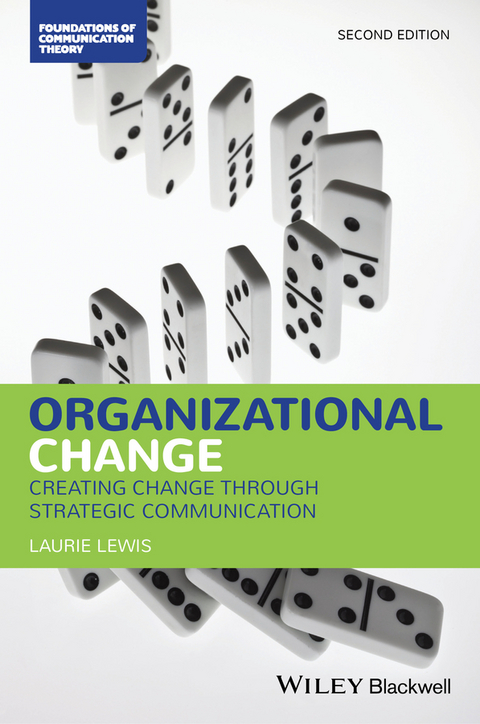
Organizational Change (eBook)
John Wiley & Sons (Verlag)
978-1-119-43131-2 (ISBN)
A comprehensive guide to essential theories and practices of change creation and implementation
Organizational Change provides an essential overview to implementing deliberate and focused change through effective communication strategies. Author Laurie Lewis integrates academic rigor with real-world case studies to provide a comprehensive examination of both theoretical and pragmatic approaches to alterations and modifications of organizational structures. Emphasizing the importance of formal and informal communication in implementation of change, this text investigates methods of information dissemination and examines various channels for communicating change. Coverage of stakeholder relationships, concepts of uncertainty and resistance, assessing change outcomes, and more provides readers with a solid foundational knowledge of change dynamics in organizations.
Extensively revised and updated, this second edition provides new case studies on topics such as design of input solicitation, and current research in areas including the persuasive effects of sidedness or inoculation, and socially supportive communication. Improved pedagogical tools, streamlined organization of topics, and additional charts, graphs, and images reinforce efficient presentation of material and increase reader retention and comprehension.
- Examines empirical, theoretical, and conceptual approaches to strategic communication during organization change
- Explores key elements of change, appropriate communication strategies, and outcome evaluation methods
- Presents adaptive and programmatic strategic implementation models
- Provides studies of real-world companies and actual research on organizational change
- Debunks popular myths and clarifies misunderstandings of research and theory on implementation of change
- Demonstrates how Individuals, groups, and entire organizations can create change and influence implementation.
Organizational Change provides a thorough survey of the communication and implementation strategies, methods, and conceptual foundations of change in public and private sector organizations, suitable for undergraduate and graduate study and practitioners with interest in complex change implementation.
Dr. Laurie Lewis is a Professor of Communications at Rutgers University and a Fellow at the Rutgers Center for Organizational Leadership. She is co-editor of Volunteering and Communication and the International Encyclopedia of Organizational Communication and has written numerous academic publications on topics related to organizational change, collaboration, inter-organizational communication, and stakeholder communication. Dr. Lewis has provided consulting and training for organizations including nonprofits, civil society organizations, Fortune 500 companies, and higher education institutions.
Dr. Laurie Lewis is a Professor of Communications at Rutgers University and a Fellow at the Rutgers Center for Organizational Leadership. She is co-editor of Volunteering and Communication and the International Encyclopedia of Organizational Communication and has written numerous academic publications on topics related to organizational change, collaboration, inter-organizational communication, and stakeholder communication. Dr. Lewis has provided consulting and training for organizations including nonprofits, civil society organizations, Fortune 500 companies, and higher education institutions.
Introduction 1
1 Defining Organizational Change 20
2 Processes of Communication During Change 53
3 A Stakeholder Communication Model of Change 94
4 Outcomes of Change Processes 126
5 Communication Approaches and Strategies 156
6 Power and Resistance 191
7 Antecedents to Strategies, Assessments, and Interactions 227
8 Stakeholder Interactions: Storying and Framing 253
9 Applying the Model in Practice 281
Glossary 304
Index 3
Introduction
Only the wisest and the stupidest of men never change
Confucius
If you don't change direction, you'll end up where you're headed
Chinese Proverb
Change is a prominent feature of organizational, civic, and personal life. Change is something we sometimes seek, sometimes resist, and often have thrust upon us. It would not be an overstatement to suggest that society is rife with change and questions about how, when, and in what ways change ought to occur. Goal achievement, progress, and even the avoidance of crisis very often involve implementing planned changes. Change can serve as a means to address many important challenges such as those related to policy, governance, rule of law, philosophy, and distribution of information, rights, and resources; challenges of efficiency, effectiveness, quality, and competitiveness; and challenges hinged on shared values, understanding, and cooperation. These challenges span across many sectors of society including private sector organizations upon which we depend for goods, services, and the basis of our economy; public sector organizations that run our community, state, national, and international governance; and non‐governmental or nonprofit organizations that promote community and leisure activity as well as provide for numerous humanitarian, scientific, professional, cultural, and social services.
Change is sometimes necessary to correct past failures and accomplish learning and improvement. And, although decision‐makers can often agree on problems to be solved, the principles involved in solving them, and even the specific changes to be made in a given situation, making the change happen – through implementing ideas and improvements – can be incredibly challenging. For example, in the aftermath of Hurricanes Katrina and Maria or after the 9/11 tragedy, hindsight produced many ideas and suggestions for improvement in preventive measures, security measures, and procedures of first responders among others. In order to realize those changes in time to be prepared for the next hurricane or attack, leaders needed to not only vet the ideas, but figure out how to install changes, deal with conflicting opinions about the changes, provide for necessary adjustments to the ideas as they were introduced, and cope with the unexpected consequences of changes made. These are all tasks of implementation. Failure to implement change as a result of organizational learning can result in repeated failure. One could argue that failure to implement change as a result of what was learned from the Exxon Valdez oil spill in Alaska may have led to the BP oil spill disaster in the Gulf of Mexico years later.
Change is sometimes important because it provides opportunities for growth, development, increasing resources, and seizing a moment that if missed may have negative consequences. Leaders who are frozen in the process of implementing change, who are not able to act efficiently and effectively in bringing an innovative idea into practice soon enough, may be unable to realize the benefits of even the best of ideas. In some cases, being second or third with a great idea is worthless; in some cases, resources are so scarce and timing so critical that delays in getting innovation up and running can mean a missed opportunity. If companies, governments, and other collectives who are trying to innovate are not able to swiftly and smoothly bring new ideas into the marketplace or operations, the window for innovation may close. Successful implementation is key to realizing the potential of most great ideas.
Alternatively, change processes are sometimes wrong‐headed, faddish, unnecessary, and potentially disastrous in their consequences. Huge investments in time, money, physical resources, and social and political capital can be wasted if spent on flawed, misguided changes that have little value or high negative consequences. The period of implementation is the last stopgap period where poor decisions to adopt changes can be recognized and corrected before lasting damage results.
Many factors give rise to change processes in organizations. Organizations seek to be innovative; give in to pressures to follow the “pack” or an industry or sector leader; or are coerced by forces of public opinion, regulatory force, or marketplace mechanisms to attempt change. The success of change in organizations can be measured by a variety of perspectives – those who seek the change; those who are asked to alter their practice; those whose stakes are most impacted by old and new ways of doing; and bystanders of the process among others. However we come to those assessments, the process of implementing change – of putting ideas into practice – is a major determinant of outcomes. This book is about that process.
State of the Art
Many theorists, researchers, and consultants have written about the implementation process. Expertise from many disciplines and sub‐disciplines has been offered to explain implementation, including management, psychology, sociology, social work, technology transfer, and communication, to name a few. Important insights into implementation and important components of change are often isolated within disciplines or sub‐disciplines. Sometimes similar ideas crop up across disciplines and occasionally researchers have built upon work across disciplinary lines. However, too often, each approach to change has ignored important contributions of those writing in other fields or sub‐fields representing different approaches. Even in our isolation, much has been accomplished in furthering our understanding of the implementation process. Since an earlier review I conducted over 12 years ago (Lewis and Seibold 1998), the study of change implementation has grown considerably in scope, sophistication, and depth. Despite the relative isolation of some of our research on implementation processes, one is struck in a thorough review of the literature that several central themes continue to emerge in the ways that we think, write, and research about this process. Some of these themes emphasize some important limitations to our most common approaches to change implementation.
Weaknesses in Current Approaches to Change Implementation
First, we have been overly focused on implementers' strategies and recipients' responses. Implementers are those people in organizations who take on a formal role in bringing about the change effort and translating the idea of change into practice. An overemphasis on implementers suggests by our very questions and research approaches that initiators of change play a strategic and central role in communication but other stakeholders are passive and peripheral. Stakeholders are those who have a stake in an organization's process and or outputs. The popular press books that provide advice for practitioners nearly exclusively provide instruction for those who will implement change while completely ignoring the role of stakeholders on how to become meaningfully engaged in change or even on how to forestall or alter a change initiative (which at times may be an incredibly valuable role). Even in the books for implementers there is little acknowledgment that other stakeholders will often strategically attempt to derail or re‐direct a change effort. We ascribe “resistance” behaviors or attitudes as a mere reaction rather than as an affirmative, principled perspective of stakeholders who care about their organizations and a wide array of stakes held by various stakeholders, and whom in their resistance can bring much to enhance and inform change processes. By thinking of non‐implementer stakeholders as mere audiences for implementers' messages about change but not as actors who have stakes, insight, and valuable perspective, which they are asserting in organizations, we miss a critically important source of explanation of how change processes unfold in organizations.
Second, and related to the first point, too often we have ascribed the reactions stakeholders (primarily employees) have to change efforts as being due to: (i) emotional response (e.g. stress, anxiety, fear), (ii) misunderstanding communication of implementers, (iii) direct experience engaging the change in some material way, and/or (iv) individual cognitive framing of the change and what it “means” to individuals in their own heads. In doing so we have often overlooked any consideration of the very social aspects of sensemaking and sensegiving relative to change initiatives. We have assumed that individuals react to change for a host of individual reasons – many of them rooted in irrational anxieties, personal interests, and personality flaws. Again, this approach portrays stakeholders as reactionary and not as strategic; as individualistic and not collective; as focused on self‐interest and not on shared interests. It implies that we need to deal with recipients of change programs one‐by‐one in a paternal or therapeutic manner.
Thus, in viewing stakeholders as autonomous individuals who come to understand change only in relation to what they are being told by implementers or through direct experience with change, we've missed altogether or underplayed the influence multiple stakeholders have on one another. In this misplaced focus, we miss the strategic attempts among stakeholders to influence each others' sensemaking and the products of that joint sensemaking – including the formation of powerful coalitions, rivalries, and schisms. We also...
| Erscheint lt. Verlag | 18.12.2018 |
|---|---|
| Reihe/Serie | Blackwell Foundations of Communication Theory Series |
| Blackwell Foundations of Communication Theory Series | Foundations of Communication Theory Series |
| Sprache | englisch |
| Themenwelt | Sachbuch/Ratgeber ► Gesundheit / Leben / Psychologie |
| Naturwissenschaften | |
| Sozialwissenschaften ► Kommunikation / Medien ► Kommunikationswissenschaft | |
| Sozialwissenschaften ► Politik / Verwaltung | |
| Sozialwissenschaften ► Soziologie | |
| Wirtschaft ► Betriebswirtschaft / Management ► Planung / Organisation | |
| Schlagworte | Business & Management • change adoption • change diffusion • change implementation • change implementation communication • change implementation methods • Change in organizations • Change models • change theory • Communication & Media Studies • communication approaches • communication methods in organizations • Communication strategy • Communication Studies • Communication theory • creating change • information dissemination • input solicitation • introduction to organizational change • Kommunikationstheorie • Kommunikationswissenschaft • Kommunikation u. Medienforschung • organizational change cases • organizational change concepts • organizational change definition • organizational change examples • organizational change overview • organizational change studies • organizational change textbook • organizational change theory • planned organizational change • stakeholder change strategy • stakeholder communication model • stakeholder framing • stakeholder interaction • stakeholder theory • Strategic Communication • Strategic Management • Strategisches Management • types of organizational change • unplanned organizational change • Wirtschaft u. Management |
| ISBN-10 | 1-119-43131-X / 111943131X |
| ISBN-13 | 978-1-119-43131-2 / 9781119431312 |
| Informationen gemäß Produktsicherheitsverordnung (GPSR) | |
| Haben Sie eine Frage zum Produkt? |
 EPUB (Adobe DRM)
Kopierschutz: Adobe-DRM
Adobe-DRM ist ein Kopierschutz, der das eBook vor Mißbrauch schützen soll. Dabei wird das eBook bereits beim Download auf Ihre persönliche Adobe-ID autorisiert. Lesen können Sie das eBook dann nur auf den Geräten, welche ebenfalls auf Ihre Adobe-ID registriert sind.
Details zum Adobe-DRM
Dateiformat: EPUB (Electronic Publication)
EPUB ist ein offener Standard für eBooks und eignet sich besonders zur Darstellung von Belletristik und Sachbüchern. Der Fließtext wird dynamisch an die Display- und Schriftgröße angepasst. Auch für mobile Lesegeräte ist EPUB daher gut geeignet.
Systemvoraussetzungen:
PC/Mac: Mit einem PC oder Mac können Sie dieses eBook lesen. Sie benötigen eine
eReader: Dieses eBook kann mit (fast) allen eBook-Readern gelesen werden. Mit dem amazon-Kindle ist es aber nicht kompatibel.
Smartphone/Tablet: Egal ob Apple oder Android, dieses eBook können Sie lesen. Sie benötigen eine
Geräteliste und zusätzliche Hinweise
Buying eBooks from abroad
For tax law reasons we can sell eBooks just within Germany and Switzerland. Regrettably we cannot fulfill eBook-orders from other countries.
aus dem Bereich