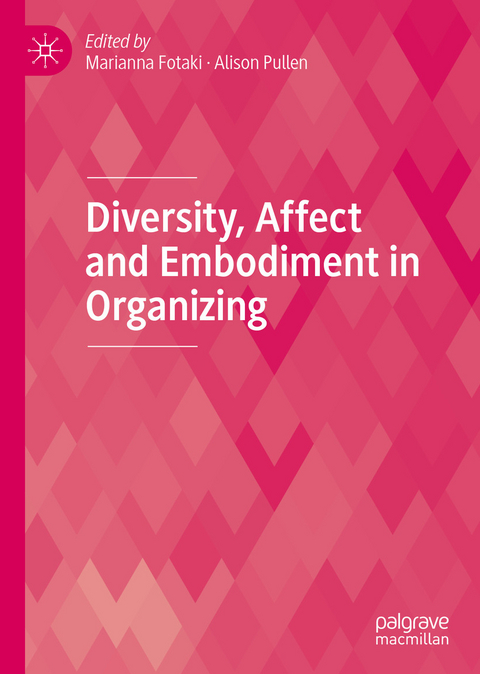
Diversity, Affect and Embodiment in Organizing (eBook)
XV, 335 Seiten
Springer International Publishing (Verlag)
978-3-319-98917-4 (ISBN)
Bringing together research from critical diversity studies and organization theory, this edited collection challenges unspoken norms and patterns of discrimination in organizational bodies. The authors problematize the management of diversity by focusing on the differentiations between racialized, aged, gendered and sexed bodies. By taking a fresh approach and placing the body at the forefront of power relations, this thought-provoking book seeks to challenge the homogenizing and oppressive dimensions of organizational governance, structure and culture that deny bodily difference. An insightful read for scholars of HRM, diversity management and organization, Diversity, Affect and Embodiment in Organizing encourages an active approach to tackling discrimination and recognizes the diversity of embodied lives.
Marianna Fotaki is Professor of Business Ethics at Warwick Business School, UK, and holds a visiting professorship at the University of Manchester. She has published over 40 papers on the marketization of public services, health inequalities, gender and otherness in organizations, and business in society in leading international journals.
Alison Pullen is Professor of Management and Organization Studies at Macquarie University, Sydney, Australia. Her primary research interests concern the dynamics of identity and gender as they play out in organizational settings. Alison's current writing also concerns the critical appraisal of feminism in organization and the development of feminist research methodologies.
Marianna Fotaki is Professor of Business Ethics at Warwick Business School, UK, and holds a visiting professorship at the University of Manchester. She has published over 40 papers on the marketization of public services, health inequalities, gender and otherness in organizations, and business in society in leading international journals. Alison Pullen is Professor of Management and Organization Studies at Macquarie University, Sydney, Australia. Her primary research interests concern the dynamics of identity and gender as they play out in organizational settings. Alison's current writing also concerns the critical appraisal of feminism in organization and the development of feminist research methodologies.
Preface 5
Contents 7
Notes on Contributors 10
List of Tables 14
1: Introducing Affective Embodiment and Diversity 15
The Diverse Goals of Diversity in Organizations 15
Why Embodiment and Affect Matters for Understanding Diversity? 19
Summary and Questions Addressed 20
Ways Forward 27
References 29
Part I: Theoretical Developments: Affect, Bodies and Diversity 34
2: The Political and Ethical Potential of Affective Resonance Between Bodies 35
Prologue 35
Introduction 37
Theorizing Affective Resonance Between Bodies 40
Political and Ethical Potential of Affective Resonance Between Bodies 41
Methodology 43
Setting 45
Management Seminar: Defensive Routines 47
Analysis 49
Co-subjective Circuit of Affects 50
Messy Entanglements of Psychological and Political Anxieties 51
Transgression of Rational Schemes and Organizational Economies 52
Vulnerability as Strength 53
Conclusion 54
References 56
3: Nurturing Bodies: Exploring Discourses of Parental Leave as Communicative Practices of Affective Embodiment 59
Identity/Difference 61
Communicative Practices of Affective Embodiment 62
The Affective Embodiment of Discourses of Parental Leave 64
Leaning In: The Working Mother 66
Leaning Out: The Caring Father 67
Opting Out: (Not) Your Average Mom 69
Opting In: Swedish Dads 70
Discussion—Or: What Is Left Out? 73
Conclusion: Global Embodiments? 75
References 76
4: Body-Sensitive Diversity Research Between Enablement and Disablement 80
Introduction 80
Diversity Research, Organization Theory, and ‘the Body’: An Ambivalent Relationship 82
Disability Studies and the Body: A Conflictual Relationship 85
The Establishment of Disability Studies 86
The Social Model of Disability and the Denied Body 88
The Cultural Model of Disability and the Insignificant Body 89
The Relational Model of Disability and the Acknowledged Body 90
Dis_ability and Embodiment: A Shimmering Relationship 91
Summary and Outlook 94
References 96
5: The Sick Body: Conceptualizing the Experience of Illness in Senior Leadership 101
Introduction 101
Defining the ‘Sick Body’ in Senior Leadership 103
The Corporate Athlete at Work 105
In Search of the Sick-Bodied Leader 109
Discussion and Conclusion 112
References 115
Part II: Empirical Studies of Diversity and Affective Embodiment 121
6: Uniform Matters: Body Possibilities of the Gendered Soldier 122
Introduction 122
Conceptual Framework: Affect Theory and Its Relevance for Studying Gendered Bodies in Organizations 124
Affect, Body, Discourse 126
The Affective Body and Body Possibilities 128
Methodology: Narrating Body Possibilities 131
Data Collection 131
Analytical Strategy 132
Analysis: Affective Figures of Body Possibilities 133
Becoming-Soldier 133
Becoming-Woman-Not-Soldier 137
Becoming-Soldier-Not-Woman 139
Becoming-Soldier-Woman 141
Concluding Discussion: Uniform Matters 143
References 145
7: Dancers as Inter-Corporeality: Breaking Down the Reluctant Body 148
Introduction 148
A Body’s Experience 149
Bodies in the Dance 153
Tales from the Dance Floor 156
Boundaries as Opportunities: Re-negotiating Order Through Questioning the Self and the Other 156
Re-inventing Gendered Selves Through Transcending Bodily Boundaries 158
Affective Bodily Fusion in a Space Between Freedom and Oppression 161
Discussion 162
References 166
8: Bounded Complexity of Bodily Realities: The (Dis)Embodiment of Elderly Lesbians 171
Introduction 171
Organized Body 174
Study Details and Method 179
Research Results on the Dis/Embodiment of Older Lesbians 180
Splitting of the Body into Parts 181
Machine Metaphor of the Body That Guides the Relationship of the Parts 183
Interweaving of Conceptual Schemes with Actual Institutional Arrangements 186
Deconstructive and Reconstructive Imprints 190
Discussion 193
Conclusion 195
References 196
9: The Embodiment of Otherness: Deconstructing Power Relations Between Staffing Agencies, Diverse Jobseekers, and Organizations in the Israeli Business Sector 203
Introduction 203
The Staffing Industry’s Central Position in the Labor Market 205
Agency Workers and Precarious Work 205
Workforce Diversity 207
Diversity and the Embodiment of Otherness 209
SAs’ Potential Effect on Workforce Diversity in Client Organizations 210
The Research Context: The Israeli Labor Market 210
Method 212
Sample 212
Data Collection and Analysis 212
Findings 213
SAs’ Dual Construction of Workforce Diversity via Their Pool of Applicants 213
SAs’ Dual Impact on Workforce Diversity via Practices Aimed at Their Client Organizations 216
Discussion 219
Practical Implications 224
Limitations and Suggestions for Future Research 225
References 226
10: Disembodied Senior Managers: The Perspective of Male Senior Managers in an Australian Hospitality Organisation 233
Introduction 233
Gendered Organisations and the “Disembodied Worker” 234
Methodology 240
Findings 242
Long-Hours Culture 242
Geographical Mobility 244
Support and Sponsorship 246
The Idea of Traditional Female Traits 247
Discussion 248
References 251
Part III: Critical Political Approaches on Affective Embodiment 254
11: Embodying the Social: Desire and Devo(r)ation at the Teatro Oficina 255
Organizing, Embodiment, and Affect 257
United by Anthropophagy: Organizing Between Bodies 259
Illustrative Case Study: Teat(r)o Oficina Uzyna Uzona 261
Anthropophagic Desire: From Taboo to Totem 263
Stages of Occupation: From Representation to Presence 265
In the Corridor of the Big Snake: Embodied Spaces and Urban Occupations 267
Discussion 269
Embodiment and Desire for the Other 270
Organizing Presence Versus Organizing Representation 271
Political Potentials and Pitfalls of Embodied Organizing 273
Conclusion 274
References 275
12: Affect, Diversity, and the Problem of Consolation in the Critique of Public Servant Identity 280
Introduction 280
The Affective Governmentality of Public Service as ‘Diverse’ Ground for Identity Work 283
The Problem of Consolation in the Critique of Neoliberal Diversity 288
First Step: On the Call for “A Public Servant Without Affection” 288
Second Step: On ‘Consolatory’ Critiques and the ‘Affected Researcher’ 293
Towards an ‘Inconsolable’ Approach to Affective Diversity 298
References 305
13: Reverie as Reflexivity 309
Introduction 309
Introducing Reverie 311
Tracing Example Reveries 317
Conclusion 329
References 330
Index 334
| Erscheint lt. Verlag | 6.12.2018 |
|---|---|
| Zusatzinfo | XV, 335 p. |
| Verlagsort | Cham |
| Sprache | englisch |
| Themenwelt | Wirtschaft ► Betriebswirtschaft / Management ► Personalwesen |
| Wirtschaft ► Betriebswirtschaft / Management ► Unternehmensführung / Management | |
| Schlagworte | Age • Body • critical diversity • Discrimination • Gender • Oppression • Organizational Management • Race • Social norms |
| ISBN-10 | 3-319-98917-0 / 3319989170 |
| ISBN-13 | 978-3-319-98917-4 / 9783319989174 |
| Informationen gemäß Produktsicherheitsverordnung (GPSR) | |
| Haben Sie eine Frage zum Produkt? |
 PDF (Wasserzeichen)
DRM: Digitales Wasserzeichen
Dieses eBook enthält ein digitales Wasserzeichen und ist damit für Sie personalisiert. Bei einer missbräuchlichen Weitergabe des eBooks an Dritte ist eine Rückverfolgung an die Quelle möglich.
Dateiformat: PDF (Portable Document Format)
Mit einem festen Seitenlayout eignet sich die PDF besonders für Fachbücher mit Spalten, Tabellen und Abbildungen. Eine PDF kann auf fast allen Geräten angezeigt werden, ist aber für kleine Displays (Smartphone, eReader) nur eingeschränkt geeignet.
Systemvoraussetzungen:
PC/Mac: Mit einem PC oder Mac können Sie dieses eBook lesen. Sie benötigen dafür einen PDF-Viewer - z.B. den Adobe Reader oder Adobe Digital Editions.
eReader: Dieses eBook kann mit (fast) allen eBook-Readern gelesen werden. Mit dem amazon-Kindle ist es aber nicht kompatibel.
Smartphone/Tablet: Egal ob Apple oder Android, dieses eBook können Sie lesen. Sie benötigen dafür einen PDF-Viewer - z.B. die kostenlose Adobe Digital Editions-App.
Buying eBooks from abroad
For tax law reasons we can sell eBooks just within Germany and Switzerland. Regrettably we cannot fulfill eBook-orders from other countries.
aus dem Bereich