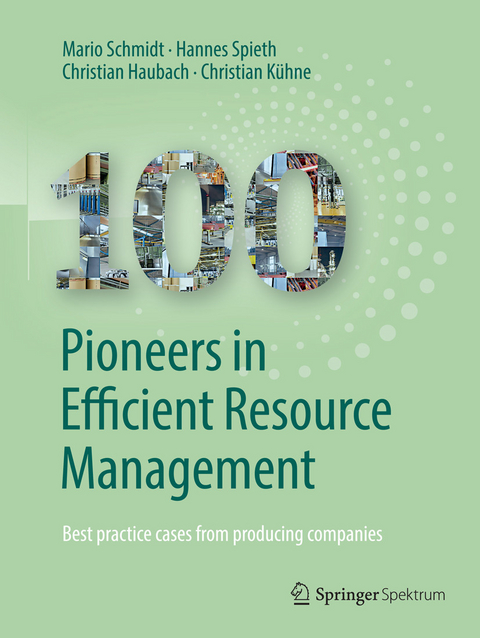
100 Pioneers in Efficient Resource Management (eBook)
530 Seiten
Springer Berlin Heidelberg (Verlag)
9783662567456 (ISBN)
The book presents about 100 current examples of how energy and materials can be saved in manufacturing companies. They serve to show which measures can be used in modern companies to exploit the potential for resource efficiency. The book is aimed at practitioners in companies and consulting firms, but is also suitable for the university sector as a practical introduction to the topic of resource efficiency. The materials used account for almost 43 percent of the costs of an average industrial company in Germany. Personnel costs, on the other hand, are only 22 percent, while energy costs are as low as 2 percent. If a company wants to save costs, above all it must consider the use of materials and produce in a resource-efficient manner. This simultaneously relieves the environment and reduces dependence on scarce raw materials. The implementation of resource efficiency is not easy. There are indeed numerous starting points in production, often in process innovations or in product development. However, only a few companies publish their measures and savings potentials. In practice, this means that there are often no learning examples in practice, but some of them are explicitly listed in this work. As you can see, resource efficiency in production and products can also be seen as a success factor for many companies. In the project 100 Pioneers in Efficient Resource Management, committed companies from
Baden-Wuerttemberg are showing their solutions. The project was carried out by a competent team from the Pforzheim University and the State Agency for Environmental Technology. Leading trade associations in Baden-Württemberg have supported it.
Prof. Dr. Mario Schmidt und Dr. Christian Haubach, beide Institut für Industrial Ecology (INEC), Hochschule Pforzheim; Dr. Hannes Spieth und Dr. Joa Bauer, beide Technologie- und Innovationszentrum Umwelttechnik und Ressourceneffizienz Baden-Württemberg GmbH, Böblingen
Prof. Dr. Mario Schmidt und Dr. Christian Haubach, beide Institut für Industrial Ecology (INEC), Hochschule Pforzheim; Dr. Hannes Spieth und Dr. Joa Bauer, beide Technologie- und Innovationszentrum Umwelttechnik und Ressourceneffizienz Baden-Württemberg GmbH, Böblingen
Introduction: Communicate about resource efficiency.- PART I - Introduction to the topic.- 1 Resource efficiency in the industrial society.- 2 approaches to operational resource efficiency.- 3 Methods and tools.- 4 Resource efficiency as an export product.- 5 The 100-company project.- PART II - Examples of companies.- Mining and quarrying.- Food industry.- Textile industry.- Wood industry.- Paper industry.- Chemical industry.- Pharmaceutical industry.- Rubber and plastics industry.- Manufacture of glass and ceramics.- Metal processing industry.- Precision mechanical industry.- Manufacture of measuring and control instruments.- Electrical industry.- Mechanical engineering.- Automotive industry.- Furniture industry.- Medical technology.- Energy supply.- Recycling industry.- Construction industry.- Appendix.
| Erscheint lt. Verlag | 4.12.2018 |
|---|---|
| Zusatzinfo | XXIV, 530 p. 600 illus. in color. |
| Verlagsort | Berlin |
| Sprache | englisch |
| Themenwelt | Naturwissenschaften ► Biologie |
| Naturwissenschaften ► Geowissenschaften | |
| Sozialwissenschaften ► Politik / Verwaltung | |
| Wirtschaft | |
| Schlagworte | Baden-Württemberg • Biotechnology • Case Studies • Ecology • energy efficiency • Nachhaltigkeit • Praxisbeispiele • Resource Efficiency |
| ISBN-13 | 9783662567456 / 9783662567456 |
| Informationen gemäß Produktsicherheitsverordnung (GPSR) | |
| Haben Sie eine Frage zum Produkt? |
 PDF (Wasserzeichen)
DRM: Digitales Wasserzeichen
Dieses eBook enthält ein digitales Wasserzeichen und ist damit für Sie personalisiert. Bei einer missbräuchlichen Weitergabe des eBooks an Dritte ist eine Rückverfolgung an die Quelle möglich.
Dateiformat: PDF (Portable Document Format)
Mit einem festen Seitenlayout eignet sich die PDF besonders für Fachbücher mit Spalten, Tabellen und Abbildungen. Eine PDF kann auf fast allen Geräten angezeigt werden, ist aber für kleine Displays (Smartphone, eReader) nur eingeschränkt geeignet.
Systemvoraussetzungen:
PC/Mac: Mit einem PC oder Mac können Sie dieses eBook lesen. Sie benötigen dafür einen PDF-Viewer - z.B. den Adobe Reader oder Adobe Digital Editions.
eReader: Dieses eBook kann mit (fast) allen eBook-Readern gelesen werden. Mit dem amazon-Kindle ist es aber nicht kompatibel.
Smartphone/Tablet: Egal ob Apple oder Android, dieses eBook können Sie lesen. Sie benötigen dafür einen PDF-Viewer - z.B. die kostenlose Adobe Digital Editions-App.
Buying eBooks from abroad
For tax law reasons we can sell eBooks just within Germany and Switzerland. Regrettably we cannot fulfill eBook-orders from other countries.
aus dem Bereich