


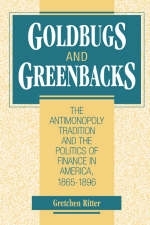
Goldbugs and Greenbacks
The Antimonopoly Tradition and the Politics of Finance in America, 1865–1896
Seiten
1997
Cambridge University Press (Verlag)
978-0-521-56167-9 (ISBN)
Cambridge University Press (Verlag)
978-0-521-56167-9 (ISBN)
This is a book about the late-nineteenth-century money debates in American politics, and about the role of history in American political development. Behind the discussions over gold versus silver and state versus national banks was a broader dialogue about sectionalism, class relations, and the future course of the American economy and democracy.
In the late-nineteenth century, there was a popular and heated debate over what sort of financial system America should have. Behind the discussions over gold versus silver and state versus national banks was a broader dialogue about sectionalism, class relations, and the future course of the American economy and democracy. Professor Ritter contends that there was a distinctive and neglected political tradition in the United States - the antimonopoly tradition - which was championed by nearly every major agricultural and labor group during the period from the Civil War until 1900. The book explains why the antimonopolists (including the National Labor Union, the Greenbackers, the Knights of Labor, and the Populists) saw the financial system as the key to maintaining economic opportunity and democratic control for all classes and regions.
In the late-nineteenth century, there was a popular and heated debate over what sort of financial system America should have. Behind the discussions over gold versus silver and state versus national banks was a broader dialogue about sectionalism, class relations, and the future course of the American economy and democracy. Professor Ritter contends that there was a distinctive and neglected political tradition in the United States - the antimonopoly tradition - which was championed by nearly every major agricultural and labor group during the period from the Civil War until 1900. The book explains why the antimonopolists (including the National Labor Union, the Greenbackers, the Knights of Labor, and the Populists) saw the financial system as the key to maintaining economic opportunity and democratic control for all classes and regions.
1. The money debate and American political development; 2. Party politics and the financial debate, 1865–1896; 3. Greenbacks versus gold: the contest over finance in the 1870s; 4. The 'people's money': Greenbackism in North Carolina, Illinois and Massachusetts; 5. The battle of the standards: the financial debate of the 1890s; 6. Populism and the politics of finance in North Carolina, Illinois and Massachusetts in the 1890s; 7. Money, history, and American political development; Appendix A. Financial terms of the 1870s and 1890s; Appendix B. Major banking and currency legislation, 1860–1900; Appendix C. An antimonopolist reading of L. Frank Baum's The Wonderful Wizard of Oz.
| Erscheint lt. Verlag | 13.3.1997 |
|---|---|
| Verlagsort | Cambridge |
| Sprache | englisch |
| Maße | 160 x 238 mm |
| Gewicht | 620 g |
| Themenwelt | Geschichte ► Allgemeine Geschichte ► Neuzeit (bis 1918) |
| Geisteswissenschaften ► Geschichte ► Regional- / Ländergeschichte | |
| Wirtschaft ► Betriebswirtschaft / Management ► Finanzierung | |
| ISBN-10 | 0-521-56167-1 / 0521561671 |
| ISBN-13 | 978-0-521-56167-9 / 9780521561679 |
| Zustand | Neuware |
| Informationen gemäß Produktsicherheitsverordnung (GPSR) | |
| Haben Sie eine Frage zum Produkt? |
Mehr entdecken
aus dem Bereich


aus dem Bereich
Geschichte einer wilden Handlung
Buch | Hardcover (2024)
C.H.Beck (Verlag)
CHF 47,60


