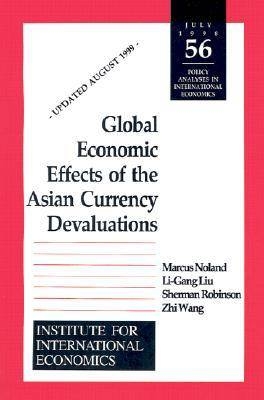
Global Economic Effects of the Asian Currency Devaluations
The Peterson Institute for International Economics (Verlag)
978-0-88132-260-6 (ISBN)
- Lieferbar (Termin unbekannt)
- Portofrei ab CHF 40
- Auch auf Rechnung
- Artikel merken
The Asian financial crisis has precipitated significant changes in real exchange rates in the region that will substantially alter the volume and pattern of international trade. The crisis countries will increase their exports and, especially, reduce their imports. Japan, China, and the other non-crisis countries will experience more complex changes. The trade balances of the United States and Western Europe will deteriorate by about $40-50 billion as a result of the currency movements in Asia. This study, newly updated in August 1999, quantifies the impact of the currency changes on the individual countries in Asia, on the United States, on Europe and on other regions on a sector-by-sector basis. It analyzes the additional impact that might occur if China, thus far a relative bystander in the crisis, were to devalue its currency as well. It then examines potential trade policy responses to these developments including the risk of an upsurge in protectionist pressure in the United States.
Li-Gang Liu was a visiting fellow at the Peterson Institute for International Economics. Named as "Economist of the Year" in 2012 by China Business News, Liu is chief economist for greater China at the Australia and New Zealand Banking Group (ANZ) in Hong Kong, and focusses on macroeconomics, foreign exchange, capital markets, and strategy research. Previously he was senior manager at the Research Department of the Hong Kong Monetary Authority, senior fellow at the Asian Development Bank Institute in Tokyo, economist in the Office of Chief Economist for the East Asian and Pacific Region at the World Bank Group, and research associate at PIIE. Marcus Noland, executive vice president and director of studies, has been associated with the Institute since 1985. From 2009 through 2012, he served as the Institute's deputy director. His research addresses a wide range of topics at the interstice of economics, political science, and international relations. His areas of geographical knowledge and interest include Asia and Africa where he has lived and worked, and the Middle East. In the past he has written extensively on the economies of Japan, Korea, and China, and is unique among American economists in having devoted serious scholarly effort to the problems of North Korea and the prospects for Korean unification. He won the 2000-01 Ohira Memorial Award for his book Avoiding the Apocalypse: The Future of the Two Koreas.
| Erscheint lt. Verlag | 1.7.1998 |
|---|---|
| Verlagsort | Washington |
| Sprache | englisch |
| Maße | 6 x 9 mm |
| Gewicht | 62 g |
| Themenwelt | Wirtschaft ► Betriebswirtschaft / Management ► Finanzierung |
| Betriebswirtschaft / Management ► Spezielle Betriebswirtschaftslehre ► Bankbetriebslehre | |
| Wirtschaft ► Volkswirtschaftslehre ► Finanzwissenschaft | |
| Wirtschaft ► Volkswirtschaftslehre ► Makroökonomie | |
| ISBN-10 | 0-88132-260-1 / 0881322601 |
| ISBN-13 | 978-0-88132-260-6 / 9780881322606 |
| Zustand | Neuware |
| Informationen gemäß Produktsicherheitsverordnung (GPSR) | |
| Haben Sie eine Frage zum Produkt? |
aus dem Bereich