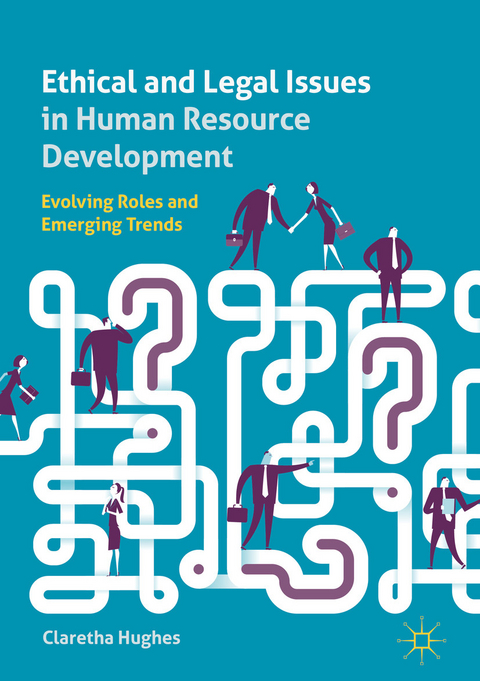
Ethical and Legal Issues in Human Resource Development (eBook)
XXIII, 146 Seiten
Springer International Publishing (Verlag)
9783319995281 (ISBN)
This book explores the role of HRD professionals in ethical and legal decision making in the workplace. While previous books have described the need for ethics in HRD, this book presents ways that HRD scholars and professionals can influence, through collaborative relationships, effective implementation of ethical policies and legal standards in the workplace. The ethical policies of an organization provide a key insight into its values, and this book shows the relationship between those values and HRD practices, such as training and development, career development, and organization development. Exploring such topics as protected classes, diversity intelligence, employee rights, and employee privacy, this book will inform HRD scholars and professionals on researching and enhancing ethical and legal decision making in the workplace.
Claretha Hughes is Professor of Human Resource and Workforce Development at the University of Arkansas, USA. She has over 27 years of diverse management, supervisory, and administrative experience in organizational and workforce development. She is a member of Association for Talent Development and has edited and published articles in Advances in Developing Human Resources, Human Resource Development Review, and Workforce Education Forum. She has written and edited 8 books. Her book Valuing People and Technology in the Workplace: A Competitive Advantage Framework won the R. Wayne Pace Book of the Year award in 2012. She has a PhD from Virginia Tech, USA and her MBA is from the Sam M. Walton College of Business at the University of Arkansas, USA.
Claretha Hughes is Professor of Human Resource and Workforce Development at the University of Arkansas, USA. She has over 27 years of diverse management, supervisory, and administrative experience in organizational and workforce development. She is a member of Association for Talent Development and has edited and published articles in Advances in Developing Human Resources, Human Resource Development Review, and Workforce Education Forum. She has written and edited 8 books. Her book Valuing People and Technology in the Workplace: A Competitive Advantage Framework won the R. Wayne Pace Book of the Year award in 2012. She has a PhD from Virginia Tech, USA and her MBA is from the Sam M. Walton College of Business at the University of Arkansas, USA.
Chapter 1: Introduction: Examining Ethical and Legal Issues in Human Resource Development
Chapter 2: Toward a More Specific and Collaborative Understanding of Ethical and Legal Issues in HRD
The collaborative role of HRD professionals in developing ethical and legal standards within organizations.
Recognizing the contributions of HRD professionals in developing ethical training programs and resources.
Economics of ethical and legal workplace policies
Conclusion
Chapter 3: Values and Decision-Making
The role of values, ethics, and ethical decision making in the workplace.
Historical views of ethics
Principles and theories of ethics
Ethical and unethical decision making
HRD through codes of ethics
Communication through codes of ethics
Accountability for ethical behavior
Ethical and legal issues as a core value of the organization
Conclusion
Chapter 4: Connecting Ethics and Diversity using Diversity Intelligence
Protected Class groups in the workplace
The role of self-awareness, buy-in, and diversity intelligence
Developing leader DQ using communication channels
Ethical and diversity training methodology
What role does power and privilege play in determining who is treated ethically and legally fair in the workplace?
Group power in the workplace
How do perceptions act as barriers affecting protected class groups?
The federal mandate of Affirmative Action
Assess the role of affirmative action in overall ethical evaluation
Conclusion
Chapter 5: Workplace Hiring and Retention
Hiring
Retention
Employee rights in the workplace
Differentiate between employee security and employer rights
Non-compete clauses and its impact on worker loyalty and company success
Downsizing within the workplace.
Conclusion
Chapter 6: Laws, Ethics, and Policies
Electronic monitoring in the workplace
Whistleblowing and its impact on organizations
Intellectual property rights and its impact on individuals and organizations
Conclusion
Chapter 7: Research Ethics, Governance, and the Future
Institutional Review Board (IRB), Freedom of Information Act (FOIA) and Research Ethics
Are HRD researchers and professionals practicing appropriate research ethics?
Training, education, and future trends
Governance
Conclusion
| Erscheint lt. Verlag | 30.10.2018 |
|---|---|
| Zusatzinfo | XXIII, 146 p. |
| Verlagsort | Cham |
| Sprache | englisch |
| Themenwelt | Wirtschaft ► Betriebswirtschaft / Management |
| Schlagworte | Diversity • Downsizing • employee rights • ethical decision making • HRD ethics • Human resource development • legal issues in HRD • Organizational values • Performance Improvement • Retention • training and development |
| ISBN-13 | 9783319995281 / 9783319995281 |
| Informationen gemäß Produktsicherheitsverordnung (GPSR) | |
| Haben Sie eine Frage zum Produkt? |
 PDF (Wasserzeichen)
DRM: Digitales Wasserzeichen
Dieses eBook enthält ein digitales Wasserzeichen und ist damit für Sie personalisiert. Bei einer missbräuchlichen Weitergabe des eBooks an Dritte ist eine Rückverfolgung an die Quelle möglich.
Dateiformat: PDF (Portable Document Format)
Mit einem festen Seitenlayout eignet sich die PDF besonders für Fachbücher mit Spalten, Tabellen und Abbildungen. Eine PDF kann auf fast allen Geräten angezeigt werden, ist aber für kleine Displays (Smartphone, eReader) nur eingeschränkt geeignet.
Systemvoraussetzungen:
PC/Mac: Mit einem PC oder Mac können Sie dieses eBook lesen. Sie benötigen dafür einen PDF-Viewer - z.B. den Adobe Reader oder Adobe Digital Editions.
eReader: Dieses eBook kann mit (fast) allen eBook-Readern gelesen werden. Mit dem amazon-Kindle ist es aber nicht kompatibel.
Smartphone/Tablet: Egal ob Apple oder Android, dieses eBook können Sie lesen. Sie benötigen dafür einen PDF-Viewer - z.B. die kostenlose Adobe Digital Editions-App.
Buying eBooks from abroad
For tax law reasons we can sell eBooks just within Germany and Switzerland. Regrettably we cannot fulfill eBook-orders from other countries.
aus dem Bereich