


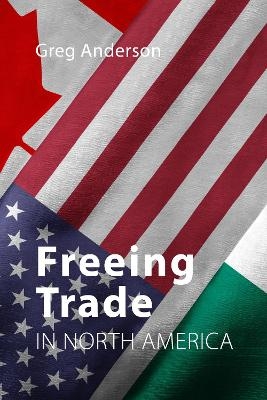
Freeing Trade in North America
Seiten
2019
Agenda Publishing (Verlag)
978-1-78821-061-4 (ISBN)
Agenda Publishing (Verlag)
978-1-78821-061-4 (ISBN)
A concise analysis and overview of the trilateral trade agreements – NAFTA and its successor USCMA – that have created one of the largest trade blocs in the world.
Conceived in an era of rapid post-Cold War economic liberalization, the North American Free Trade Agreement (NAFTA), signed in 1994, brought together Canada, Mexico and the United States with the aim of creating a regional trade bloc that eliminated the friction and costs of trade between the three nations.
Without an overarching institutional framework, NAFTA never sought to attain the levels of integration achieved by the European Union – for many it was a missed opportunity – and never quite fulfilled its potential as a single market. And under Trump’s administration a trilateral trade agreement has become increasingly precarious.
This book provides an overview of NAFTA and its successor the USCMA, explaining the theory behind the politics and economics of trade in North America. It offers an accessible and concise analysis of the key provisions, shortcomings and past revision efforts of the governments involved.
At a time of increasing protectionism and heightened awareness of trading relationships, the book highlights the lessons to be learnt from the fraught history of one of the largest trade blocs in the world.
Conceived in an era of rapid post-Cold War economic liberalization, the North American Free Trade Agreement (NAFTA), signed in 1994, brought together Canada, Mexico and the United States with the aim of creating a regional trade bloc that eliminated the friction and costs of trade between the three nations.
Without an overarching institutional framework, NAFTA never sought to attain the levels of integration achieved by the European Union – for many it was a missed opportunity – and never quite fulfilled its potential as a single market. And under Trump’s administration a trilateral trade agreement has become increasingly precarious.
This book provides an overview of NAFTA and its successor the USCMA, explaining the theory behind the politics and economics of trade in North America. It offers an accessible and concise analysis of the key provisions, shortcomings and past revision efforts of the governments involved.
At a time of increasing protectionism and heightened awareness of trading relationships, the book highlights the lessons to be learnt from the fraught history of one of the largest trade blocs in the world.
Greg Anderson is Professor in the Department of Political Science at the University of Alberta. He is co-editor of Regional Governance in Post-NAFTA North America (2015).
1. The North American idea2. What the NAFTA is (and is not)3. North America as region4. New ground broken and (mixed?) results5. Much ado about foreign direct investment6. Governance in the NAFTA, or lack thereof?7. Labour and the environment8. NAFTA 2.0: did the USMCA modernize anything?
| Erscheinungsdatum | 10.05.2021 |
|---|---|
| Verlagsort | Newcastle upon Tyne |
| Sprache | englisch |
| Maße | 156 x 234 mm |
| Themenwelt | Wirtschaft ► Volkswirtschaftslehre ► Wirtschaftspolitik |
| ISBN-10 | 1-78821-061-1 / 1788210611 |
| ISBN-13 | 978-1-78821-061-4 / 9781788210614 |
| Zustand | Neuware |
| Informationen gemäß Produktsicherheitsverordnung (GPSR) | |
| Haben Sie eine Frage zum Produkt? |
Mehr entdecken
aus dem Bereich


aus dem Bereich
Wohlstand, Wachstum, Wettbewerb
Buch | Softcover (2025)
Kohlhammer (Verlag)
CHF 68,90
mit Marx, Menger und Marshall durch die Grundlagen der Ökonomie
Buch | Hardcover (2025)
De Gruyter Oldenbourg (Verlag)
CHF 62,90
Buch | Softcover (2025)
Europa-Lehrmittel (Verlag)
CHF 44,90


