


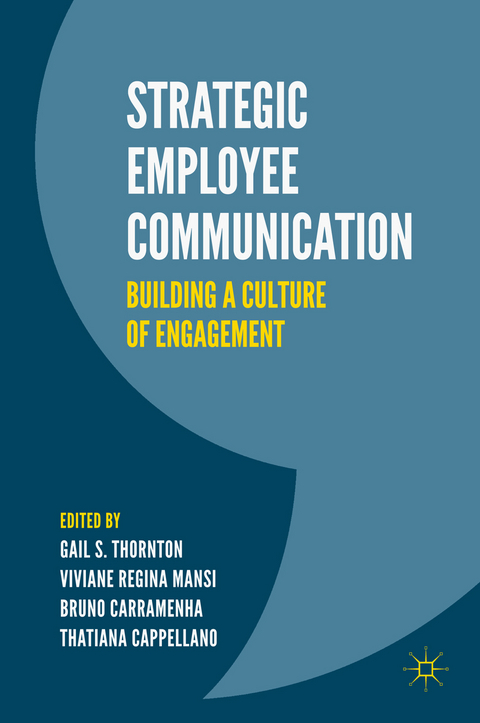
Strategic Employee Communication (eBook)
XXIX, 321 Seiten
Springer International Publishing (Verlag)
9783319978949 (ISBN)
Employee engagement (or a lack thereof) can often be linked to poor communication and a detachment from company goals. Companies of all sizes are looking for ways to boost communication, recognizing its impact on key business outcomes, such as productivity and profitability.
This book offers fresh insights about opportunities to improve the quality of employee communications based on employees' needs. It highlights the importance of simple, jargon-free communication that focuses on dialogue and content. High-performing organizations are more likely to think about communication from the audience perspective, rather than purely from the management perspective. The case studies offer readers a firm understanding of ways to implement and measure communication in daily practice. Effective communication requires planning and this book, with its focus on the US, Latin America, and emerging markets, will guide readers in using communication in the alignment of corporate and employee needs.
Gail S. Thornton, a global communications executive with international experience in pharmaceuticals, now maintains a consulting practice in pharmaceuticals/health care and biotechnology.
Viviane Mansi is global head of corporate communications and branding for Votorantim Cimentos, one of the largest cement companies in the world, headquartered in Brazil.
Bruno Carramenha is a professor of communication and public relations at leading universities in Brazil and also a consultant in organizational culture and communications issues.
Thatiana Cappellano is a communications and public relations consultant, who works with major companies in Brazil concerning organizational culture and communications issues.
Gail S. Thornton, a global communications executive with international experience in pharmaceuticals, now maintains a consulting practice in pharmaceuticals/health care and biotechnology. Viviane Mansi is global head of corporate communications and branding for Votorantim Cimentos, one of the largest cement companies in the world, headquartered in Brazil. Bruno Carramenha is a professor of communication and public relations at leading universities in Brazil and also a consultant in organizational culture and communications issues. Thatiana Cappellano is a communications and public relations consultant, who works with major companies in Brazil concerning organizational culture and communications issues.
Foreword 5
Preface 9
Contents 13
Notes on Contributors 17
List of Figures 25
List of Tables 28
Part I Organizational Culture 29
1 The Incoherence of a Solid Organizational Culture for Liquid Employees 30
The Role of Work to the Subject 31
The Solid Modernity of Organizational Culture 35
The Liquid Employee 40
Final Considerations 47
References 48
2 Bodymedia Theory: A Value Proposition for Organizational Culture 50
The Experience of the Body in Capitalism 51
Biopolitical Summonings 51
The Body Within Employee Communication Practices 54
What Is Bodymedia Theory? 58
Considerations 61
References 62
3 Organizational Ethics: The Challenges Faced by Communication and Culture to Change Behaviors 63
Strategic Role of the Communication Professional 65
The Will and Example of Leaders 67
License or Historic Justification 68
Coherent Communication 69
Aligned Management Practices 70
Informal Narratives 71
Our Challenge 72
References 72
4 Leadership Communications with an Appreciative Approach in a Participative Culture: The Case of Nutrimental 74
Integrated Organizational Communications 75
Leadership Communications and Appreciative Leadership 77
Appreciative Inquiry 78
Case Study Methodology 80
References 84
5 WhatsApp and the Mediatization of Informal Communication in Organizations 85
Contemporaneity and Mediatization 85
Digital Media 87
Employee Communication and Its Importance Within Organizations 88
Informal Communication 90
WhatsApp and Informal Communication 92
Main Features 93
Evidence: Empirical Observations 94
The President’s Last Name 95
Final Considerations 96
References 97
6 Diversity Management: An Overlook on Brazil’s Largest Companies 99
Diversity Management 101
Methodology 103
Results 105
Finding #1: Diversity Matters, but Is Not Relevant 105
Finding #2: An Empty Speech, a Poor Experience 106
Finding #3: There Is Diversity, but It Is Waiting to Be Embraced 107
Finding #4: With Constant Prejudice, Tolerance Is Confused with Inclusion 108
Finding #5: Oblivious, Absent, and Sarcastic Leadership 109
Finding #6: Diversity: How Much Is It Worth 111
Final Considerations 112
References 112
7 Behind Every Engagement There Is Always a Good Story 114
Storytelling to Help Support Functions and Business Areas 116
Reference 118
8 Employer Branding, Employee Value Proposition, and Employee Experience: New Approaches for People Management in Organizations 119
Why Employer Branding? 119
Branding & Brand Equity: Foundations
Employer Branding: Concepts 121
The Employee Value Proposition (EVP) 121
Employer Branding and Employee Experience: What You See, What You Get 122
What Is Next 124
Bibliography 124
Part II Leadership and Engagement 126
9 Internal Communications Flourishes at the Grassroots: The Growing Importance of Managers in Employee Engagement 127
The More Employees Feel Informed and Engaged, the Better 128
Meeting the Challenges of Employee Engagement 130
(Appropriate) Content is King 130
Case Study 132
Building Global Internal Communications for Emerging Markets 132
Continuity: It is Never Really “Done” 134
Case Study 134
Engaging Employees in Change at the Country Level 134
Conversation: It Must Be a Two-Way Street 135
Case Study 136
Reinforcing Corporate Culture Through Top-Down and Bottom-Up Employee Engagement 136
Overcoming the Challenges of Employee Engagement 138
References 139
10 Work, Motivation, and Monday Mornings 141
Motivation 142
Purpose 145
Ownership 147
Self-Awareness 149
11 Building Trust from the Inside Out: Employees and Their Power of Influence 153
What Is Trust? 153
Edelman Trust Barometer Survey 155
Trust as a Key Element of Communication 158
What’s Next? 163
12 Leadership Communications, Dialogue, and Communications Areas: New Paths for Employee Communications 166
Does Involving Leaders Make Sense? 168
A Matter of Dialogue 169
The Role of Communications Areas 171
13 Social Team Building as a Practice of Corporate Values to Achieve Engagement 174
Complexity “in” and of “Relations” 176
Communication, Leadership, and Engagement in Organizations 177
Humanization in Organizations 179
Social Team Building, Team Interaction, and Empowerment Through Social Impact Action 180
A Leadership Engagement Experience 183
Engaging, Sharing Values and Purpose 185
References 186
14 Humanized Employee Communications: The Possible Contributions of Public Relations in the BIOFAST Group Experience 187
The Importance of the Human and Intellectual Capital for the Organizations in the Twenty-First Century 189
Case: BIOFAST Group 191
References 196
Part III Planning and Measurement 197
15 Employee Communications Management: The Role of Planning and Communication Channels 198
Maturity Levels 200
Planning 202
Steps of Planning (as a Product) 204
Communications Channels 205
References 207
16 The Maturity Matrix for Employee Communications: Paving the Way for a New Model of Organizational Communications 208
Current Challenges in Employee Communications 208
Motivations, Aspirations, and Objectives 209
Maturity Matrix Drivers 210
Tactical Driver 210
Strategic Driver 211
Political Driver 211
Premises 212
Maturity Levels 212
Maturity Level 1: Tactical—Suppressed Demand 212
Tactical Drivers 212
Strategic Drivers 213
Political Drivers 216
Maturity Level 2: Tactical—Demand Oriented 216
Tactical Drivers 216
Strategic Drivers 217
Political Drivers 217
Maturity Level 3: Consultant 218
Tactical Drivers 218
Strategic Drivers 219
Political Drivers 219
Maturity Level 4: Strategist 220
Tactical Drivers 220
Strategic Drivers 221
Political Drivers 221
Maturity Level 5: Advisor 222
Tactical Drivers 222
Strategic Drivers 222
Political Drivers 223
Using the Maturity Matrix to Ascertain Current Maturity Level 223
Conclusions 224
17 Planning and Measurement: Propositions for the Strategic Work of Employee Communications 225
Multiple Approaches to Complex Challenges 226
Planning and Leadership 227
Research 227
Leadership Engagement 228
Reputation 230
Planning 231
Mission 232
Business Scenario 233
Internal and External Analysis 233
Objectives 234
Strategies 234
Assessment 235
Indicators Definition 235
Measuring the Strategy 237
The Bad News 238
References 239
18 Communication Measurement as a Key Factor for Organizational Strategy Success 241
How to Plan and Measure Communications? 243
Putting the Plan into Practice 246
Identify Organizational Goals 247
Identify Target Audiences 247
Establish KPIs for Each Objective, as Well as Short-Term Targets 248
Choose Tools for Control and Benchmark 248
Analyze Results 248
Present Results to the Company Board 249
Continually Measure to Enhance Performance 249
References 252
19 On the Imperative of Planning Employee Communications: Theoretical Considerations and the Case Study of Vale 253
When Planning Makes a Difference 255
Planning vs. Opportunity: The Fine Art of Finding a Balance 260
Employee Communications Plans in Practice 261
Communicating and Building Relationships with Internal Stakeholders Universo Vale 262
Background 262
Objectives 263
Stakeholders 263
Planning and Execution 263
Results 266
Key Figures 267
Conclusions 268
References 269
20 Simplification to Drive Relevance: GE’s Moment of “Letting Go” 270
In Practice: What We Are Letting Go Of 271
Inspiration to Join the “Letting Go” Movement 272
21 Communications Agencies in Practice: Reflections and Stories from Working with Clients in Employee Communications Projects 274
Operational vs. Strategic: What Is the Current Role of Employee Communications in Your Company? 275
Part IV Channels and Campaigns 288
22 On Employee Communications Channels and Campaigns 289
Positioning Employee Communications 290
Employee Communications Channels and Their Uses 291
Communications Campaigns 293
Conclusions 294
23 Corporate Mobile Communication: Challenges and Reflections in an Environment of Connected Employees 296
Work Environment and Employees’ Relationships 296
Recent Technological Innovations at the Service of Communication 298
Cell Phones 299
Tablets 299
Programs for Mobile Communication 300
Digital Context on Internal Communication: Concepts, Practices, and Impacts 300
Risks and Challenges for Mobile Internal Communication 305
References 307
24 An Employee Communications Strategy to Support the Launch of a New Business Strategy 308
Background 308
The Healthcare System and Pharmaceutical Market in Mexico 309
Factors Influencing the Lack of Growth in the Mexican Pharmaceutical Market 310
Drug Distribution, Demand Generation, and Pricing 311
New Public Policy for the Purchase of Medicine 311
A New Sales Strategy and Business Vision 311
Lack of Credibility Among Employees About the New Business Plan 312
The Challenge: To Invest or Not to Invest in Communications? 312
Restructuring Announcement and Impact on Job Posts 313
New Business Strategy 313
Communications Scheme 313
Visual Identity 313
Objective 314
Strategy 314
Communications Materials 314
Kick Off 314
Meetings with Functional Leaders 315
New Technologies 315
Communications Channels 315
Results 315
Conclusions/Recommendations 316
25 Rituals and the Leaderships: Cases of Strategic Use of Communication Campaigns for the Employees 317
Case 1: Either You Put the Students in the Classroom, or We Will End Your Course 318
Case 2: Our Product Is Not Allowed Within Our Own Company 320
Case 3: I Would Never Allow Defective Production of Goods in My Shift! 322
Index 326
| Erscheint lt. Verlag | 6.10.2018 |
|---|---|
| Zusatzinfo | XXIX, 321 p. 13 illus. |
| Verlagsort | Cham |
| Sprache | englisch |
| Original-Titel | Ensaios Sobre Comunicacao Com Empregados: Multiplas Abordagens Para Desafios Complexos |
| Themenwelt | Wirtschaft ► Betriebswirtschaft / Management ► Marketing / Vertrieb |
| Wirtschaft ► Betriebswirtschaft / Management ► Personalwesen | |
| Wirtschaft ► Betriebswirtschaft / Management ► Unternehmensführung / Management | |
| Schlagworte | Appreciative Inquiry • Corporate Values • Employee engagement • Employee well-being • Leadership Communication • Organizational Culture • Organizational ethics • Social Media • strategic communications • team buidling |
| ISBN-13 | 9783319978949 / 9783319978949 |
| Informationen gemäß Produktsicherheitsverordnung (GPSR) | |
| Haben Sie eine Frage zum Produkt? |
 PDF (Wasserzeichen)
DRM: Digitales Wasserzeichen
Dieses eBook enthält ein digitales Wasserzeichen und ist damit für Sie personalisiert. Bei einer missbräuchlichen Weitergabe des eBooks an Dritte ist eine Rückverfolgung an die Quelle möglich.
Dateiformat: PDF (Portable Document Format)
Mit einem festen Seitenlayout eignet sich die PDF besonders für Fachbücher mit Spalten, Tabellen und Abbildungen. Eine PDF kann auf fast allen Geräten angezeigt werden, ist aber für kleine Displays (Smartphone, eReader) nur eingeschränkt geeignet.
Systemvoraussetzungen:
PC/Mac: Mit einem PC oder Mac können Sie dieses eBook lesen. Sie benötigen dafür einen PDF-Viewer - z.B. den Adobe Reader oder Adobe Digital Editions.
eReader: Dieses eBook kann mit (fast) allen eBook-Readern gelesen werden. Mit dem amazon-Kindle ist es aber nicht kompatibel.
Smartphone/Tablet: Egal ob Apple oder Android, dieses eBook können Sie lesen. Sie benötigen dafür einen PDF-Viewer - z.B. die kostenlose Adobe Digital Editions-App.
Buying eBooks from abroad
For tax law reasons we can sell eBooks just within Germany and Switzerland. Regrettably we cannot fulfill eBook-orders from other countries.
aus dem Bereich


