


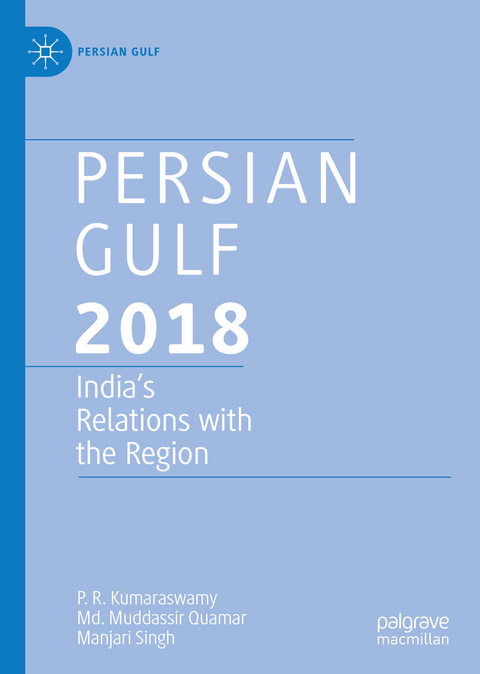
Persian Gulf 2018 (eBook)
XXII, 254 Seiten
Springer Singapore (Verlag)
978-981-13-1978-5 (ISBN)
P. R. Kumaraswamy is a professor of contemporary Middle East studies in Jawaharlal Nehru University (JNU), New Delhi. From 1992-1999 he was a research fellow at the Harry S., Truman Research Institute for the Advancement of Peace, Jerusalem. Since joining JNU in September 1999, he has been researching, teaching, and writing on various aspects of the contemporary Middle East. His works include Squaring the Circle: Mahatma Gandhi and the Jewish National Home (2018); India's Israel Policy (2010); and Historical Dictionary of the Arab Israeli Conflict (2015, second edition). Prof. Kumaraswamy has edited a number of volumes and published research articles in international journals. In October 2009 he set up the virtual Middle East Institute, New Delhi and serves as its honorary director. He is also the editor of Contemporary Review of the Middle East andthe series editor of Persian Gulf: India's Relations with the Region.
Md. Muddassir Quamar is Associate Fellow in the Institute for Defence Studies & Analyses, New Delhi. He holds a Ph.D. in Middle East studies from Jawaharlal Nehru University. His doctoral thesis examined social developments in Saudi Arabia between 1991 and 2010 within a conceptual framework of Islamic modernism. Dr. Quamar's areas of interest include Politics & Societies in the Gulf, Middle East Strategic Affairs, and Political Islam. His research papers have appeared in leading international journals such as Contemporary Arab Affairs, Digest of Middle East Studies, Journal of Arabian Studies and Journal of South Asian and Middle Eastern Studies. He has co-edited an anthology titled Contemporary Persian Gulf: Essays in Honour of Gulshan Dietl, Prakash C. Jain and Girijesh Pant, contributed chapters to edited volumes and regularly contributes opinion articles on strategic developments in Middle East and India-Gulf relations. Dr. Quamar was has been a visiting fellow in King Faisal Center for Research and Islamic Studies, Riyadh and serves as Associate Editor of Contemporary Review of the Middle East.
Manjari Singh is doctoral candidate and Ryoichi Sasakawa Young Leaders Fellowship Fund (SYLFF) Fellow at the Centre for West Asian Studies, Jawaharlal Nehru University, New Delhi, India. She has published research articles in peer-reviewed journal such as Contemporary Review of the Middle East, Mediterranean Quarterly and Migration and Development. She is a co-editor of Islamic Movements in Middle East (Forthcoming).
The Persian Gulf 2018 is sixth in the series published by MEI@ND and examines India's bilateral relations with the countries along the Persian Gulf, namely, Bahrain, Iran, Iraq, Kuwait, Oman, Qatar, Saudi Arabia, UAE and Yemen. It focuses on developments during 2017 and offers a comprehensive account of the strategic, political, economic and cultural aspects of bilateral developments along with specific policy recommendations for India.The book also provides an in-depth analysis of internal dynamics of these countries.
P. R. Kumaraswamy is a professor of contemporary Middle East studies in Jawaharlal Nehru University (JNU), New Delhi. From 1992-1999 he was a research fellow at the Harry S., Truman Research Institute for the Advancement of Peace, Jerusalem. Since joining JNU in September 1999, he has been researching, teaching, and writing on various aspects of the contemporary Middle East. His works include Squaring the Circle: Mahatma Gandhi and the Jewish National Home (2018); India’s Israel Policy (2010); and Historical Dictionary of the Arab Israeli Conflict (2015, second edition). Prof. Kumaraswamy has edited a number of volumes and published research articles in international journals. In October 2009 he set up the virtual Middle East Institute, New Delhi and serves as its honorary director. He is also the editor of Contemporary Review of the Middle East andthe series editor of Persian Gulf: India’s Relations with the Region. Md. Muddassir Quamar is Associate Fellow in the Institute for Defence Studies & Analyses, New Delhi. He holds a Ph.D. in Middle East studies from Jawaharlal Nehru University. His doctoral thesis examined social developments in Saudi Arabia between 1991 and 2010 within a conceptual framework of Islamic modernism. Dr. Quamar’s areas of interest include Politics & Societies in the Gulf, Middle East Strategic Affairs, and Political Islam. His research papers have appeared in leading international journals such as Contemporary Arab Affairs, Digest of Middle East Studies, Journal of Arabian Studies and Journal of South Asian and Middle Eastern Studies. He has co-edited an anthology titled Contemporary Persian Gulf: Essays in Honour of Gulshan Dietl, Prakash C. Jain and Girijesh Pant, contributed chapters to edited volumes and regularly contributes opinion articles on strategic developments in Middle East and India-Gulf relations. Dr. Quamar was has been a visiting fellow in King Faisal Center for Research and Islamic Studies, Riyadh and serves as Associate Editor of Contemporary Review of the Middle East. Manjari Singh is doctoral candidate and Ryoichi Sasakawa Young Leaders Fellowship Fund (SYLFF) Fellow at the Centre for West Asian Studies, Jawaharlal Nehru University, New Delhi, India. She has published research articles in peer-reviewed journal such as Contemporary Review of the Middle East, Mediterranean Quarterly and Migration and Development. She is a co-editor of Islamic Movements in Middle East (Forthcoming).
1 Introduction2 Bahrain3 Iran4 Iraq5 Kuwait6 Oman7 Qatar8 Saudi Arabia9 UAE10 Yemen11 GCC12 Policy Options
| Erscheint lt. Verlag | 4.10.2018 |
|---|---|
| Reihe/Serie | Persian Gulf | Persian Gulf |
| Zusatzinfo | XXII, 254 p. 46 illus. |
| Verlagsort | Singapore |
| Sprache | englisch |
| Themenwelt | Sozialwissenschaften ► Politik / Verwaltung ► Europäische / Internationale Politik |
| Sozialwissenschaften ► Politik / Verwaltung ► Politische Systeme | |
| Wirtschaft ► Betriebswirtschaft / Management ► Unternehmensführung / Management | |
| Wirtschaft ► Volkswirtschaftslehre ► Makroökonomie | |
| Wirtschaft ► Volkswirtschaftslehre ► Wirtschaftspolitik | |
| Schlagworte | Gulf Cooperation Council • Middle East-India • Middle East politics • Migration • persian gulf • Trade and Economics |
| ISBN-10 | 981-13-1978-2 / 9811319782 |
| ISBN-13 | 978-981-13-1978-5 / 9789811319785 |
| Informationen gemäß Produktsicherheitsverordnung (GPSR) | |
| Haben Sie eine Frage zum Produkt? |
 PDF (Wasserzeichen)
DRM: Digitales Wasserzeichen
Dieses eBook enthält ein digitales Wasserzeichen und ist damit für Sie personalisiert. Bei einer missbräuchlichen Weitergabe des eBooks an Dritte ist eine Rückverfolgung an die Quelle möglich.
Dateiformat: PDF (Portable Document Format)
Mit einem festen Seitenlayout eignet sich die PDF besonders für Fachbücher mit Spalten, Tabellen und Abbildungen. Eine PDF kann auf fast allen Geräten angezeigt werden, ist aber für kleine Displays (Smartphone, eReader) nur eingeschränkt geeignet.
Systemvoraussetzungen:
PC/Mac: Mit einem PC oder Mac können Sie dieses eBook lesen. Sie benötigen dafür einen PDF-Viewer - z.B. den Adobe Reader oder Adobe Digital Editions.
eReader: Dieses eBook kann mit (fast) allen eBook-Readern gelesen werden. Mit dem amazon-Kindle ist es aber nicht kompatibel.
Smartphone/Tablet: Egal ob Apple oder Android, dieses eBook können Sie lesen. Sie benötigen dafür einen PDF-Viewer - z.B. die kostenlose Adobe Digital Editions-App.
Buying eBooks from abroad
For tax law reasons we can sell eBooks just within Germany and Switzerland. Regrettably we cannot fulfill eBook-orders from other countries.


