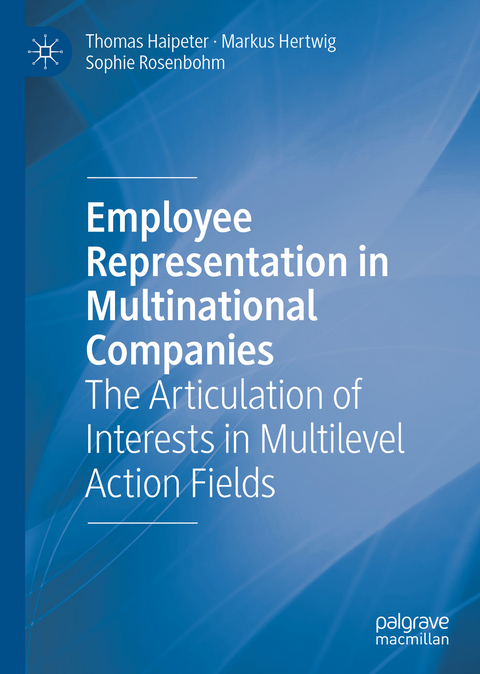
Employee Representation in Multinational Companies (eBook)
XI, 294 Seiten
Springer International Publishing (Verlag)
9783319975597 (ISBN)
Investigating the issue of employee representation in multinational companies (MNCs), this book sets out to systematically conceptualise the modes of articulation between different action fields. While previous studies have focused on forms of employee representation that have emerged throughout recent decades, rather little is known about the interaction and coordination of representational bodies and actors, such as trade unions and European or World Works Councils. Given the growing importance of transnational restructuring in MNCs, understanding the conditions under which employees are able to participate in company decision-making is a crucial issue. Based on empirical case studies and interviews with employee representatives from ten countries across Europe, the authors investigate the role of representational bodies in periods of company restructuring. Proposing a shift in perspectives in research on transnational labour relations and bringing new insights into structures and practices of employee representation in MNCs, this book will be a valuable read for both scholars and practitioners.
Thomas Haipeter is Head of the research unit Working Time and Work Organisation at the Institute for Work, Skills and Training (IAQ) at the University of Duisburg-Essen, Germany. His research interests involve industrial relations, work organisation, transnationalisation and digitalisation. He is member of several professional associations.
Markus Hertwig is Professor of Sociology at Chemnitz University of Technology, Germany. His research focuses on industrial relations and the digitalisation of work and organisations. He is a board member of the German Industrial Relations Association (GIRA).
Sophie Rosenbohm is a post-doctoral researcher at the Institute for Work, Skills and Training (IAQ) at the University of Duisburg-Essen, Germany. Her research interests revolve around industrial relations, sociology of work and organisations, and research methods. She is co-editor of the refereed journal Industrielle Beziehungen (The German Journal of Industrial Relations).
Thomas Haipeter is Head of the research unit Working Time and Work Organisation at the Institute for Work, Skills and Training (IAQ) at the University of Duisburg-Essen, Germany. His research interests involve industrial relations, work organisation, transnationalisation and digitalisation. He is member of several professional associations. Markus Hertwig is Professor of Sociology at Chemnitz University of Technology, Germany. His research focuses on industrial relations and the digitalisation of work and organisations. He is a board member of the German Industrial Relations Association (GIRA). Sophie Rosenbohm is a post-doctoral researcher at the Institute for Work, Skills and Training (IAQ) at the University of Duisburg-Essen, Germany. Her research interests revolve around industrial relations, sociology of work and organisations, and research methods. She is co-editor of the refereed journal Industrielle Beziehungen (The German Journal of Industrial Relations).
Preface 5
Contents 7
List of Figures 9
List of Tables 10
1: Introduction: Transnational Interest Representation and the Articulation of Employee Interests 11
Multi-level Systems as an Action Problem for Transnational Employee Representation 11
Articulation and EWC Research 15
Interests, Identity, Culture, and Solidarity 20
Aim and Structure of This Study 23
References 25
2: Articulation, Structuration, and Action Fields: Theoretical Approaches 29
Employee Representation in a Multi-level System 29
Structuration and Action Fields 30
The Action Fields of Interest Representation 34
The Concept of Articulation 38
Elements of Articulation 43
Four Patterns of Articulation 45
References 52
3: Research Strategy and Design 56
Choosing the Case Studies 56
Interviews 61
Structures of International Bodies 66
Case-Study Descriptions 67
‘Bank’ 67
‘Cars’ 70
‘Chemicals’ 73
‘MedTech’ 75
‘Postal Services’ 77
‘Power’ 78
‘Rubber’ 80
‘Synthetic’ 81
‘Transport’ 83
‘Wholesale’ 85
References 86
4: Patterns of Articulation 87
Types of Articulation and the Case-Study Sample 87
Comprehensive Articulation 90
Objects of Articulation 90
Interest Articulation During Restructuring 92
‘Cars’ 92
‘Chemicals’ 95
‘Power’ 98
Key Actors 101
Resources and Sources of Power 107
Interpretations and Interests 116
Summary 126
Fragmented Coordination 127
Objects of Articulation 127
Interest Articulation During Restructuring 128
‘Synthetic’ 128
‘Postal Services’ 134
‘Transport’ 138
Key Actors 140
Resources and Sources of Power 144
Interpretations and Interests 147
Summary 149
International Integration 150
Objects of Articulation 150
Interest Articulation During Restructuring 152
‘Rubber’ 152
‘MedTech’ 155
‘Bank’ 156
Key Actors 160
Resources and Sources of Power 166
Interpretations and Interests 170
Summary 176
Disarticulation 178
Objects of Articulation 178
Interest Articulation During Restructuring 179
Key Actors 181
Resources and Sources of Power 182
Interpretations and Interests 185
Summary 188
References 190
5: Varieties of Articulation: Interest Representation in Multinational Companies at National and Local Level 191
Introduction 191
The Diversity of Interest Representation 194
National and Local Interest Articulation in the Case-Study Companies 197
Employee Representation in Germany 200
Interest Representation Structures and Levels 200
Board-Level Employee Representation 205
Interest Representation in Other Home and Host Countries 209
Workplace and Trade Union Employee Representation 209
Levels of Employee Representation 211
Trade Union Pluralism 215
Differences in Resources 217
Feedback Effects of Transnational Employee Representation 219
Information 219
Regulations, Agreements, and Resources 223
Summary 228
References 230
6: Patterns of Articulation Between Transnational Workplace Employee Representatives and Trade Unions: Coordination and Trade Union Networks 233
Introduction 233
Trade Union Articulation Structures at the Case-Study Companies 236
Articulation by Trade Union Coordinators 238
Coordination by European Branch-Level Union Federations 243
Trade Union Networks 244
Trade Union Network at ‘Bank’ 244
Trade Union Network at ‘Cars’ 248
Summary 255
References 257
7: Articulation Practices in Comparison: Patterns, Conditions, and Outcomes of Employee Interest Representation 258
Forms of Coordination and Integration: Patterns of Articulation in Comparison 258
Forms of Coordination 260
Forms of Integration 265
Dimensions of Articulation 268
Key Actors 269
Power and Resources 272
Interpretations and Interests 276
Context and Conditions of Articulation 279
Articulation and Negotiation Practice: Outcomes of Employee Representation 284
Conclusion and Prospects 290
References 294
Index 296
| Erscheint lt. Verlag | 26.9.2018 |
|---|---|
| Übersetzer | Pete Burgess |
| Zusatzinfo | XI, 294 p. 3 illus. |
| Verlagsort | Cham |
| Sprache | englisch |
| Themenwelt | Wirtschaft ► Betriebswirtschaft / Management ► Personalwesen |
| Wirtschaft ► Betriebswirtschaft / Management ► Unternehmensführung / Management | |
| Schlagworte | action fields • company structure • Cross-border • employee representation • Institutions • Labour relations • Multinational Corporations • Representatives • Trade unions • transnational |
| ISBN-13 | 9783319975597 / 9783319975597 |
| Informationen gemäß Produktsicherheitsverordnung (GPSR) | |
| Haben Sie eine Frage zum Produkt? |
 PDF (Wasserzeichen)
DRM: Digitales Wasserzeichen
Dieses eBook enthält ein digitales Wasserzeichen und ist damit für Sie personalisiert. Bei einer missbräuchlichen Weitergabe des eBooks an Dritte ist eine Rückverfolgung an die Quelle möglich.
Dateiformat: PDF (Portable Document Format)
Mit einem festen Seitenlayout eignet sich die PDF besonders für Fachbücher mit Spalten, Tabellen und Abbildungen. Eine PDF kann auf fast allen Geräten angezeigt werden, ist aber für kleine Displays (Smartphone, eReader) nur eingeschränkt geeignet.
Systemvoraussetzungen:
PC/Mac: Mit einem PC oder Mac können Sie dieses eBook lesen. Sie benötigen dafür einen PDF-Viewer - z.B. den Adobe Reader oder Adobe Digital Editions.
eReader: Dieses eBook kann mit (fast) allen eBook-Readern gelesen werden. Mit dem amazon-Kindle ist es aber nicht kompatibel.
Smartphone/Tablet: Egal ob Apple oder Android, dieses eBook können Sie lesen. Sie benötigen dafür einen PDF-Viewer - z.B. die kostenlose Adobe Digital Editions-App.
Buying eBooks from abroad
For tax law reasons we can sell eBooks just within Germany and Switzerland. Regrettably we cannot fulfill eBook-orders from other countries.
aus dem Bereich