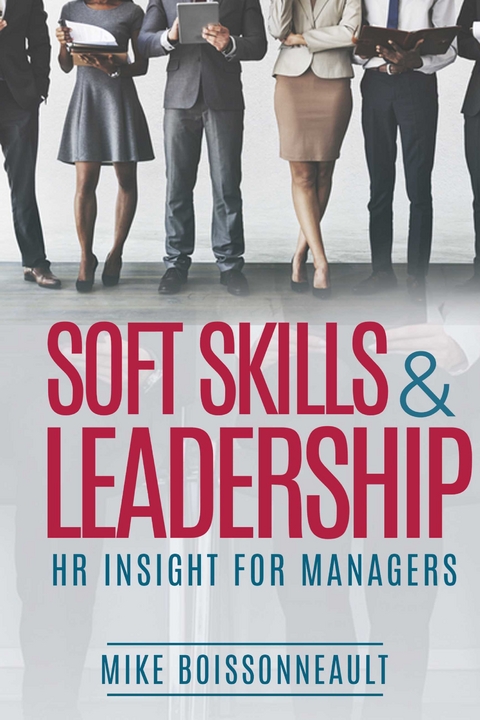
Soft Skills & Leadership (eBook)
156 Seiten
Bookbaby (Verlag)
9781543935967 (ISBN)
Soft Skills & Leadership - HR Insight for Managers is written as an open letter and offers provocative ideas and solutions for HR practitioners assisting business managers with growth, development and diplomacy. It's a journey through the traditional HR disciplines and meant to inspire and motivate business managers to gain personal value and strength in current roles. Mike Boissonneault provides a comprehensive and thought provoking essay on the various HR disciplines and written in standard business language. It is a bridge to connect and bond HR professionals with their business managers. In fact, the book can also be a refresher for HR practitioners. For managers who can't afford to go off site for developmental training, they can learn about HR specialization, and will immediately create a better respect for, and support of, their HR partnerships. Also, for aspiring HR staff, this book can whet their appetite and inspire them to see the depth and breadth of what HR is about and how the business community can embrace their best practices. Written by an HR executive, who worked on both sides of this business relationship in a large corporation, Mike gives a fresh and diplomatic review of the soft skills necessary for best management practices. This book is a virtual tour of HR disciplines, explained with a business manager's purview. It's written to inspire business leaders to embrace the collaborative efforts and support of the HR industry while creating a valuable knowledge base and tool for themselves. There are numerous HR organizations and consulting companies who offer thought leadership for the HR communities. Reference sites are current, relevant and inspiring with case studies and other information debated, negotiated and resolved. It's a great environment for HR to share with their business managers, to help find common respect for each other's roles and responsibilities. Blogs, articles and podcasts are important pieces of content to support many decisions in today's business climate. Many of these sites, as Mike points out, are free of charge. The book sets the table by presenting the current gap in soft skill or HR leadership within the business manager's early years. Those formative manager years are typically shaped by poor time management and over-burdened schedules. The book covers some of the reality of being an early manager and the personal changes and commitment associated with the role. Each of the various HR disciplines is explained and correlated between the HR terminology and normal business administrative language. Starting with business design, (org charting) the book shows how a company balances roles, titles and training alignment. The soft skills are evident in areas such as Performance Management, Diversity and Talent Acquisition, for example. The book deals with the various systems, programs and guidelines of how to gather, store and delete sensitive employee data. The employee life cycle starts in organizational design and discussed. Managers can learn from HR leaders in how to create an annual calendar of business events to attend to, featuring performance cycles. Today's talent acquisition is thoroughly reviewed and in step by step fashion. In the book, Mike explains the stages of activity required to hire as this is a very expensive undertaking and more expensive problem if there is a bad hire. Another significant discussion in the book is the discerning between the terms management and leadership. The soft skills and competencies of a leader are so important to note. There is a strong sentiment for creating more leadership and recognizing those qualities as important as any of the organizational skills. Technology and systems will shape the roles in the future as HR and business managers communicate differently. These HR professionals are there explicitly to support business, programs, growth and development and need management support for success. This book opens the mind to
Bridging Managers and HR Partners
Chapter 1
Something’s Missing
Business leaders are faced with many tasks in their daily routines. Owning or running a company, a division, a business unit or even leading a small team of employees has built in expectations. Managers are accountable for most everything that happens “on their watch”.
America has an endless number of small companies and major corporations. No matter the size of the operation, people manage people. The life cycle of an employee is as significant a road map as the production supply chain for any product manufactured. It is imperative to have fair and equitable laws governing each stage of that process and evolution. Employment, by its very nature, drives personal and community growth on every level. Without rules and organization, businesses fail and the economy suffers. Something’s missing.
An obvious path to answer the question of “What’s missing?” would be to steer new managers towards Human Resources disciplines and training. This book will provoke thought and offer an array of information on creating, sustaining and transforming businesses. This is the start of the bridge building between any business management team and HR doctrines. Organizational development and individual growth are areas of focus and deep discussion. Much of the typical design of companies are influenced by their specific industries and future business plans. We will delve into those areas to open dialogue and point to the currently available resources to back up the various schemes. Expanding the minds of business professionals to think broadly and act compliantly is a driver for the book. Human Resources professionals or programs can assist you.
Systems and processes change often and are greatly influenced by technology. We will focus on the theoretical practices and offer solutions and endorsements of some of the best business or human capital protocols and suggest applications available to support the various business and workforce management needs.
The workforce of the future is an important factor in any current business planning. Learning how to stay relevant and garnering the trust of the workforce is a paramount goal for Workforce Management. Another key derivative of the book can be incorporating a peripheral approach to understanding the expectations of the workforce, where a business fits into the supply chain of any given company or industry and ultimately how to leverage immediate and on-demand resources and/or trade organizations.
We anticipate that our readers will cross several demographics. Some will be attracted directly out of the school of business who may look to Human Resources as a target market for jobs. Others will be transitioning professionals who would like to either go into a management trek or an HR discipline. Still others, possibly the largest demographic, would be first and second tier (early) managers at companies big and small who need refresher courses and/or training in what we consider soft skills and Workforce Management. We will deliver training information with cross over skills for both Workforce Management and Human Resources professionals.
Early Manager Role
Let’s look at some details of being a manager, especially with little experience. Managing a workforce or a workplace is as complex as ever, given mixed generations, rapid advances in technology, competition 24/7, customer service requirements, cultural diversity, skills training, work/life balance and so much other criteria that stuffs the daily to-do list. How can a manager or leader deal with so much and still be effective in their role? They need organization, structure, practice, training, learning, mentoring, etc. to effectively do their job. As you can see, the role of young Workforce Management is among the most confusing, yet impactful on the planet.
The most effective managers will make a tangible impact on the workforce, workplace, products, services and/or marketplace. Generally, managers are put into position for similar reasons, with expectations including observing operations and reporting on activity with respect to progress versus stated goals. They find the right balance between hard skills and soft skills. Often individuals are promoted into managerial assignments based upon their hard skill success and they learn some of the managerial soft skills while on the job. While this may prove to be a suitable system in certain industries or companies, it is more the exception than the rule.
There are many expectations on both sides of the equation of Workforce Management. Leaders are expected to have the answers, plan accordingly, juggle schedules, run a tight ship, produce and protect the brand. These expectations typically come from the executive or ownership level. Conversely, the workforce expects their leaders to listen, work miracles, be lenient, manage leisurely, advocate on their behalf, allow perks and not be tough in performance management.
Somewhere in between, managers must figure out what is the absolute necessity for them to survive in the role. Is that where they will find balance? What are the basic requirements of a manager, a people leader, someone who is given the keys to open or close on a business day, lead people and set examples of good citizenship? What is in the core of a leader? What is a manager carved out of? Is there a mold that all who share this title can cling to? Where is the recipe? One thing is certain, this is a case where one size cannot fit all.
What’s missing in many cases is a support for the basic survival of a manager, let alone growth and development within the role. How will a manager find comparisons in the marketplace to emulate, learn from or steer clear of? When will the clock slow down enough for a manager to fit in the new responsibilities and find time to continue the climb? We’ll try to answer some of these questions or at least provoke thought. Navigating one’s immediate role when other people are dependent upon can be daunting and unless more clearly delineated, might be overwhelming and have negative effects.
Manager job descriptions are usually divided into a combination of hard skills and soft skills. Again, to keep this simple, the hard skills are generally those that someone contributes as an individual, usually skills that are clearly delineated, progressively more complex and can be measured against expectations, targets, peers, etc. Hard skills are typically hands-on based and therefore part of the performance in a role that is clearly demonstrable and weighed or scored. Soft skills are those that can use reasoning, coaching, attitude and personality. They are regularly referred to as “people skills”, whereby they can be based upon competencies, such as supportive, dynamic or team oriented abilities. There are great publications and organizations which teach and create customized lists of competencies. These can be used by companies to set expectations with specific management roles and responsibilities.
It’s important to note that there are vast reasons to hire or promote someone into a supervisory or managerial role and many more reasons not to do so.
Still, there never seems to be a shortage of candidates to fill a managerial role. Why do people seek roles that in so many ways seem to be baited with unknown pitfalls? There is often personal motivation for people to aspire to leadership roles, which could be financial or emotional that drive someone to seek out that next tier on the company ladder. Many gravitate to the role because they are simply tired of taking orders at the levels they have been productive at for years. They have been observant and think they can do the work because they have the skill in influencing others, demonstrated leadership on the floor, and always volunteer for more work and tougher assignments. What they haven’t witnessed up front is the back office. That is where new managers struggle at times to balance the new roles and keep things in perspective. It should be covered in the interview. They may have overlooked or else tuned out during the interview conversation regarding longer hours, detailed reporting, team (not individual) performance, etc.
Managers need help early on in their careers and should turn to the Human Resources professionals or, in lieu of availability, the HR support organizations to help guide them, execute programs and set appropriate goals and milestones to reach in the future. This book intends to build bridges between HR and the various lines of business through expertise and advocacy.
Performance Management
A very important role and one shared by managers and their HR partners (where applicable) is performance management. On the surface, it may seem like this is all the job of a manager entails. Isn’t it a simple role? Just write a report on who did what and how it all worked out? Not quite that easy. Performance management has evolved and is so disparate in many industries so we’ll cover some basics and you’ll be researching best ways in your business to do performance management well.
Set goals for yourself as an individual, for your workforce and employees and for your department, division, company, business entity. Assign or schedule you workforce into the roles as designed for your business and provide support, training, supervision and rules. Create workflow and adhere to the...
| Erscheint lt. Verlag | 18.6.2018 |
|---|---|
| Sprache | englisch |
| Themenwelt | Wirtschaft ► Betriebswirtschaft / Management ► Personalwesen |
| ISBN-13 | 9781543935967 / 9781543935967 |
| Informationen gemäß Produktsicherheitsverordnung (GPSR) | |
| Haben Sie eine Frage zum Produkt? |
 EPUB (Ohne DRM)
Größe: 543 KB
Digital Rights Management: ohne DRM
Dieses eBook enthält kein DRM oder Kopierschutz. Eine Weitergabe an Dritte ist jedoch rechtlich nicht zulässig, weil Sie beim Kauf nur die Rechte an der persönlichen Nutzung erwerben.
Dateiformat: EPUB (Electronic Publication)
EPUB ist ein offener Standard für eBooks und eignet sich besonders zur Darstellung von Belletristik und Sachbüchern. Der Fließtext wird dynamisch an die Display- und Schriftgröße angepasst. Auch für mobile Lesegeräte ist EPUB daher gut geeignet.
Systemvoraussetzungen:
PC/Mac: Mit einem PC oder Mac können Sie dieses eBook lesen. Sie benötigen dafür die kostenlose Software Adobe Digital Editions.
eReader: Dieses eBook kann mit (fast) allen eBook-Readern gelesen werden. Mit dem amazon-Kindle ist es aber nicht kompatibel.
Smartphone/Tablet: Egal ob Apple oder Android, dieses eBook können Sie lesen. Sie benötigen dafür eine kostenlose App.
Geräteliste und zusätzliche Hinweise
Buying eBooks from abroad
For tax law reasons we can sell eBooks just within Germany and Switzerland. Regrettably we cannot fulfill eBook-orders from other countries.
aus dem Bereich