


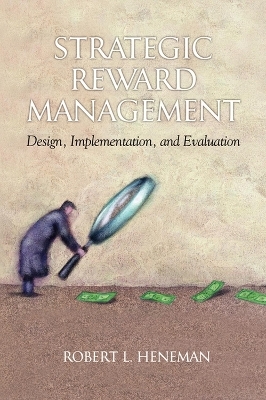
Strategic Reward Management
Information Age Publishing (Verlag)
978-1-931576-55-0 (ISBN)
- Titel z.Zt. nicht lieferbar
- Versandkostenfrei
- Auch auf Rechnung
- Artikel merken
The contents of this book center around the management of strategic reward systems. In particular, the book focuses in on the following elements of managing a reward system: design, implementation, and evaluation. It is my belief that too much time is spent on the administration of strategic reward systems at the expense of these other activities that add more value than does administration to the organization.
Moreover, it is very important to remember that the management of reward systems takes place in a larger context that must be accommodated when designing, implementing, and evaluating strategic reward systems. This larger context includes the business environment, business strategy, and compensation strategy. Elements of the environment include the internal environment (organizational structure, business processes, HR systems) and external environment (laws and regulations, labor markets, and unions).
The collection of articles presented throughout the book is very concerned with the fit of strategic reward management with the business environment, business strategy, and compensation strategy. Research has clearly documented the importance of this "fit" to organizational effectiveness (Gomez-Mejia & Balkin, 1992). A practical illustration makes the point as well. Taco Bell was found guilty in a class action suit by current and former employees. In order to keep the number of labor hours low in a productivity formula used to grant bonuses to managers, employee time sheets failed to account for overtime hours by employees. Failure to pay attention to the legal context in designing, implementing, and evaluating a strategic reward program cost Taco Bell millions of dollars (Gatewood, 2001).
Although all of the readings in the book focus in on the management of strategic rewards in the larger business context, the readings are organized by topical area. The selection of topics is simply based on my writing interests and do not reflect the entire domain of important topics in strategic reward management.
Preface
Acknowledgments
Part I. Introduction; R.L. Heneman
Part II. Pay and the Changing Business Context
Chapter 1. Compensation Systems in the Global Context; R.L. Heneman, C.H. Fey, and Z.M. Wang.
Chapter 2. The Changing Nature of Work and its Effects on Compensation Design and Delivery; R.L. Heneman, G.E. Ledford, and M.T. Gresham.
Chapter 3. Performance-Based Pay Plans; R.L. Heneman and M.T. Gresham.
Part III. Pay in New Business Environments
Chapter 4. Hybrid Reward Systems for Virtual Organizations: A Review and Recommendations; R.L. Heneman, J.W. Tansky, and E.C. Tomlinson.
Chapter 5. Alternative Rewards in Unionized Environments; R.L. Heneman, C. von Hippel, D.E. Eskew, and D.B. Greenberger.
Chapter 6. Alternative Rewards in Union Settings; G.L. Dalton, J. Stevens, and R.L. Heneman.
Chapter 7. Competency Pay for Professionals and Managers in Business: A Review and Implications for Teachers; R.L. Heneman and G.E. Ledford.
Part IV. Strategic Pay Issues
Chapter 8. Corporate Business Strategies and Compensation Strategies; R.L. Heneman.
Chapter 9. Contextual Determinants of Variable Pay Plan Design: A Proposed Research Framework; M.P. Miceli and R.L. Heneman.
Chapter 10. Reward System Alignment; R.L. Heneman and K.E. Dixon.
Chapter 11. How to Find, Select, and Evaluate Pay Surveys to Meet Your Organization’s Needs; R.L. Heneman and K. Dixon.
Chapter 12. Compensation: A Troublesome Lead System in Organizational Change; G.E. Ledford and R.L. Heneman.
Part V. From Job Evaluation to Work Evaluation
Chapter 13. Job and Work Evaluation: A Literature Review; R.L. Heneman.
Chapter 14. Work Evaluation: Current State of the Art and Future Prospects; R.L. Heneman.
Part VI. Team Pay
Chapter 15. Balancing Group and Individual Rewards: Rewarding Individual Contributions to the Team; R.L. Heneman and C. von Hippel.
Chapter 16. Team Pay for Novice, Intermediate, and Advanced Teams; R.L. Heneman, K.E. Dixon, and M.T. Gresham.
Part VII. Merit Pay Revisited
Chapter 17. The Assessment of Job Performance: Focusing Attention on Context, Process, and Group Issues; R.L. Heneman and C. von Hippel.
Chapter 18. Merit Pay; R.L. Heneman.
Chapter 19. A Survey of Merit Pay Plan Effectiveness: End of the Line for Merit Pay or Hope for Improvement?; D. Eskew and R.L. Heneman.
Part VIII. Competency Pay
Chapter 20. Pay for Skills, Knowledge, and Competencies; G.E. Ledford and R.L. Heneman.
Chapter 21. The Limited Inc.: Using Strategic Performance Management to Drive Brand Leadership; R.L. Heneman and A.L. Thomas.
Chapter 22. Ability and Effort Weights in Pay Level and Pay Increase Decisions; D.J. Cohen and R.L. Heneman.
Part IX. Pay System Evaluation
Chapter 23. Pay Increase Satisfaction: A Reconceptualization of Pay Raise Satisfaction Based on Changes in Work and Pay Practices; R.L. Heneman, D.B. Greenberger, and J.A. Fox.
Chapter 24. Modeling the Relationship Between Pay Level and Pay Satisfaction; R.L. Heneman, G. Porter, D.B. Greenberger, and S. Strasser.
Chapter 25. Using Employee Attitude Surveys to Evaluate a New Incentive Pay Program; R.L. Heneman, D.E. Eskew, and J.A. Fox.
Part X. Conclusions & The Future of Strategic Rewards
Chapter 26. Total Rewards Management; R.L. Heneman and W. Schutt.
About the Author
Index
| Erscheint lt. Verlag | 30.1.2002 |
|---|---|
| Reihe/Serie | Linking Pay to Performance |
| Sprache | englisch |
| Maße | 156 x 234 mm |
| Gewicht | 924 g |
| Themenwelt | Wirtschaft ► Betriebswirtschaft / Management ► Finanzierung |
| Wirtschaft ► Betriebswirtschaft / Management ► Unternehmensführung / Management | |
| ISBN-10 | 1-931576-55-6 / 1931576556 |
| ISBN-13 | 978-1-931576-55-0 / 9781931576550 |
| Zustand | Neuware |
| Informationen gemäß Produktsicherheitsverordnung (GPSR) | |
| Haben Sie eine Frage zum Produkt? |
aus dem Bereich


