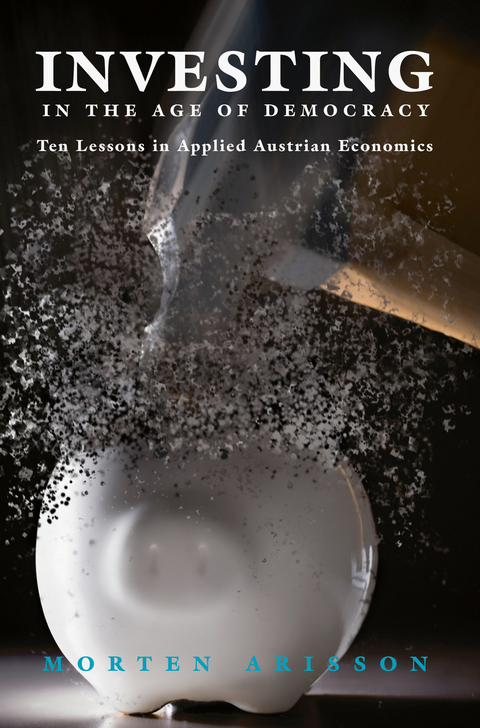
Investing in the Age of Democracy (eBook)
XIX, 167 Seiten
Springer International Publishing (Verlag)
978-3-319-95903-0 (ISBN)
This book offers a structured, deductive approach to Austrian investing, beginning with an analysis of the current investing paradigm. There are five economic concepts on which the Austrian School of Economics has a unique view: Entrepreneurship, Class Probability, Capital, the Interest Rate, and Institutions. This book explains, lesson by lesson, how each of theseshapes our thinking about investing. If we follow them through their logical consequences, they leave us with a unique approach to investing. Except for the theory of probability, there has not been a comprehensive analysis of the linkages between these concepts, when it comes to investing. Although they would have been obvious to the average investor before the age of democracy, since the French and American revolutions, government interventions have steadily transformed the way we think about them (and the way we invest). Above all, Entrepreneurship and Institutions are downplayed today, while investors use Case Probability, and confuse the concepts of Money and Capital.
This book offers a historical review of these interventions, to shed light on how we went from what was common sense to the status quo. Offering a sometimes technical analysis, the book examines a series of fundamental investment fallacies, their origins and how not to fall for them.
Morten Arisson is a Canadian economist, with a Master's Degree in Business Administration. He has experience in credit portfolio management, private equity and strategy consulting.
Morten Arisson is a Canadian economist, with a Master’s Degree in Business Administration. He has experience in credit portfolio management, private equity and strategy consulting.
Dedication 5
Preface 6
Disclaimer 7
Contents 8
List of Figures 10
Introduction 12
Bibliography 16
Part I: The Current Paradigm 17
1: Working with the Wrong Tools 18
Differential Analysis 19
Probability Theory 20
The Concept of Liquidity 23
Deficient Liquidity Structures 26
Variation No. 1: Fractional Reserve Banking 27
Variation No. 2: Shadow Banking 28
Variation No. 3: Commodity ETFs 29
Variation No. 4: Clearinghouses (with Physical Delivery) 30
High-Frequency Trading 31
Sovereign Risk 34
Fallacy No.1: Creditors Are Safe as Sovereigns Do Not Vanish 34
Fallacy No. 2: You Collect More from a Sovereign 35
Fallacy No. 3: Sovereign Debt in Local Currency Cannot Default 36
Correlation (or Modern Portfolio Theory) 39
Conclusion 42
Appendix 43
Aesthetics in Infinitesimal Analysis 43
Aesthetics in General Equilibrium Theory 44
A Word on Indeterminacy 47
Bibliography 48
Part II: Fundamentals 50
2: Asset Allocation Is Intertemporal Preference 51
Intertemporal Preference 51
Conclusion 58
Capital 58
Derivatives, Commodities Are Not Investing Assets 59
Investments Versus Trades 62
Bibliography 63
3: Turing’s Decidability 64
Formalization of Entrepreneurship Is an Error 65
Decidability and Finance 68
Decidability and Capital Structure 70
Portfolio Construction 72
Mezzanine Investing: Avoid It 72
Appendix I: Monetary Policy and Capital Structure 75
Appendix II: Decidability and Economies of Scale 77
Bibliography 78
4: Equity 80
Limited Liability 84
Insider Information 87
Conclusion 89
Bibliography 90
5: Debt 91
Labour 96
Private Debt 97
Borrowing Causes 97
Repayment 99
Discouragement to Default 99
Bilateral Loans 100
Private Placements 100
Syndicated Loans 101
Corporate Bonds 101
Bibliography 102
6: Institutions 103
Private Institutions 105
The Irregular Deposit 105
The Loan 106
Money 106
Gold 108
Intervention of the Gold Market 109
Banking and Financial Intermediation 111
Virtual Currencies 112
Innovation in Institutions 113
Public Institutions 114
Bibliography 116
Part III: Economic Concepts 117
7: Systemic Risk 118
Gold Standard 121
Gold Exchange Standard 121
How It All Began 127
How Adjustments Worked Under the Gold Standard 128
How Adjustments Worked Under the Gold Exchange Standard 129
How the Perspective Changed as the United States Became a Debtor Nation 130
How Adjustments Work Without Currency Swaps 132
How Adjustments Work Today, with Currency Swaps 135
Conclusion: There Are No Black Swans 137
Bibliography 138
8: Inflation and Hyperinflation 139
The Concept of Inflation 139
Hyperinflation or How Central Banks Lose Control 142
Addendum 145
Bibliography 146
9: Real Capital Assets 147
Movable Real Assets 147
Cattle 147
Wine 148
Unmovable Real Assets 149
Forests 149
Residential Real Estate 149
Farmland 151
Bibliography 152
10: Economic Growth 153
When Did This All Begin? 153
Roy F. Harrod 155
Evsey D. Domar 155
James Tobin 156
Robert Solow 157
But What Is Economic Growth? 158
Implications for the Investor 158
Bibliography 159
Final Comments 160
Bibliography 163
Index 169
| Erscheint lt. Verlag | 6.9.2018 |
|---|---|
| Zusatzinfo | XIX, 167 p. 36 illus. |
| Verlagsort | Cham |
| Sprache | englisch |
| Themenwelt | Sachbuch/Ratgeber ► Beruf / Finanzen / Recht / Wirtschaft ► Geld / Bank / Börse |
| Wirtschaft ► Betriebswirtschaft / Management ► Unternehmensführung / Management | |
| Wirtschaft ► Volkswirtschaftslehre | |
| Schlagworte | Asset Allocation • Austrian Economics • Austrian School approach • Black Swan • Central Banking • debt • Equity • Investments and Securities • portfolio optimization • systemic risk |
| ISBN-10 | 3-319-95903-4 / 3319959034 |
| ISBN-13 | 978-3-319-95903-0 / 9783319959030 |
| Informationen gemäß Produktsicherheitsverordnung (GPSR) | |
| Haben Sie eine Frage zum Produkt? |
 PDF (Wasserzeichen)
DRM: Digitales Wasserzeichen
Dieses eBook enthält ein digitales Wasserzeichen und ist damit für Sie personalisiert. Bei einer missbräuchlichen Weitergabe des eBooks an Dritte ist eine Rückverfolgung an die Quelle möglich.
Dateiformat: PDF (Portable Document Format)
Mit einem festen Seitenlayout eignet sich die PDF besonders für Fachbücher mit Spalten, Tabellen und Abbildungen. Eine PDF kann auf fast allen Geräten angezeigt werden, ist aber für kleine Displays (Smartphone, eReader) nur eingeschränkt geeignet.
Systemvoraussetzungen:
PC/Mac: Mit einem PC oder Mac können Sie dieses eBook lesen. Sie benötigen dafür einen PDF-Viewer - z.B. den Adobe Reader oder Adobe Digital Editions.
eReader: Dieses eBook kann mit (fast) allen eBook-Readern gelesen werden. Mit dem amazon-Kindle ist es aber nicht kompatibel.
Smartphone/Tablet: Egal ob Apple oder Android, dieses eBook können Sie lesen. Sie benötigen dafür einen PDF-Viewer - z.B. die kostenlose Adobe Digital Editions-App.
Buying eBooks from abroad
For tax law reasons we can sell eBooks just within Germany and Switzerland. Regrettably we cannot fulfill eBook-orders from other countries.
aus dem Bereich