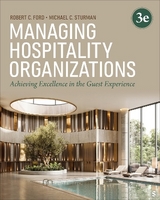
Managing Hospitality Organizations
SAGE Publications Inc (Verlag)
978-1-5443-2150-9 (ISBN)
- Titel erscheint in neuer Auflage
- Artikel merken
"A perfect book for any Hospitality program, excellent instructor support, and a good resource for students."
–Denise A. Braley, Mitchell College
Today’s economy is dominated by the rapidly growing service sector. Even businesses primarily selling goods are reinventing their image and positioning themselves as service providers. Managing Hospitality Organizations: Achieving Excellence in the Guest Experience takes students on a journey through the evolving service industry. Each chapter focuses on a core principle of hospitality management and is packed with practical advice, examples, and cases from some of the best companies in the service sector. Authors Robert C. Ford and Michael C. Sturman emphasize the critical importance of focusing on the guest and creating that unforgettable customer experience. Whether your students will be managing a neighborhood café, a convention center, or a high-end resort hotel, they will learn invaluable skills for managing the guest experience in today’s ultracompetitive environment.
The Second Edition includes new coverage of technology, sustainability, sexual harassment, diversity and inclusion, and ethical leadership.
Give your students the SAGE edge!
SAGE edge offers a robust online environment featuring an impressive array of free tools and resources for review, study, and further exploration, keeping both instructors and students on the cutting edge of teaching and learning.
Robert C. Ford (Ph.D., Arizona State University) is professor emeritus of management in the College of Business Administration (COBA) of the University of Central Florida (UCF) where he taught management of service organizations. He joined UCF as the chair of its hospitality department. He was also the COBA Associate Dean for Graduate and External Programs. Bob has authored and coauthored numerous publications in both top research and practitioner journals. He has served on several editorial boards including Cornell Hospitality Quarterly, British Journal of Management, Journal of Leadership and Organizational Studies, Journal of Convention and Event Tourism, and Journal of Service Management. Currently, he is associate editor of Organizational Dynamics. He has also published several books including Managing the Guest Experience in Hospitality, Achieving Service Excellence: Strategies for Health Care, Managing Destination Marketing Organizations, and The Fun Minute Manager. Bob has participated actively in many professional organizations. He has served the Academy of Management (AOM) as editor of The Academy of Management Executive, Director of Placement, board member of the HRM and Careers divisions, Division Chair for both its Management History and its Management Education and Development divisions, and as a member and chair of its Ethics Adjudication Committee. Bob has served the Southern Management Association (SMA) in every elective office including that of president. He was a founding member and Chair of the Accreditation Commission for Programs in Hospitality Administration and served on the Destination Marketing Accreditation Program. Bob has been recognized for his service by many organizations. He received the Distinguished Service Award from AOM’s MED, the Richard Hodgett’s Distinguished Career Award from Management History, and SMA’s Distinguished Service Award and was elected to SMA Fellows. In recognition of his service to hospitality education, Bob was given the Paul Brown Award by the Florida Hotel and Lodging Association. He was also twice awarded a W. James Whyte Research Fellow by the University of Queensland. Michael C. Sturman (Ph.D., Cornell University) is Professor of Human Resource Management in the Rutgers’ School of Management and Labor Relations. His research focuses on the prediction of individual job performance over time and the influence of compensation systems. He also examines the use of HR Analytics and Metrics to improve HR decision-making and the return on HR investments. Michael has published research articles in journals such as the Academy of Management Journal, Journal of Applied Psychology, Journal of Management, Organizational Research Methods, and Personnel Psychology. He has also published practitioner-oriented papers in Compensation and Benefits Review, the American Compensation Association Journal, Cornell Hospitality Quarterly, International Journal of Hospitality Management, Lodging Magazine, and Lodging HR, and is a presenter in Salary.com’s CompX Compensation Education series. Before coming to Rutgers, Michael was the Kenneth and Marjorie Blanchard Professor of Human Resources at Cornell University’s College of Business, where he held appointments in the Management Area and the School of Hotel Administration, as well as a courtesy appointment with the School of Industrial and Labor Relations. Michael holds a Ph.D., M.S., and B.S. from Cornell University’s School of Industrial and Labor Relations, and is a Senior Professional of Human Resources as certified by the Society for Human Resource Management. He teaches undergraduate, graduate, and executive courses on human resource management, HR analytics, compensation, and analytical methods.
Foreword
Preface
Acknowledgments
About the Authors
Introduction
SECTION I. THE HOSPITALITY SERVICE STRATEGY
1. The Basics of Wow! The Guest Knows Best
Introduction
Guestology: What is it?
The Guest Experience
Guest Expectations
Quality, Value, and Cost Defined
The Importance of Guestology
Lessons Learned
2. Meeting Guest Expectations through Planning
Introduction
Three Generic Strategies
The Hospitality Planning Cycle
Assessing the Environment
Assessing the Organization Itself: The Internal Assessment
Vision and Mission Statements
Developing the Service Strategy
Action Plans
Involving Employees in Planning
The Uncertain Future
Lessons Learned
3. Setting the Scene for the Guest Experience
Introduction
Creating “The Show”
Why is the Environment Important?
A Model: How the Service Environment Affects the Guest
Lessons Learned
4. Developing the Hospitality Culture: Everyone Serves!
Introduction
The Importance of Leaders
The Importance of Culture
Culture as a Competitive Advantage
Beliefs, Values, and Norms
Culture and the Environment
Communicating the Culture
Changing the Culture
Lessons Learned
SECTION II. THE HOSPITALITY SERVICE STAFF
5. Staffing for Service
Introduction
The Many Employees of the Hospitality Industry
The First Step: Study the Job
The Second Step: Recruit a Pool of Qualified Candidates
The Third Step: Select the Best Candidate
The Fourth Step: Hire the Best Applicant
The Fifth Step: Make the New Hire Feel Welcome
The Sixth Step: Turnover—Retaining the Best and Selecting People out of an Organization
Lessons Learned
6. Training and Developing Employees to Serve
Introduction
Employee Training
Developing a Training Program
Types of Training
Training Methods
Challenges and Pitfalls of Training
Employee Development
Lessons Learned
7. Serving with a Smile: Motivating Exceptional Service
Introduction
Motivating Employees
The Needs People Have
The Rewards Managers can Provide
Ways Rewards Can Motivate
How Managers and Leaders Provide the Right Direction
Lessons Learned
8. Involving the Guest: The Co-Creation of Value
Introduction
The Guest Can Help!
Strategies for Involving the Guest
Determining Where Co-Production Makes Sense
One Last Point: Firing the Guest
Lessons Learned
Section III. The Hospitality Service Delivery System
9. Communicating for Service
Introduction
The Challenge of Managing Information
Information and the Service Product
Information and the Service Setting
Information and the Delivery System
Decision Support Systems
The Hospitality Organization as an Information System
Lessons Learned
10. Planning the Service Delivery System
Introduction
Planning and Designing the Service Delivery System
Developing the Service Delivery System
Planning Techniques
Targeting Specific Problem Areas in Service Delivery Systems
Lessons Learned
11. Waiting for Service
Introduction
Capacity and Psychology: Keys to Managing Lines
Queuing Theory: Managing the Reality of the Wait
Managing the Perception of the Wait
Service Value and the Wait
Lessons Learned
12. Measuring and Managing Service Delivery
Introduction
Techniques and Methods for Assessing Service Quality
Measuring Service Quality After the Experience
SERVQUAL
Finding and Using the Technique that Fits
Lessons Learned
13. Fixing Service Failures
Introduction
Service Failures: Types, Where, and Why
The Importance of Fixing Service Failures
Dealing With Service Failures
Recovering From Service Failure
Lessons Learned
14. Service Excellence: Leading the Way to Wow!
Introduction
The Three Ss: Strategy, Staffing, and Systems
Hospitality and the Future
Leading the Way Into the Future
Leading and Managing
It all Begins—and Ends—with the Guest
Lessons Learned
Glossary
Additional Readings
Index
| Erscheinungsdatum | 17.01.2019 |
|---|---|
| Verlagsort | Thousand Oaks |
| Sprache | englisch |
| Maße | 203 x 254 mm |
| Gewicht | 1210 g |
| Themenwelt | Wirtschaft ► Betriebswirtschaft / Management |
| ISBN-10 | 1-5443-2150-3 / 1544321503 |
| ISBN-13 | 978-1-5443-2150-9 / 9781544321509 |
| Zustand | Neuware |
| Informationen gemäß Produktsicherheitsverordnung (GPSR) | |
| Haben Sie eine Frage zum Produkt? |
aus dem Bereich