


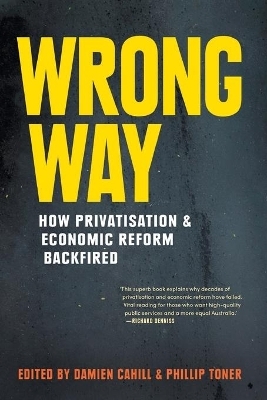
Wrong Way
How Privatisation and Economic Reform Backfired
Seiten
2018
La Trobe University Press (Verlag)
978-1-76064-038-5 (ISBN)
La Trobe University Press (Verlag)
978-1-76064-038-5 (ISBN)
- Keine Verlagsinformationen verfügbar
- Artikel merken
Since the 1980s, waves of neoliberal 'economic reform' have transformed Australia.
Privatisation, deregulation, marketisation and the contracting out of government services- for three decades now, there has been widespread agreement among policymakers on the desirability of these strategies. But the benefits of economic reform are increasingly being questioned. Alongside growing voter disenchantment, new voices of dissent argue that instead of efficiency and improved services, economic reform has led to unaccountable oligopolies, increased prices, reduced productivity and degradation of the public good.
In Wrong Way, Australia's leading economists and public intellectuals do a cost-benefit analysis of economic reform across key areas. Have these reforms been worthwhile for the Australian community and its economy? Have they given us a better society, as promised?
'Has privatisation led to more productivity-enhancing competition? Has deregulation increased economic welfare in energy, finance, health, education and labour markets? Does the lived experience of Australians measure up to the promise of economic reform? The authors answer these questions with conclusions that are both compelling and disturbing.'
--Emeritus professor Roy Green, University of Technology Sydney
Damien Cahill & Phillip Toner on Economic Reform
Elizabeth Hill & Matt Wade on Early Childhood Education And Care
Stephen Duckett on Private Health Insurance
Phillip Toner on Vocational Education And Training
Jane Andrew & Max Baker on Prisons
Bob Davidson on Aged Care
Paul Davies on Public Sector Engineering
Sue Olney & Wilma Gallet on Employment Services
John Quiggin on Electricity
Jim Stanford on Labour Markets
Evan Jones on Banking
Peter Phibbs & Nicole Gurran on Housing
Lee Ridge on The NBN
Ben Spies-Butcher & Gareth Bryant on Universities
Michael Beggs on Monetary Policy And Unemployment
John Quiggin on Productivity
Peter Brain on Orthodox Economic Models
Patricia Ranald on Free Trade
David Richardson on Foreign Investment
Frank Stilwell on Inequality
Privatisation, deregulation, marketisation and the contracting out of government services- for three decades now, there has been widespread agreement among policymakers on the desirability of these strategies. But the benefits of economic reform are increasingly being questioned. Alongside growing voter disenchantment, new voices of dissent argue that instead of efficiency and improved services, economic reform has led to unaccountable oligopolies, increased prices, reduced productivity and degradation of the public good.
In Wrong Way, Australia's leading economists and public intellectuals do a cost-benefit analysis of economic reform across key areas. Have these reforms been worthwhile for the Australian community and its economy? Have they given us a better society, as promised?
'Has privatisation led to more productivity-enhancing competition? Has deregulation increased economic welfare in energy, finance, health, education and labour markets? Does the lived experience of Australians measure up to the promise of economic reform? The authors answer these questions with conclusions that are both compelling and disturbing.'
--Emeritus professor Roy Green, University of Technology Sydney
Damien Cahill & Phillip Toner on Economic Reform
Elizabeth Hill & Matt Wade on Early Childhood Education And Care
Stephen Duckett on Private Health Insurance
Phillip Toner on Vocational Education And Training
Jane Andrew & Max Baker on Prisons
Bob Davidson on Aged Care
Paul Davies on Public Sector Engineering
Sue Olney & Wilma Gallet on Employment Services
John Quiggin on Electricity
Jim Stanford on Labour Markets
Evan Jones on Banking
Peter Phibbs & Nicole Gurran on Housing
Lee Ridge on The NBN
Ben Spies-Butcher & Gareth Bryant on Universities
Michael Beggs on Monetary Policy And Unemployment
John Quiggin on Productivity
Peter Brain on Orthodox Economic Models
Patricia Ranald on Free Trade
David Richardson on Foreign Investment
Frank Stilwell on Inequality
Phillip Toner is Honorary Senior Research Fellow in the Department of Political Economy at the University of Sydney. He has contributed to government inquiries on industry and vocational training, and consulted for the OECD, the World Bank, APEC, the Australian Research Council and the Department of Innovation, Science and Research. He is the author of Main Currents in Cumulative Causation- The Dynamics of Growth and Development. Damien Cahill is Associate Professor of Political Economy at the University of Sydney. He has published widely on neoliberalism, including the books The End of Laissez-Faire? On the Durability of Embedded Neoliberalism and Neoliberalism (with Martijn Konings).
| Erscheinungsdatum | 19.09.2018 |
|---|---|
| Sprache | englisch |
| Maße | 155 x 234 mm |
| Gewicht | 578 g |
| Themenwelt | Sachbuch/Ratgeber ► Beruf / Finanzen / Recht / Wirtschaft ► Wirtschaft |
| Wirtschaft ► Allgemeines / Lexika | |
| Wirtschaft ► Volkswirtschaftslehre | |
| ISBN-10 | 1-76064-038-7 / 1760640387 |
| ISBN-13 | 978-1-76064-038-5 / 9781760640385 |
| Zustand | Neuware |
| Informationen gemäß Produktsicherheitsverordnung (GPSR) | |
| Haben Sie eine Frage zum Produkt? |
Mehr entdecken
aus dem Bereich


aus dem Bereich
warum wir vor den Tech-Milliardären noch nicht einmal auf dem Mars …
Buch | Softcover (2025)
Suhrkamp (Verlag)
CHF 30,80
zum Stand der Dinge (des Alltags)
Buch | Softcover (2025)
Suhrkamp (Verlag)
CHF 30,80
Buch | Hardcover (2025)
Tropen (Verlag)
CHF 39,20


