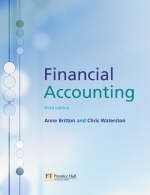
Financial Accounting
Financial Times Prentice Hall (Verlag)
978-0-273-65859-7 (ISBN)
- Titel erscheint in neuer Auflage
- Artikel merken
Developed out of the MTBE series in Business and Economics this thoroughly revised third edition of Financial Accounting successfully combines an academic, conceptual approach to the subject with an accessible, student friendly and interactive style. This new text adopts a questioning attitude to the subject, asking why accounting practices exist and how they work, without lingering on the technicalities. Increased in length, depth and coverage, for those that favour the 'why' over 'how to' approach, Financial Accounting is now the ideal introductory core text for first year financial accounting students.
Preface Acknowledgements CHAPTER 1 WHAT IS ACCOUNTING? Introduction Purposes of accounting Types of accounting Who cares anyway? - the users The future of financial accounting Summary Further study Self-assessment questions CHAPTER 2 THE BALANCE SHEET Introduction The sources and applications of fund The format of the balance sheet What the balance sheet tells the users The alternative valuation methods Statement of total recognised gains and losses Uncertainty Summary Further study Self-assessment questions CHAPTER 3 THE PROFIT AND LOSS ACCOUNT Introduction Stock valuation Non-trading organisations Limited companies Changes to the profit and loss account Information technology and accounting Summary Further study Self-assessment questions CHAPTER 4 CONCEPTS AND CHARACTERISTICS Introduction Concepts and policies Accounting estimation and measurement bases Revenue recognition A true and fair view The 'Statement of Principles' Summary Further study Self-assessment questions CHAPTER 5 THE DOUBLE ENTRY SYSTEM The need for a double entry system Double entry system - duality Double entry system - account Credit transactions Worked examples of double entry Balancing off accounts Trial balance Profit and loss account Format of the profit and loss account Balances remaining in the books Summary Further study Self-assessment questions CHAPTER 6 ADJUSTMENTS, INCLUDING ENTRIES IN LEDGER ACCOUNTS Introduction Accruals and prepayments Adjustment to ledger accounts Adjustment for bad and doubtful debts Depreciation Sale of fixed assets Summary Further study Self-assessment questions CHAPTER 7 PREPARATION OF PROFIT AND LOSS ACCOUNT AND BALANCE SHEET FROM TRIAL BALANCE AND ADJUSTMENTS Introduction Extended example Summary Further study Self-assessment questions CHAPTER 8 ACCOUNTS OF LIMITED COMPANIES The need for companies The company Company capital Summary Further study Self-assessment questions CHAPTER 9 CASH FLOW STATEMENTS Introduction Cash flows within a business Cash flow statement Summary Further study Self-assessment questions CHAPTER 10 REGULATORY FRAMEWORK IN THE UK COMPARED WITH EUROPEAN EXAMPLES AND THE INTERNATIONAL FRAMEWORK Introduction UK legal framework UK regulatory framework International regulatory framework Determinants of the accounting framework Summary Further study Self-assessment questions CHAPTER 11 INTERPRETATION, INCLUDING RATIO ANALYSIS AND CONSIDERATION OF ADDITIONAL INFORMATION REQUIRED Accounting information and users Needs and objectives of users Standards Technique of ratio analysis Performance Investment potential Financial status Limitations of ratio analysis Additional information Summary Further study Self-assessment questions CHAPTER 12 VALUATION AND PERFORMANCE MEASUREMENT Introduction Alternatives to historical cost The time value of money Putting the valuations together Inflation accounting Accounting for revaluations Statement of total recognised gains and losses Summary Further study Self-assessment questions CHAPTER 13 CONTROL OF ACCOUNTING SYSTEMS Introduction The need for controls Audit Bank reconciliations Control accounts Summary Further study Self-assessment questions CHAPTER 14 INFORMATION TECHNOLOGY AND ACCOUNTING Introductiion Control issues Audit trails Designing an accounting system Implementation Contingency planning E-accounting XML The wider picture Summary Further study Self-assessment questions CHAPTER 15 THE FINALE Introduction Case study Summary Glossary of key terms Appendix: Answers to self-assessment questions Index
| Erscheint lt. Verlag | 26.2.2003 |
|---|---|
| Verlagsort | Harlow |
| Sprache | englisch |
| Maße | 191 x 246 mm |
| Gewicht | 675 g |
| Themenwelt | Wirtschaft ► Betriebswirtschaft / Management ► Rechnungswesen / Bilanzen |
| ISBN-10 | 0-273-65859-X / 027365859X |
| ISBN-13 | 978-0-273-65859-7 / 9780273658597 |
| Zustand | Neuware |
| Informationen gemäß Produktsicherheitsverordnung (GPSR) | |
| Haben Sie eine Frage zum Produkt? |
aus dem Bereich