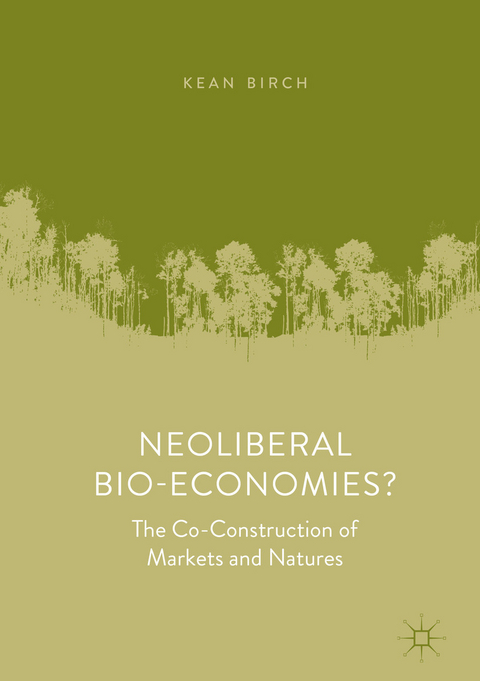
Neoliberal Bio-Economies? (eBook)
XV, 208 Seiten
Springer International Publishing (Verlag)
978-3-319-91424-4 (ISBN)
Kean Birch is a Senior Associate of the Innovation Policy Lab, University of Toronto, Canada.
Kean Birch is a Senior Associate of the Innovation Policy Lab, University of Toronto, Canada.
Dedication 5
Acknowledgments 6
Contents 7
List of Figures 10
List of Tables 11
Chapter 1: Introduction 12
Introduction 12
Our Global Climate Challenge 14
Low-Carbon Transitions: The Case of the Bio-Economy 16
Environmental Economic Geographies: Neoliberal Natures? Neoliberal Bio-Economies? 19
Empirical Material and Outline of the Book 21
References 23
Chapter 2: Neoliberal Bio-Economies? 27
Introduction 27
Understanding Neoliberalism 30
Neoliberalizing Nature 33
Understanding Nature-Economy Relations 37
Environmental Economic Geography 37
Innovation and Socio-technical Change 40
Political-Economic Materialities 42
The Co-Construction of Markets and Natures 44
Conclusion 47
References 48
Chapter 3: Background to Emerging Bio-Economies 54
Introduction 54
Climate Change and Low-Carbon Futures 56
Carbon Emissions and Changing Climate 56
Energy and Low-Carbon Transitions 58
Bioenergy and Liquid Biofuels 60
Bioenergy: From Old to New 61
Understanding Liquid Biofuels 63
Conventional Biofuels 63
Advanced Biofuels 66
Biofuels Policy Regimes and Policy Drivers 68
Brazil 68
United States of America 69
European Union 70
Where Are Advanced Biofuels Today? 72
The Emerging Bio-Economy 73
What Is the Bio-Economy? 73
Conclusion 79
References 80
Chapter 4: Bio-Economy Policy Visions 87
Introduction 87
Imagined Futures: Policy Visions and Policy Frameworks 89
Emergent Imaginaries in the Canadian Bio-Economy 92
Competing Definitions of the Bio-Economy 1: Bio-based Products 93
Competing Definitions of the Bio-Economy 2: Substitution 96
Competing Definitions of the Bio-Economy 3: Renewable Versus Sustainable 98
Competing Definitions of the Bio-Economy 4: Societal Transitions 99
Fragmented Policy Frameworks in the Canadian Bio-Economy 101
Configuring Policy Frameworks 102
Fragmented Policy Frameworks 104
Conclusion 107
References 108
Chapter 5: Legitimating Bio-Economies 112
Introduction 112
Neoliberal Natures and Political-Economic Materialities, or Material Political Economy 114
A Bioenergy Regime? 117
Political Materialities of Bio-based Energy: The Case of Ontario 119
Background to the Ontario Case Study 119
Legitimating What Biofuels? 121
Bio-based Energy Flows 122
Biomass (Im)mobility 123
Sustainability and Transboundary Leakage 126
Conclusion 127
References 128
Chapter 6: Material Limits to Bio-Economies 133
Introduction 133
Neoliberalism, Market Development, and Societal Transitions 135
Bio-Economy Policy Strategies and Market Development Policies Around the World 138
Bio-Economy Policy Strategies Around the World 138
Market Development Policies in the Bio-Economy Around the World 144
Canada’s Bio-Economy Strategy? 147
Market Development Policies in Advanced Biofuels Market: Canadian Case Study 149
Biofuel Mandates 149
Subsidies 152
Feedstock Supply Chains 154
Standards and Regulations 156
Conclusion 158
References 159
Chapter 7: Co-Constructing Markets and Natures in Bio-Economies 165
Introduction 165
Social Natures, Material Markets 167
Socio-natures 167
Material Markets 169
Co-Constructing Natures and Markets 171
The Co-construction of Markets and Natures in the Development of Advanced Biofuels 172
Analytical and Methodological Framework 172
Upstream Co-construction of Markets and Natures 175
Biomass Availability 176
Feedstock Supply Chains 179
Downstream Co-construction of Markets and Natures 182
Technology Conversion 182
Distribution and Retail 185
Cross-Cutting Co-construction of Markets and Natures 188
Conclusion 190
References 191
Chapter 8: Conclusions: Alternative Bio-Economies 195
Introduction 195
Some Theoretical Implications of My Argument 197
Alternative Bio-Economies Out There 200
Organics and the Bio-Economy 200
From Bio-Economy to Eco-economy 202
Conclusions: What Does All This Mean? 203
References 205
Index 210
| Erscheint lt. Verlag | 4.7.2018 |
|---|---|
| Zusatzinfo | XV, 208 p. 9 illus., 2 illus. in color. |
| Verlagsort | Cham |
| Sprache | englisch |
| Themenwelt | Sozialwissenschaften ► Politik / Verwaltung |
| Sozialwissenschaften ► Soziologie ► Spezielle Soziologien | |
| Wirtschaft | |
| Schlagworte | Bio-economy • bioenergy • Biofuels • Infrastructure • natural resources • Neoliberalism • Science and Technology Studies • Technoscience |
| ISBN-10 | 3-319-91424-3 / 3319914243 |
| ISBN-13 | 978-3-319-91424-4 / 9783319914244 |
| Informationen gemäß Produktsicherheitsverordnung (GPSR) | |
| Haben Sie eine Frage zum Produkt? |
 PDF (Wasserzeichen)
DRM: Digitales Wasserzeichen
Dieses eBook enthält ein digitales Wasserzeichen und ist damit für Sie personalisiert. Bei einer missbräuchlichen Weitergabe des eBooks an Dritte ist eine Rückverfolgung an die Quelle möglich.
Dateiformat: PDF (Portable Document Format)
Mit einem festen Seitenlayout eignet sich die PDF besonders für Fachbücher mit Spalten, Tabellen und Abbildungen. Eine PDF kann auf fast allen Geräten angezeigt werden, ist aber für kleine Displays (Smartphone, eReader) nur eingeschränkt geeignet.
Systemvoraussetzungen:
PC/Mac: Mit einem PC oder Mac können Sie dieses eBook lesen. Sie benötigen dafür einen PDF-Viewer - z.B. den Adobe Reader oder Adobe Digital Editions.
eReader: Dieses eBook kann mit (fast) allen eBook-Readern gelesen werden. Mit dem amazon-Kindle ist es aber nicht kompatibel.
Smartphone/Tablet: Egal ob Apple oder Android, dieses eBook können Sie lesen. Sie benötigen dafür einen PDF-Viewer - z.B. die kostenlose Adobe Digital Editions-App.
Buying eBooks from abroad
For tax law reasons we can sell eBooks just within Germany and Switzerland. Regrettably we cannot fulfill eBook-orders from other countries.
aus dem Bereich