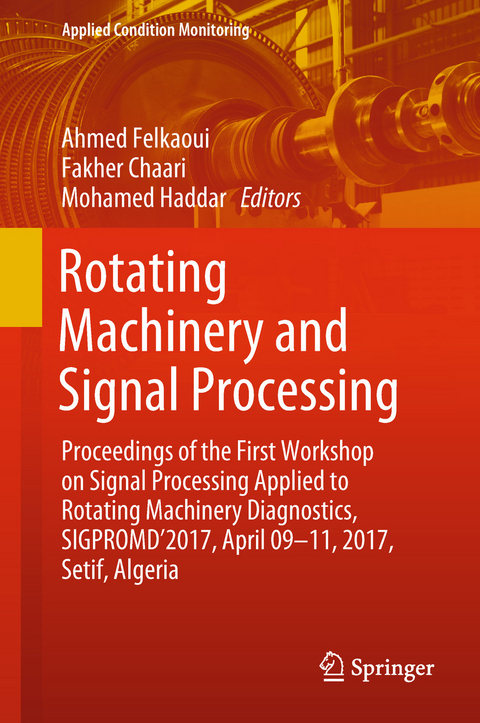
Rotating Machinery and Signal Processing (eBook)
VIII, 133 Seiten
Springer International Publishing (Verlag)
978-3-319-96181-1 (ISBN)
This book provides readers with a timely snapshot of the potential offered by and challenges posed by signal processing methods in the field of machine diagnostics and condition monitoring. It gathers contributions to the first Workshop on Signal Processing Applied to Rotating Machinery Diagnostics, held in Setif, Algeria, on April 9-10, 2017, and organized by the Applied Precision Mechanics Laboratory (LMPA) at the Institute of Precision Mechanics, University of Setif, Algeria and the Laboratory of Mechanics, Modeling and Manufacturing (LA2MP) at the National School of Engineers of Sfax. The respective chapters highlight research conducted by the two laboratories on the following main topics: noise and vibration in machines; condition monitoring in non-stationary operations; vibro-acoustic diagnosis of machinery; signal processing and pattern recognition methods; monitoring and diagnostic systems; and dynamic modeling and fault detection.
Preface 6
Contents 8
Feature Selection Scheme Based on Pareto Method for Gearbox Fault Diagnosis 10
Abstract 10
1 Introduction 10
2 Support Vector Machines (SVMs) 13
3 Vibration Data and Feature Extraction 13
3.1 The CH46 Gearbox 13
3.2 Features Extraction 15
4 Feature Selection 17
4.1 Pareto Based Feature Selection Method 17
4.2 Selection Criterions 18
5 Results and Discussion 19
6 Conclusion 22
References 22
Intelligent Gear Fault Diagnosis in Normal and Non-stationary Conditions Based on Instantaneous Angular Speed, Differential Evolution and Multi-class Support Vector Machine 25
Abstract 25
1 Introduction 26
2 Measuring Principle 27
3 Test Bench and Experimental Protocol 28
4 Experimental Part 30
4.1 Feature Extraction 31
4.1.1 Signal Analysis (Angular Features Extraction) 31
4.1.2 Spectral Analysis (Spectra Features Extraction) 32
4.1.2 Spectral Analysis (Spectra Features Extraction) 32
4.2 Feature Vector 34
4.3 Feature Selection by DEFS Algorithm 35
4.4 Classification Procedure 36
4.4.1 Support Vector Machine Theory 36
4.4.2 Multiclass SVM 38
5 Classification Results and Discussions 38
6 Conclusion 40
Acknowledgments 40
References 41
Effect of Input Data on the Neural Networks Performance Applied in Bearing Fault Diagnosis 43
Abstract 43
1 Introduction 43
2 Background 44
2.1 Rolling Element Bearings 44
2.2 Bearing Fault Diagnosis Technique 45
2.3 Multi-Layer Perceptron (MLP) 45
3 Materials and Methods 46
3.1 Data Acquisition 46
3.2 Preprocessing of Vibration Signals 48
3.2.1 Time Domain Indicators 48
3.2.2 Frequencies Domain Indicators 48
3.3 Constitution of the Patterns Vector (Networks Input) 48
3.4 Choice of the Classes (Networks Output) 48
3.5 Data Standardization 49
3.6 The Network Configuration 49
4 Results and Discussion 49
5 Conclusion 51
Acknowledgment 51
References 51
Bearing Diagnostics Using Time-Frequency Filtering and EEMD 53
Abstract 53
1 Introduction 53
2 Time-Frequency Filtering (TFF) 54
3 EMD and EEMD Algorithms 55
4 Simulation 56
5 Application to Experimental Data 59
6 Conclusion 64
References 64
The Time-Frequency Filtering (TFF) Method Used in Early Detection of Gear Faults in Variable Load and Dimensions Defect 65
Abstract 65
1 Introduction 65
2 Time-Frequency Filtering (TFF) 67
3 EMD and EEMD Algorithms 68
3.1 EMD Algorithm 68
3.2 EEMD Algorithm 69
4 Application 70
5 Conclusion 75
References 75
Comparison Between Hidden Markov Models and Artificial Neural Networks in the Classification of Bearing Defects 77
Abstract 77
1 Introduction 77
2 Related Works 78
3 Apparatus and Experimentation 80
4 Data Analysis and Features Extraction 81
5 Building Data Sets 82
6 Application of Hidden Markov Models and Artificial Neural Networks in the Classification of Bearing Defects 83
6.1 Theoretical Background 83
6.1.1 HMM 83
6.1.2 ANN 83
6.2 Application 83
6.2.1 HMM 83
6.2.2 ANN 84
7 Comparison Between HMM and ANN Based Classifiers 84
8 Conclusion 85
Acknowledgements 85
References 85
On-line Adaptive Scaling Parameter in Active Disturbance Rejection Controller 88
Abstract 88
1 Introduction 88
2 Description of the System and Road Input 89
3 Controller Design 90
4 “?” On-Line Adaptation 90
5 Results of Simulation 92
6 Conclusion 94
References 95
Modal Analysis of the Clutch Single Spur Gear Stage System with Eccentricity Defect 96
Abstract 96
1 Introduction 96
2 Numerical Model 97
2.1 Combined Clutch-Transmission Model 97
2.2 Equation of Motions 98
2.3 Modeling of Eccentricity Defect on the Gear System 99
3 Results and Discussion 99
4 Conclusion 103
References 103
Estimation of Road Disturbance for a Non Linear Half Car Model Using the Independent Component Analysis 105
Abstract 105
1 Introduction 105
2 Half Car Model 106
3 Description of the Applied Algorithm: ICA 109
4 Numerical Results 110
5 Conclusion 111
References 111
Transfer Path Analysis of Planetary Gear with Mechanical Power Recirculation 113
Abstract 113
1 Introduction 113
2 Description of the Test Bench 114
3 Numerical Results 116
3.1 Calculation of the Direct Transmissibility Matrix 116
3.2 Operational Response Decomposition 118
3.3 Experimental Setup 118
3.4 Experimental Results 119
3.4.1 Global and Direct Transmissibilities 119
3.4.2 Operational Response Reconstruction in the Stationary Conditions 121
4 Conclusion 123
Acknowledgements 123
References 123
Modeling the Transmission Path Effect in a Planetary Gearbox 125
Abstract 125
1 Introduction 125
2 Origin of the Modulation Phenomenon 126
3 Mathematical Formulation of the Transmission Path 127
4 Numerical Simulation 128
4.1 Impact of Each Planet on the Resultant Vibration 129
4.2 Analysis of Numerical Results 129
5 Conclusion 131
Acknowledgements 131
References 131
Dynamic Behavior of Spur Gearbox with Elastic Coupling in the Presence of Eccentricity Defect Under Acyclism Regime 132
Abstract 132
1 Introduction 132
2 Dynamic Model 133
2.1 Acyclism Modeling 134
2.2 Eccentricity Modeling 135
3 Equation of Motion 137
4 Numerical Results 137
5 Conclusion 140
References 141
Author Index 142
| Erscheint lt. Verlag | 19.7.2018 |
|---|---|
| Reihe/Serie | Applied Condition Monitoring | Applied Condition Monitoring |
| Zusatzinfo | VIII, 133 p. 84 illus. |
| Verlagsort | Cham |
| Sprache | englisch |
| Themenwelt | Technik ► Maschinenbau |
| Wirtschaft ► Betriebswirtschaft / Management | |
| Schlagworte | Damage monitoring techniques • digital signal processing • Fault detection methods • Fault modeling • Intelligent Fault Diagnosis • Machine modeling • Noise monitoring systems • Quality Control, Reliability, Safety and Risk • Rotating machinery diagnostics • SIGROMD2017 workshop • Vibration analysis of machinery • Vibration Signal Analysis • Vibration signature |
| ISBN-10 | 3-319-96181-0 / 3319961810 |
| ISBN-13 | 978-3-319-96181-1 / 9783319961811 |
| Informationen gemäß Produktsicherheitsverordnung (GPSR) | |
| Haben Sie eine Frage zum Produkt? |
 PDF (Wasserzeichen)
DRM: Digitales Wasserzeichen
Dieses eBook enthält ein digitales Wasserzeichen und ist damit für Sie personalisiert. Bei einer missbräuchlichen Weitergabe des eBooks an Dritte ist eine Rückverfolgung an die Quelle möglich.
Dateiformat: PDF (Portable Document Format)
Mit einem festen Seitenlayout eignet sich die PDF besonders für Fachbücher mit Spalten, Tabellen und Abbildungen. Eine PDF kann auf fast allen Geräten angezeigt werden, ist aber für kleine Displays (Smartphone, eReader) nur eingeschränkt geeignet.
Systemvoraussetzungen:
PC/Mac: Mit einem PC oder Mac können Sie dieses eBook lesen. Sie benötigen dafür einen PDF-Viewer - z.B. den Adobe Reader oder Adobe Digital Editions.
eReader: Dieses eBook kann mit (fast) allen eBook-Readern gelesen werden. Mit dem amazon-Kindle ist es aber nicht kompatibel.
Smartphone/Tablet: Egal ob Apple oder Android, dieses eBook können Sie lesen. Sie benötigen dafür einen PDF-Viewer - z.B. die kostenlose Adobe Digital Editions-App.
Buying eBooks from abroad
For tax law reasons we can sell eBooks just within Germany and Switzerland. Regrettably we cannot fulfill eBook-orders from other countries.
aus dem Bereich