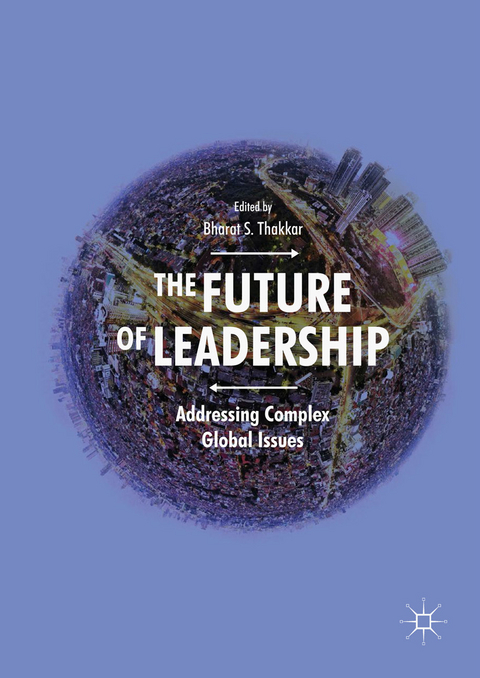
The Future of Leadership (eBook)
XXVII, 277 Seiten
Springer International Publishing (Verlag)
978-3-319-73870-3 (ISBN)
Included among the topics explored by the authors in this book are: investment for the development of diverse human capital, use of data analytics for performance improvement, declining demographic dividends in population deficient areas, and globally increasing women and minority education and employment.
Scholars in business and economics, and managers in industry and government will find this book to be a valuable resource in exploring new directions for the future development of leadership.Bharat Thakkar, Ph.D., is CEO, PREM Group, Inc., a Consulting Firm in Wheaton, Illinois, USA. He has expertise in design of systems packaging, reliability management, and heavy machinery manufacturing management using design of experiments.
Bharat Thakkar, Ph.D., is CEO, PREM Group, Inc., a Consulting Firm in Wheaton, Illinois, USA. He has expertise in design of systems packaging, reliability management, and heavy machinery manufacturing management using design of experiments.
Foreword 6
Preface 10
Acknowledgement 15
Contents 18
Editor and Contributors 20
List of Figures 22
List of Tables 24
Chapter 1 A Brief History and the Future of Leadership 25
Introduction 25
Leadership Theory and Research 26
Leadership in the Eighteenth and Nineteenth Centuries America 27
Cross-Cultural Contexts of Visionary Leadership 28
The Case of Japan 29
The Case of India 30
Leadership in the Twenty-First Century 34
Concluding Remarks 36
References 37
Chapter 2 The Quest for a Paradigm Shift in Leadership for the Next Decade and Beyond 39
Introduction 39
Organization Crises and Scandals 40
Future Leadership and Globalization 42
The Paradigm Shift for Future Leadership 43
Operational Elements Prompting Future Leadership Change 45
New Genre Leadership for the Future 47
Servant Leadership 49
Servant Leadership in Organizations of the Future 51
Operationalizing the Leadership Paradigm Shift 52
Ethics and Moral Environment 52
Collective Action in the Age of Networks 53
Corporate Social Responsibility (CSR) 54
Conclusion 56
Appendix 57
References 58
Chapter 3 Leadership in Indian High-tech Start-ups: Lessons for Future 62
High-tech Start-ups: Across the Globe, in India, and Comparison 62
Recent Findings from Study of Indian High-tech Start-up Founders and Investors 67
Indian High-tech Start-ups and Leadership: Some Road Blocks 69
Types of Start-up Founders or Leaders 69
Three ‘traps’ of Start-up Leaders 71
The Dilemma of Focus on Exploration or Exploitation 72
Stressed Out Employees at High-tech Start-ups 72
Indian Start-ups: Copy Cats of Silicon Valley 73
Financing Issues in the Indian High-tech Start-up Ecosystem Reflecting on Leadership 74
Attitude and Policies That Go Against Innovation and Its Incubation 75
Addressing the Challenges—Significant Insights from Entrepreneurial Leadership Research 76
Transformational Leadership Style for Start-up Leaders 77
The Complexity Theory Perspective to Leadership in Start-ups 78
Entrepreneurial Leadership, Capabilities and Growth 78
Contingency Leadership for Start-up Founders 80
Creating a Followership 80
Indian High-tech Start-ups and Leadership: The Road Ahead 81
Possible DNA Structure of the Successful Indian High-tech Entrepreneurs 81
Human Resources skills of Start-up Entrepreneurs 86
Relevance of the Start-up Idea and Its Implementation in the Indian Context 91
High-tech Start-up Mentoring and Financing in India and for India—A Case of Infosys Cohort 91
Lessons from the Best High-tech Start-ups in India 93
Incubators in the Indian High-tech Start-up Ecosystem 95
Financing and Future Leadership—Lessons from the Past for High-tech Start-ups in India 96
Government Measures to Promote Innovation and Start-ups in India 98
The Future of Leadership in Indian High-tech Start-ups—From Start-up to Keep-up 101
Appendix 105
References 109
Chapter 4 Complexity: The Tipping Point for Leadership 115
Brief History of Complexity 116
Dynamical Systems, Chaos, and Prediction 117
Leadership Tools for Prediction 120
Measures of Complexity 122
Difficulty of Description 123
Difficulty of Creation 123
Logical Depth 123
Thermodynamic Depth 123
Difficulty of Organization 124
Fractal Dimension 124
Hierarchical Complexity 125
Statistical Complexity 125
Properties of Complex Adaptive Systems 126
Emergence 127
Observer Dependency 128
Post-normal Science 129
Evolution 129
Adaptivity 131
Resilience 132
Robustness 132
Network Theory 132
Organizations as Complex Adaptive Systems 133
Implications of Complexity Theory for Leadership Research: The Emergence of Complexity Leadership 137
Characteristic Behaviors of Complexity Leaders 139
Speciesism: A Critical Challenge for Complex Leadership 140
Conclusion 143
References 143
Chapter 5 Leadership in the Next Decade and Beyond: The Challenges of Managing Cities in Developing Economies 147
Operational Definitions 147
Introduction 148
Cities, Leadership, and Culture 149
Issues and Challenges of Managing Cities in Developing Economies with Focus on Nigerian Cities 150
Societal Culture 157
Future View 158
Why Leadership Matters 159
References 162
Chapter 6 The Future of Women in Leadership, Breaking the Glass Ceiling: A Global Perspective 166
Introduction 166
Purpose 168
Conceptualizing the Need for Women in Leadership 169
Literature Review 170
Issues and Challenges of Women in Leadership 173
Why Women Leadership Matters 175
The Future of Women Leadership in Global Businesses 176
The Future of Women in Leadership in the Next Decade and Beyond 178
The Current State of Women Leadership in Politics and Senior Management Positions 180
The State of Women Leaders in Politics and Senior Management Globally in 2012 and 2015 181
The 2016 State of Women CEO’s, Board Directors, and Senior Management Positions in Four Countries 182
Operational Definitions 183
Strategic Recommendations 184
Summary and Conclusion 185
References 186
Chapter 7 Leadership in the Next Decade: Data Analytics—Transforming Information to Knowledge 189
Data Analytics—Transforming Information to Knowledge 189
The Problem with Data Storage as a Mechanism for Organizational Learning 190
A Working Definition of Data Analytics 193
Why Care About Analytics? 194
Types of Analytics 195
How Leadership Can Take Advantage of Data Analytics 197
When to Use Analytics 201
When NOT to Use Analytics 202
The Evolution of Data Analytics in an Organization 204
Leadership and the Future of Analytics 206
Conclusion 209
References 210
Chapter 8 Future of Leadership in Healthcare Business: A Global Perspective 216
Introduction 216
The Human Factor 216
Continuing Education 217
Management Style 219
A Equalitarian Business Plan 220
Economic Externalities 222
Reimbursement 223
Politics, Preventative Care and Dr. Shetty’s Model 224
Technology 224
Overview 226
Leadership Visions 227
Visions 227
Author Experience 235
Ideas for the Future 237
Discussion 240
Conclusion 242
Appendix A 242
Appendix B 243
References 244
Chapter 9 Nonprofit Leadership and Decision Making: Radical Choice Application for Nonprofit’s Sustainability 248
Introduction 248
Background Problem 248
Business Strategies for Nonprofits 249
Objectives 250
Volunteer Contributions in Relation to Nonprofits’ Sustainability 250
Positioning Nonprofit: Cultivation of Baby Boomers 251
Mission 252
Global Mind-Set and Culture 252
Culture and Diversity: Recruitment, Management, and Retention 253
Hofstede Cultural Orientation: Relevance in Volunteerism 253
Technology 256
Trend in Volunteerism 257
Opportunities and Challenges: Baby Boomers as Volunteers 257
The Need to Adopt Commercial Strategies in Nonprofits’ Domain 258
Integrated Leadership 259
Leadership 260
Difference Between Leadership and Management 260
The Traditional Leadership Styles in Brief 263
Transactional Leadership 263
Situational Leadership Style 264
Servant Leadership Model 265
Transformational Leadership Style 266
Level 5 Leadership Style 268
From Greatness to Good, and to No More 269
A Brief Comparative Analysis of Business Decision-Making Theories 269
Rational Decision-Making Model 270
Naturalistic Decision-Making Model 271
The Quality of Decisions Made 271
Bias Theory Model 272
Time-Critical and Non-time-Critical 273
Cost-Effective Related 274
Limitations of the Models 274
Nonprofit Leaders and Decision Support System (DSS) 275
How to Use Rational Choice Decision Making to Enhance Leadership 277
Strategic Recruitment of Volunteers Using Integrated Leadership and Decision-Making Models 278
Exemplification of Rational Choice and EMV of Nonprofit 279
Risk Involved 280
Leaders and Ethical Decision Making 281
Some Recommendations to Prevent Unethical Decision Making 282
Managerial Implications 285
Tips for Future Leaders 286
Summary 289
References 290
Subject Index 294
| Erscheint lt. Verlag | 1.6.2018 |
|---|---|
| Zusatzinfo | XXVII, 277 p. 30 illus. |
| Verlagsort | Cham |
| Sprache | englisch |
| Themenwelt | Wirtschaft ► Betriebswirtschaft / Management ► Personalwesen |
| Wirtschaft ► Betriebswirtschaft / Management ► Unternehmensführung / Management | |
| Schlagworte | Complexity theory • data analytics • effective leadership • emottional intelligence • General Systems Theory • Healthcare Management • Indian High-tech Start-ups • knowledge management • Servant Leadership • Transactional leadership • Transformational Leadership • Women in Leadership |
| ISBN-10 | 3-319-73870-4 / 3319738704 |
| ISBN-13 | 978-3-319-73870-3 / 9783319738703 |
| Informationen gemäß Produktsicherheitsverordnung (GPSR) | |
| Haben Sie eine Frage zum Produkt? |
 PDF (Wasserzeichen)
DRM: Digitales Wasserzeichen
Dieses eBook enthält ein digitales Wasserzeichen und ist damit für Sie personalisiert. Bei einer missbräuchlichen Weitergabe des eBooks an Dritte ist eine Rückverfolgung an die Quelle möglich.
Dateiformat: PDF (Portable Document Format)
Mit einem festen Seitenlayout eignet sich die PDF besonders für Fachbücher mit Spalten, Tabellen und Abbildungen. Eine PDF kann auf fast allen Geräten angezeigt werden, ist aber für kleine Displays (Smartphone, eReader) nur eingeschränkt geeignet.
Systemvoraussetzungen:
PC/Mac: Mit einem PC oder Mac können Sie dieses eBook lesen. Sie benötigen dafür einen PDF-Viewer - z.B. den Adobe Reader oder Adobe Digital Editions.
eReader: Dieses eBook kann mit (fast) allen eBook-Readern gelesen werden. Mit dem amazon-Kindle ist es aber nicht kompatibel.
Smartphone/Tablet: Egal ob Apple oder Android, dieses eBook können Sie lesen. Sie benötigen dafür einen PDF-Viewer - z.B. die kostenlose Adobe Digital Editions-App.
Buying eBooks from abroad
For tax law reasons we can sell eBooks just within Germany and Switzerland. Regrettably we cannot fulfill eBook-orders from other countries.
aus dem Bereich