


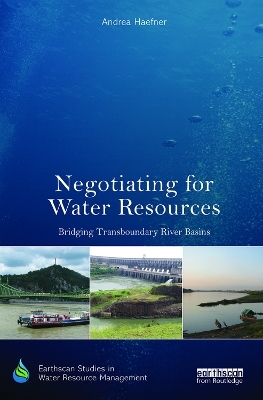
Negotiating for Water Resources
Bridging Transboundary River Basins
Seiten
2018
Routledge (Verlag)
978-0-367-00025-7 (ISBN)
Routledge (Verlag)
978-0-367-00025-7 (ISBN)
Haefner explores the drivers of conflict and cooperation between states in transnational river basins. She provides a three level analysis across three case studies, including the regional framework, the River Basin Organisations, and the micro-level.
Over 90 per cent of the world population lives in countries that share a river basin with others. Freshwater resources are scarce and different nations, actors and users compete for limited resources in transboundary river basins; often conflicting with each other. Water is a resource with no substitute: it cannot be secured in sufficiently large quantities through long-distance trade deals; and, due to the interconnectivity of the hydrological system, the actions of one country in its water management have a direct bearing on the interests of neighbouring countries. For instance, in the Mekong River Basin, current hydropower and navigation developments in certain countries impact on traditional sources of income such as fisheries, and rice production in others. These kinds of changes in water use have given rise to conflict between countries in that region and others, but have also led, in some cases, to greater cooperation. The past few decades have seen a number of new agreements about the sharing of river resources and cooperation between riparian states.
Negotiating for Water Resources explores the drivers of conflict and cooperation between states in transnational river basins. Drawing on extensive fieldwork and interviews on the Mekong, Danube and La Plata River Basins, the book provides a three level analysis across three case studies, including the regional framework (EU, ASEAN and Mercosur), the River Basin Organisations (ICPDR, MRC and CIC) and the micro-level. The key question of the book is: To what extent do power asymmetries prevent or inhibit cooperation between riparian states over water resources? This is linked to the question of how institutions contribute to mitigate competition for natural resources and how states interact in a multilateral arena. Overall, the book argues that cooperation in transboundary river basins is possible even where there are asymmetric power relations, challenging realist assumptions about competition and conflict over resources.
Over 90 per cent of the world population lives in countries that share a river basin with others. Freshwater resources are scarce and different nations, actors and users compete for limited resources in transboundary river basins; often conflicting with each other. Water is a resource with no substitute: it cannot be secured in sufficiently large quantities through long-distance trade deals; and, due to the interconnectivity of the hydrological system, the actions of one country in its water management have a direct bearing on the interests of neighbouring countries. For instance, in the Mekong River Basin, current hydropower and navigation developments in certain countries impact on traditional sources of income such as fisheries, and rice production in others. These kinds of changes in water use have given rise to conflict between countries in that region and others, but have also led, in some cases, to greater cooperation. The past few decades have seen a number of new agreements about the sharing of river resources and cooperation between riparian states.
Negotiating for Water Resources explores the drivers of conflict and cooperation between states in transnational river basins. Drawing on extensive fieldwork and interviews on the Mekong, Danube and La Plata River Basins, the book provides a three level analysis across three case studies, including the regional framework (EU, ASEAN and Mercosur), the River Basin Organisations (ICPDR, MRC and CIC) and the micro-level. The key question of the book is: To what extent do power asymmetries prevent or inhibit cooperation between riparian states over water resources? This is linked to the question of how institutions contribute to mitigate competition for natural resources and how states interact in a multilateral arena. Overall, the book argues that cooperation in transboundary river basins is possible even where there are asymmetric power relations, challenging realist assumptions about competition and conflict over resources.
Andrea Haefner is an Adjunct Research Fellow at the Griffith Asia Institute in Brisbane, Australia, where she also received her PhD. She has previously worked with international and national organisations in Asia and with the German local government. Her research focuses on non-traditional security issues focusing on environmental security and water governance.
Chapter 1: Introduction
Chapter 2: Cooperation and Conflict in Transboundary River Basins – A Framework
Chapter 3: Troubled Mekong: Upstream-downstream Challenges and Current Developments
Chapter 4: Danube River: The Leading Example?
Chapter 5: La Plata River Basin: Overlapping Bilateral and Multilateral Treaties
Chapter 6: Cross Case Analysis, Findings and Lessons
Chapter 7: Conclusion
| Erscheinungsdatum | 19.09.2018 |
|---|---|
| Reihe/Serie | Earthscan Studies in Water Resource Management |
| Zusatzinfo | 2 Tables, black and white; 14 Line drawings, black and white; 3 Halftones, black and white; 17 Illustrations, black and white |
| Verlagsort | London |
| Sprache | englisch |
| Maße | 152 x 229 mm |
| Gewicht | 362 g |
| Themenwelt | Naturwissenschaften ► Biologie ► Ökologie / Naturschutz |
| Sozialwissenschaften ► Politik / Verwaltung ► Europäische / Internationale Politik | |
| Sozialwissenschaften ► Politik / Verwaltung ► Vergleichende Politikwissenschaften | |
| Wirtschaft ► Volkswirtschaftslehre | |
| ISBN-10 | 0-367-00025-3 / 0367000253 |
| ISBN-13 | 978-0-367-00025-7 / 9780367000257 |
| Zustand | Neuware |
| Informationen gemäß Produktsicherheitsverordnung (GPSR) | |
| Haben Sie eine Frage zum Produkt? |
Mehr entdecken
aus dem Bereich



aus dem Bereich
Methoden – Lösungen – Anwendungen
Buch | Hardcover (2025)
Hanser (Verlag)
CHF 69,95


