


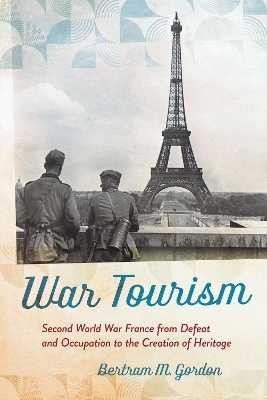
War Tourism
Second World War France from Defeat and Occupation to the Creation of Heritage
Seiten
2018
Cornell University Press (Verlag)
978-1-5017-1587-7 (ISBN)
Cornell University Press (Verlag)
978-1-5017-1587-7 (ISBN)
As German troops entered Paris following their victory in June 1940, the American journalist William L. Shirer observed that they carried cameras and behaved as "naïve tourists." One of the first things Hitler did after his victory was to tour occupied Paris, where he was famously photographed in front of the Eiffel Tower.Focusing on tourism by...
As German troops entered Paris following their victory in June 1940, the American journalist William L. Shirer observed that they carried cameras and behaved as "naïve tourists." One of the first things Hitler did after his victory was to tour occupied Paris, where he was famously photographed in front of the Eiffel Tower.
Focusing on tourism by German personnel, military and civil, and French civilians during the war, as well as war-related memory tourism since, War Tourism addresses the fundamental linkages between the two. As Bertram M. Gordon shows, Germans toured occupied France by the thousands in groups organized by their army and guided by suggestions in magazines such as Der Deutsche Wegleiter fr Paris [The German Guide for Paris]. Despite the hardships imposed by war and occupation, many French civilians continued to take holidays. Facilitated by the Popular Front legislation of 1936, this solidified the practice of workers' vacations, leading to a postwar surge in tourism.
After the end of the war, the phenomenon of memory tourism transformed sites such as the Maginot Line fortresses. The influx of tourists with links either directly or indirectly to the war took hold and continues to play a significant economic role in Normandy and elsewhere. As France moved from wartime to a postwar era of reconciliation and European Union, memory tourism has held strong and exerts significant influence across the country.
As German troops entered Paris following their victory in June 1940, the American journalist William L. Shirer observed that they carried cameras and behaved as "naïve tourists." One of the first things Hitler did after his victory was to tour occupied Paris, where he was famously photographed in front of the Eiffel Tower.
Focusing on tourism by German personnel, military and civil, and French civilians during the war, as well as war-related memory tourism since, War Tourism addresses the fundamental linkages between the two. As Bertram M. Gordon shows, Germans toured occupied France by the thousands in groups organized by their army and guided by suggestions in magazines such as Der Deutsche Wegleiter fr Paris [The German Guide for Paris]. Despite the hardships imposed by war and occupation, many French civilians continued to take holidays. Facilitated by the Popular Front legislation of 1936, this solidified the practice of workers' vacations, leading to a postwar surge in tourism.
After the end of the war, the phenomenon of memory tourism transformed sites such as the Maginot Line fortresses. The influx of tourists with links either directly or indirectly to the war took hold and continues to play a significant economic role in Normandy and elsewhere. As France moved from wartime to a postwar era of reconciliation and European Union, memory tourism has held strong and exerts significant influence across the country.
Bertram Gordon is Professor of European History at Mills College. He is the author of Collaborationism in France during the Second World War and The Historical Dictionary of World War II France.
Preface
Introduction: Tourism, Aesthetics, and War
1. The Emergence of France as a Tourist Icon in the Belle Époque
2. Two 1940 Locales as Sites and Symbols: The Maginot Line and the Compiègne Railway Car
3. French Tourism in their Occupied Country
4. German Tourism in Occupied France, 1940–1944
5. The Liberation-1944: Normandy and Paris
6. Sites of Memory and the TouristImaginary
7. Tourism, War, and Memory in PostwarFrance
Conclusion: Tourism and Appropriate Remembrance
Appendix: References and Sites
Notes
Index
| Erscheinungsdatum | 05.10.2018 |
|---|---|
| Zusatzinfo | 19 b&w halftones, 2 charts - 2 Charts - 19 Halftones, black and white |
| Verlagsort | Ithaca |
| Sprache | englisch |
| Maße | 152 x 229 mm |
| Gewicht | 907 g |
| Themenwelt | Geschichte ► Allgemeine Geschichte ► Neuzeit (bis 1918) |
| Geschichte ► Allgemeine Geschichte ► 1918 bis 1945 | |
| Geisteswissenschaften ► Geschichte ► Regional- / Ländergeschichte | |
| Geschichte ► Teilgebiete der Geschichte ► Militärgeschichte | |
| Wirtschaft | |
| ISBN-10 | 1-5017-1587-9 / 1501715879 |
| ISBN-13 | 978-1-5017-1587-7 / 9781501715877 |
| Zustand | Neuware |
| Informationen gemäß Produktsicherheitsverordnung (GPSR) | |
| Haben Sie eine Frage zum Produkt? |
Mehr entdecken
aus dem Bereich

aus dem Bereich
Geschichte einer wilden Handlung
Buch | Hardcover (2024)
C.H.Beck (Verlag)
CHF 47,60


