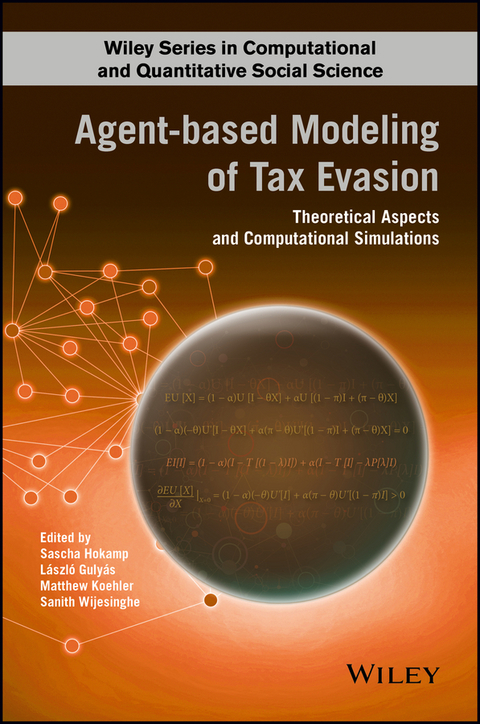
Agent-based Modeling of Tax Evasion (eBook)
John Wiley & Sons (Verlag)
978-1-119-15570-6 (ISBN)
The only single-source guide to understanding, using, adapting, and designing state-of-the-art agent-based modelling of tax evasion
A computational method for simulating the behavior of individuals or groups and their effects on an entire system, agent-based modeling has proven itself to be a powerful new tool for detecting tax fraud. While interdisciplinary groups and individuals working in the tax domain have published numerous articles in diverse peer-reviewed journals and have presented their findings at international conferences, until Agent-based Modelling of Tax Evasion there was no authoritative, single-source guide to state-of-the-art agent-based tax evasion modeling techniques and technologies.
Featuring contributions from distinguished experts in the field from around the globe, Agent-Based Modelling of Tax Evasion provides in-depth coverage of an array of field tested agent-based tax evasion models. Models are presented in a unified format so as to enable readers to systematically work their way through the various modeling alternatives available to them. Three main components of each agent-based model are explored in accordance with the Overview, Design Concepts, and Details (ODD) protocol, each section of which contains several sub elements that help to illustrate the model clearly and that assist readers in replicating the modeling results described.
- Presents models in a unified and structured manner to provide a point of reference for readers interested in agent-based modelling of tax evasion
- Explores the theoretical aspects and diversity of agent-based modeling through the example of tax evasion
- Provides an overview of the characteristics of more than thirty agent-based tax evasion frameworks
- Functions as a solid foundation for lectures and seminars on agent-based modelling of tax evasion
The only comprehensive treatment of agent-based tax evasion models and their applications, this book is an indispensable working resource for practitioners and tax evasion modelers both in the agent-based computational domain and using other methodologies. It is also an excellent pedagogical resource for teaching tax evasion modeling and/or agent-based modeling generally.
Sascha Hokamp, PhD is a member of the Research Unit for Sustainability and Global Change (FNU) and of the Center for Earth System Research and Sustainability (CEN), Universität Hamburg. His research topics include illicit activities (tax evasion and doping in elite sports) and the shadow economy.
László Gulyás, PhD is Assistant Professor at Eötvös Loránd University, Budapest. He is a former Head of Division at AITIA International, Inc. He has been doing research on agent-based modeling and multi-agent systems since 1996.
Matthew Koehler, PhD is the Applied Complexity Sciences Area Lead for US Treasury/Internal Revenue Service, US Commerce, and Social Security Administration Program Division at The MITRE Corporation.
Sanith Wijesinghe, PhD is Chief Engineer of the Model Based Analytics department at The MITRE Corporation.
The only single-source guide to understanding, using, adapting, and designing state-of-the-art agent-based modelling of tax evasion A computational method for simulating the behavior of individuals or groups and their effects on an entire system, agent-based modeling has proven itself to be a powerful new tool for detecting tax fraud. While interdisciplinary groups and individuals working in the tax domain have published numerous articles in diverse peer-reviewed journals and have presented their findings at international conferences, until Agent-based Modelling of Tax Evasion there was no authoritative, single-source guide to state-of-the-art agent-based tax evasion modeling techniques and technologies. Featuring contributions from distinguished experts in the field from around the globe, Agent-Based Modelling of Tax Evasion provides in-depth coverage of an array of field tested agent-based tax evasion models. Models are presented in a unified format so as to enable readers to systematically work their way through the various modeling alternatives available to them. Three main components of each agent-based model are explored in accordance with the Overview, Design Concepts, and Details (ODD) protocol, each section of which contains several sub elements that help to illustrate the model clearly and that assist readers in replicating the modeling results described. Presents models in a unified and structured manner to provide a point of reference for readers interested in agent-based modelling of tax evasion Explores the theoretical aspects and diversity of agent-based modeling through the example of tax evasion Provides an overview of the characteristics of more than thirty agent-based tax evasion frameworks Functions as a solid foundation for lectures and seminars on agent-based modelling of tax evasion The only comprehensive treatment of agent-based tax evasion models and their applications, this book is an indispensable working resource for practitioners and tax evasion modelers both in the agent-based computational domain and using other methodologies. It is also an excellent pedagogical resource for teaching tax evasion modeling and/or agent-based modeling generally.
Sascha Hokamp, PhD is a member of the Research Unit for Sustainability and Global Change (FNU) and of the Center for Earth System Research and Sustainability (CEN), Universität Hamburg. His research topics include illicit activities (tax evasion and doping in elite sports) and the shadow economy. László Gulyás, PhD is Assistant Professor at Eötvös Loránd University, Budapest. He is a former Head of Division at AITIA International, Inc. He has been doing research on agent-based modeling and multi-agent systems since 1996. Matthew Koehler, PhD is the Applied Complexity Sciences Area Lead for US Treasury/Internal Revenue Service, US Commerce, and Social Security Administration Program Division at The MITRE Corporation. Sanith Wijesinghe, PhD is Chief Engineer of the Model Based Analytics department at The MITRE Corporation.
Notes on Contributors
Amanda Andrei is a social scientist and senior artificial intelligence engineer at The MITRE Corporation specializing in social analytics, development of innovative processes and spaces, and application of mixed methods to sociotechnical problems. She received her BA in Anthropology from the College of William & Mary, her Certificate in Computational Social Science from George Mason University, and her MA in Communication, Culture, and Technology from Georgetown University.
Kim M. Bloomquist is an operations research analyst with the U.S. Internal Revenue Service's Taxpayer Advocate Service. He has authored and coauthored numerous papers and book chapters on the economics of taxpayer compliance and agent-based modeling. His research has been cited in Congressional testimony, the Washington Post, Tax Notes, and Tax Notes International. He has received several awards for his research on tax compliance including the Organization for Economic Cooperation and Development's (OECD) Jan Francke Tax Research Award, the Cedric Sandford medal for the best paper at the seventh International Conference on Tax Administration in Sydney, Australia, and the IRS Research Community Award for Research Technical Expertise. Kim received his PhD (Computational Social Science) from George Mason University, Fairfax, Virginia in 2012.
Kevin Comer is a Modeling and Simulation Engineer at the MITRE Corporation, specializing in agent-based modeling design, development and validation. His primary focus is in simulating the dynamics of the individual health insurance market. He also works on modeling processes in cybersecurity and homeland security. He received his B.S. in Systems Engineering and Economics from the University of Virginia, his M.S. in Operations Research from George Mason University Volgenau School of Engineering, and his Ph.D. in Computational Social Science from George Mason University's Department of Computational Social Science. His email address is ktcomer@mitre.org.
Andrés M. Cuervo Díaz completed his BSc in Physics from Universidad de los Andes, Bogota, Colombia, in 2014 in the field of quantum optics and is a master's student in the study program “Integrated Climate System Sciences” at the Cluster of Excellence (DFG EXC 177 CliSAP), participating in the research group Climate Change and Security (CLISEC). He is mainly interested in agent-based and integrated assessment modeling for the evaluation of policies' performance and possible strategies to enhance environmental protection and climate change action.
László Gulyás holds a PhD in Computer Science from Eötvös Loránd University, Hungary. He is an assistant professor at Eötvös Loránd University, Budapest, and held the position of head of division at AITIA International, Inc. He has been doing research on agent-based modeling and multiagent systems since 1996. He has been involved in teaching both graduate and undergraduate level courses in agent-based modeling and simulation at Harvard University, at the Central European University and at the Eötvös Loránd University, Hungary. He has authored several book chapters and journal articles. In particular, László has published on agent-based modeling of tax evasion since 2009.
Nigar Hashimzade obtained her PhD in Economics from Cornell University in 2003. Prior to her current position at Durham she has worked at the University of Exeter and the University of Reading. Her research interests are in applied microeconomic theory and in quantitative methods. Since 2012, she has been involved in research on the behavioral approach to tax evasion funded jointly by the ESRC, HMRC, and HMT. Among other projects, she works on developing behavioral models of tax compliance decisions in social networks and on building agent-based models that can be used to assess and compare tax enforcement policies in a complex environment. Nigar has published in leading international academic journals and contributed to a number of monographs, for some of which she has also been a coeditor. Her previous career was in theoretical physics.
Christine Harvey is a high-performance and analytic computing engineer at The MITRE Corporation in Washington, D.C. She specializes in data analysis and high-performance computing in simulations. In addition, her research interests include agent-based modeling and big data analysis, particularly in the field of Healthcare. She completed her masters in Computational Science from Stockton University in 2013 and is expected to finish her PhD in Computational Science and Informatics at George Mason University in 2018.
Erik Hemberg is a postdoctoral researcher in the ALFA group in CSAIL at the Massachusetts Institute of Technology. He performs research regarding scaleable machine learning. He is currently involved in research regarding tax evasion and physiological time series prediction. He received his PhD in Computer Science from the University College Dublin, Ireland. At ICAIL 2015 he co-authored the Peter Jackson Best Innovative Application paper.
Sascha Hokamp obtained his PhD in Public Economics from the Brandenburg University of Technology Cottbus, Germany, in 2013. He was awarded a stipend from the Deutsche Bundesbank via the “Verein für Socialpolitik” in 2011 and 2012. He is involved in organizing the biannual “Shadow Economy” conference series, founded at the Westfälische Wilhelms-Universität Münster, Germany, in 2009. He served in 2015 as a guest editor in Economics of Governance on “The Shadow Economy, Tax Evasion, and Governance.” Sascha is a member of the Research Unit for Sustainability and Global Change (FNU) and of the Center for Earth System Research and Sustainability (CEN), Universität Hamburg, Germany, and he is participating researcher at the Cluster of Excellence “Integrated Climate System Analysis and Prediction” (DFG EXC 177 CliSAP), on the project “Societal Use of Climate Information.” His research topics are integrated assessment modeling of climate change, agent-based modeling of environmental challenges, and climate policy as well as illicit activities (tax evasion and doping in elite-sports) and the shadow economy.
Matthew Koehler is the Applied Complexity Sciences Area Lead for the U.S. Treasury/Internal Revenue Service, U.S. Commerce, and Social Security Administration Program Division at The MITRE Corporation. He has concentrated on decision support using agent-based models and simulations, and the analysis and visualization of large datasets coming from complex systems. He received his AB in Anthropology from Kenyon College, his MPA from Indiana University's School of Public and Environmental Affairs, his JD from George Washington University's Law School, and his PhD in Computational Social Science from George Mason University's Krasnow Institute for Advanced Study, Department of Computational Social Science.
Toni Llacer holds a PhD in Sociology from the Universitat Autónoma de Barcelona (UAB), Spain. His research field is the interdisciplinary study of tax evasion. He obtained a bachelor's degree in Economics from Universitat Pompeu Fabra, a bachelor's degree in Philosophy from Universitat de Barcelona (Academic Excellence Award), and a master of science in Applied Social Research from UAB.
Tamás Máhr has a PhD in Computer Sciences from the Delft University of Technology, The Netherlands, and project manager of the simulation group of AITIA International Inc. He has been the senior software architect of the CRISIS project on agent-based modeling of the macro-financial system, responsible for the CRISIS Game Architecture, as well as for the CRISIS Integrated Simulator. His past research involved agent-based transportation planning and robustness of multiagent logistical planning, but he also published on auction algorithms, which are commonly used mechanisms in multiagent systems. Before the PhD track, Tamás got his MSc from the Budapest University of Technology and Economics, Hungary.
Shaun Michel is a computational sociologist in The MITRE Corporation's Department of Artificial Intelligence and Cognitive Science, specializing in simulation modeling, social behavior, and globalization. He began working on a PhD in Sociology at George Mason University in 2012 and he holds a master's degree in Sociology from East Tennessee State University.
Francisco J. Miguel Quesada is an associate professor at the Universitat Autónoma de Barcelona (UAB) teaching Methodology for the Social Sciences, Sociology of Consumption, and Applied Statistics for Marketing Analysis. He holds a PhD in Sociology from the UAB and a university specialist degree in Sociology of Consumption from the Universidad Complutense de Madrid. He has conducted research in sociology of consumption, social indicators, and school-to-work transitions. At present, he mainly works in the domain of computational sociology as GSADI group member. As Head of the “Laboratory for Socio-Historical Dynamics Simulation” (LSDS), he has been involved in several projects on the use of agent-based social simulation for modeling social networks dynamics and evolution of social behavior.
Luigi Mittone is a full professor of Economics at the University of Trento, Italy. At the University of Trento he is the Director of the Doctoral School of Social Sciences, Director of the Cognitive and Experimental Economics Laboratory, and coordinator of the International...
| Erscheint lt. Verlag | 12.2.2018 |
|---|---|
| Reihe/Serie | Wiley Series in Computational and Quantitative Social Science |
| Wiley Series in Computational and Quantitative Social Science | Wiley Series in Computational and Quantitative Social Science |
| Sprache | englisch |
| Themenwelt | Mathematik / Informatik ► Mathematik ► Angewandte Mathematik |
| Mathematik / Informatik ► Mathematik ► Statistik | |
| Mathematik / Informatik ► Mathematik ► Wahrscheinlichkeit / Kombinatorik | |
| Recht / Steuern ► Steuern / Steuerrecht | |
| Recht / Steuern ► Wirtschaftsrecht | |
| Wirtschaft ► Volkswirtschaftslehre ► Wirtschaftspolitik | |
| Schlagworte | Accounting • agent-based modeling • agent-based modeling and tax evasion applications • agent-based modeling and tax evasion theory • agent-based simulations • agent-based tax evasion model examples • agent-based tax evasion modeling case studies • Angew. Wahrscheinlichkeitsrechn. u. Statistik / Modelle • Applied Probability & Statistics - Models • Besteuerung • Computational modeling • Data Modeling • Data Science • Design Concepts and Details (ODD) protocol • detecting tax evasion • Finanz- u. Wirtschaftsstatistik • Overview • predicting tax evasion • Rechnungswesen • shadow economy statistical modeling • Statistics • Statistics for Finance, Business & Economics • Statistik • Taxation • tax compliance analysis • tax compliance behavior simulation tools • tax compliance human-based calibration • Tax evasion • tax evasion behavioral explanations • tax evasion modeling • tax evasion psychology • tax evasion simulation • tax evasion statistical modeling • tax evasion stochastic modeling • tax experiments • tax fraud modeling • Tax Morale • tax payer behavior modeling • tax payer behavior simulation • Wirtschaftsstatistik |
| ISBN-10 | 1-119-15570-3 / 1119155703 |
| ISBN-13 | 978-1-119-15570-6 / 9781119155706 |
| Informationen gemäß Produktsicherheitsverordnung (GPSR) | |
| Haben Sie eine Frage zum Produkt? |
 EPUB (Adobe DRM)
Kopierschutz: Adobe-DRM
Adobe-DRM ist ein Kopierschutz, der das eBook vor Mißbrauch schützen soll. Dabei wird das eBook bereits beim Download auf Ihre persönliche Adobe-ID autorisiert. Lesen können Sie das eBook dann nur auf den Geräten, welche ebenfalls auf Ihre Adobe-ID registriert sind.
Details zum Adobe-DRM
Dateiformat: EPUB (Electronic Publication)
EPUB ist ein offener Standard für eBooks und eignet sich besonders zur Darstellung von Belletristik und Sachbüchern. Der Fließtext wird dynamisch an die Display- und Schriftgröße angepasst. Auch für mobile Lesegeräte ist EPUB daher gut geeignet.
Systemvoraussetzungen:
PC/Mac: Mit einem PC oder Mac können Sie dieses eBook lesen. Sie benötigen eine
eReader: Dieses eBook kann mit (fast) allen eBook-Readern gelesen werden. Mit dem amazon-Kindle ist es aber nicht kompatibel.
Smartphone/Tablet: Egal ob Apple oder Android, dieses eBook können Sie lesen. Sie benötigen eine
Geräteliste und zusätzliche Hinweise
Buying eBooks from abroad
For tax law reasons we can sell eBooks just within Germany and Switzerland. Regrettably we cannot fulfill eBook-orders from other countries.
aus dem Bereich