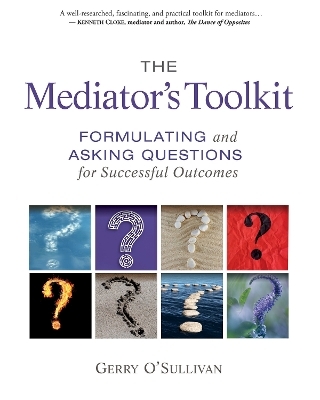
The Mediator's Toolkit
New Society Publishers (Verlag)
978-0-86571-897-5 (ISBN)
- Titel erscheint in neuer Auflage
- Artikel merken
“Dives deep into the psychology of information and emotion in conflict situations . . . Highly recommended for facilitators and negotiators as well as mediators.” —Jennifer Beer, author of The Mediator’s Handbook and negotiation instructor at Wharton School, University of Pennsylvania
Knowing how to formulate and ask incisive questions to get to the core of a conflict, challenge entrenched thinking, and shift perspectives is the key to successful conflict resolution. The Mediator’s Toolkit employs the author’s powerful “S Questions Model” to provide readers with the skills and tools to do just that. It addresses four dimensions of successful questions for mediation: the subject matter dimension, the structure dimension, the information-seeking dimension, and the shifting thinking dimension. The toolkit clearly explains:
The theory behind each question type, including exploration of relevant neuroscience and psychology
The purpose of different types of questions
How the questions work
When to use different types of questions
How to build and apply questions to mediation in a non-threatening way
This essential practical guide will radically sharpen, focus, and improve the questioning skills of qualified mediators, students, lecturers, trainers, and those using questions to challenge and effect change, in any context.
Gerry O'Sullivan is a mediator, trainer, and facilitator with over 30 years of experience in conflict resolution and training. She is an advanced member of the Mediators' Institute of Ireland (MII) and is a member of the US-based Mediators Beyond Borders Consultants Team. She has delivered training internationally with Lawyers Without Borders, in partnership with the Director of Training from CEDR, UK. Gerry delivers accredited Certified Professional Mediation Training in Ireland and has delivered mediation training for the University of Limerick's Masters in Peace and Development program, and she was involved in the development of mediation training in the Law Faculty of Griffith College, Ireland. Gerry is Director of O'Sullivan Solutions and she lives on the southwest coast of Ireland.
Acknowledgments
Glossary
Introduction
Book Content
Terminology
Sequences of Questions
SECTION I: The S Questions Model — Theory
Chapter 1: Introduction and Purpose of the S Questions Model
The S Questions Model
Premise on Which the S Questions Model Has Been Developed
Outline Summary of the Model
The S Questions Model
The Purpose of Mediation Questions
Perspective and Paradigm
Chapter 2: How We Process and Communicate Information
How Information Is Processed
Factors That Contribute to the Information That We Process
The NLP Model of Communication
Our Created Paradigm Becomes Our Reference Point for Interpreting Information
How We Communicate Information to Others
Distortion, Deletion and Generalization When Communicating to Others
The Surface Structure Language We Use When We Communicate with Others
Using Mediation Questions to Create a Paradigm Shift
Chapter 3: Working with the Brain in Mediation
The Brain
Working with the Avoid-threat Reflex in Mediation
SECTION 2: Practical Application of the S Questions Model
Chapter 4: Methodology to Minimize an Avoid-threat Reflex When Asking Questions
Methodology
Chapter 5: The S Questions Model Applied to a Mediation Process
Reflective Preparation for Questions
The S Questions Model
S Questions Model Applied to Initial Separate Meeting
S Questions Model Applied to Joint Meeting
SECTION 3: Practical Application of S1, S2 and S3 Questions
Chapter 6: S1: The Subject Matter Dimension of Questions
Chapter 7: S2: The Structure Dimension of Questions
Chapter 8: S3: The Seeking Information Dimension of Questions
SECTION 4: Practical Application of S4 Questions
Chapter 9: Introduction: The Eight Types of S4: Shift Thinking Dimension of Questions 91
S4: The Shift Thinking Dimension of Questions
Chapter 10: S4: Journey of Inference Questions
S4: The Shift Thinking Dimension of Questions — Journey of Inference Questions
How Do Journey of Inference Questions Work?
When to Ask Journey of Inference Questions
Methodology
Chapter 11: S4: Neuro-Linguistic Programming Questions
S4: The Shift Thinking Dimension of Questions — Neuro-Linguistic Programming Questions
How Do Neuro-Linguistic Programming Questions Work?
When to Ask Neuro-Linguistic Programming-based Questions
Methodology
Chapter 12: S4: Distinction and Difference Questions
S4: The Shift Thinking Dimension of Questions — Distinction and Difference Questions
How Do Distinction and Difference Questions Work?
When to Ask Distinction and Difference Questions
Methodology
Chapter 13: S4: Reflective Connecting Questions
S4: The Shift Thinking Dimension of Questions — Reflective Connecting Questions
How Do Reflective Connecting Questions Work?
When to Ask Reflective Connecting Questions
Methodology
Chapter 14: S4: Cognitive Elements-based Questions
S4: The Shift Thinking Dimension of Questions — Cognitive Elements-Based Questions
How Do Cognitive Elements-based Questions Work?
When to Ask Cognitive Elements-based Questions
Methodology
Chapter 15: S4: Other People Questions
S4: The Shift Thinking Dimension of Questions — Other People Questions
How Do Other People Questions Work?
When to Ask Other People Questions
Methodology
Chapter 16: S4: Underlying Interests Questions
S4: The Shift Thinking Dimension of Questions — Underlying Interests Questions
How Do Underlying Interests Questions Work?
When to Ask Underlying Interests Questions
Methodology
Chapter 17: S4: Future Focus Questions
S4: The Shift Thinking Dimension of Questions — Future Focus Questions
How Do Future Focus Questions Work?
When to Ask Future Focus Questions
Methodology
Endnotes
Index
About the Authors
A Note about the Publisher
| Erscheinungsdatum | 11.09.2018 |
|---|---|
| Zusatzinfo | 35 Line drawings, black and white |
| Verlagsort | Gabriola Island |
| Sprache | englisch |
| Maße | 203 x 254 mm |
| Gewicht | 662 g |
| Themenwelt | Recht / Steuern ► EU / Internationales Recht |
| Recht / Steuern ► Privatrecht / Bürgerliches Recht ► Zivilverfahrensrecht | |
| Sozialwissenschaften ► Pädagogik ► Sozialpädagogik | |
| Sozialwissenschaften ► Soziologie ► Mikrosoziologie | |
| Wirtschaft ► Betriebswirtschaft / Management | |
| ISBN-10 | 0-86571-897-0 / 0865718970 |
| ISBN-13 | 978-0-86571-897-5 / 9780865718975 |
| Zustand | Neuware |
| Informationen gemäß Produktsicherheitsverordnung (GPSR) | |
| Haben Sie eine Frage zum Produkt? |
aus dem Bereich