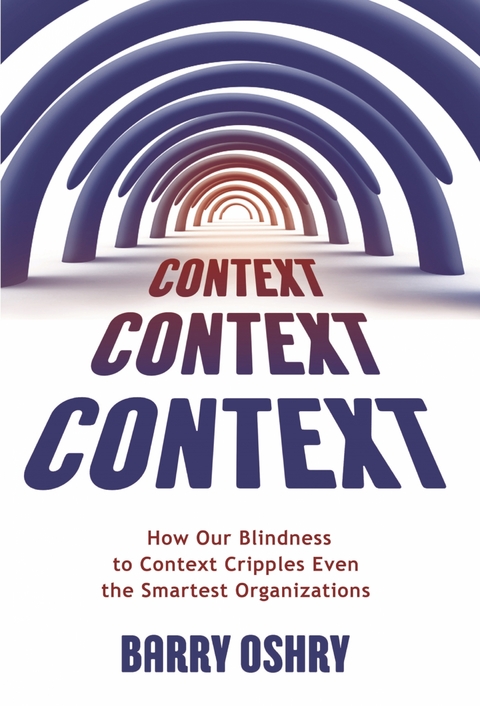
Context, Context, Context (eBook)
158 Seiten
Triarchy Press (Verlag)
9781911193296 (ISBN)
Barry Oshry explains the problem with organizational structures in this dialogue between two consultants about a change initiative. A guide to Systems Thinking for organizations, it's as engaging and helpful as any business book you've ever read. Give it to team leaders, trainers, HR people, managers and chief execs and transform your organization.
Barry Oshry explains the problem with organizational structures in this dialogue between two consultants about a change initiative. A guide to Systems Thinking for organizations, it's as engaging and helpful as any business book you've ever read. Give it to team leaders, trainers, HR people, managers and chief execs and transform your organization.
Chapter 1: THE PLAN
SHE:
Dynamics Unlimited had been a successful company since its founding 15+ years ago. In the last couple of years, however, the company has experienced a severe downturn resulting from a variety of events and conditions: disruptive competition, new technology, changing workforce demographics, globalization, and unpredictable patterns of governmental regulations.
HE:
A familiar story.
SHE:
Yes, and a recent organizational survey revealed what everyone already knew: low employee engagement, distrust of management, insecurity, rapid employee turnover, low morale, and widespread customer dissatisfaction.
HE:
And your assignment was to turn this ship around?
SHE:
Actually, no, not at first anyway.
HE:
Please explain.
SHE:
Well, the Tops had an emergency meeting.
HE:
With everyone?
SHE:
No, just Tops. Enough is enough. We need to restore our excellence. That was the message.
HE:
And the next question was How?
Enter THE PLAN
SHE:
The Tops interviewed several consulting firms. One offered what the Tops felt was an intriguing possibility – called THE PLAN. They assured the Tops that THE PLAN was the key to achieving DU’s goal: Renewed Excellence! DU was in dismal shape; THE PLAN promised hope, so a desperate Top team gave it a try.
HE:
I’ve never heard of THE PLAN.
SHE:
Allow me to describe it.
THE PLAN for total system empowerment
SHE:
According to THE PLAN, all organizations, in fact all human systems, are organic entities engaging with ever-changing environments. In these environments, there are dangers to be avoided and opportunities to be taken advantage of. The fundamental business of all such systems is to survive in their environments and, if possible, thrive by successfully coping with dangers and prospecting among opportunities.
A system in an environment of dangers and opportunities
HE:
Surviving and thriving. Coping and prospecting. Sounds like lyrics for a country song.
SHE:
With too many unhappy outcomes.
HE:
Tell me more.
SHE:
THE PLAN is based on the idea that each part of a system – Top,
Middle, Bottom, and Customer – because of its position, has a unique contribution it can make to the system’s ability to survive and thrive.
Shapers, Producers, Integrators, Validators
SHE:
According to THE PLAN, the system needs Tops to function as SYSTEM SHAPERS, Workers as SYSTEM PRODUCERS, Middles as SYSTEM INTEGRATORS, and Customers as SYSTEM VALIDATORS.
When all this is happening, excellence is sure to follow.
HE:
When all of this is happening.
SHE:
That is the point.
Tops as System SHAPERS
SHE:
According to THE PLAN, Tops are uniquely positioned to function as the SHAPERS of the system. They do this by looking outward, scanning DU’s environment: What are the dangers out there, present and emerging? And what are the possibilities, the opportunities, to be taken advantage of? And the Tops shape the system by looking inward, seeing that the system has the structure, processes, and resources for coping with the dangers and prospecting among possible opportunities.
HE:
So, as I understand it, this isn’t necessarily what Tops do; it’s what they can do.
SHE:
Exactly. Given their unique position, this is the contribution Tops can make to DU’s ability to survive and thrive: Be the system’s SHAPERS.
HE:
A reasonable goal.
SHE:
We’ll see.
Workers as System PRODUCERS
SHE:
Workers are uniquely positioned to function as system PRODUCERS. As PRODUCERS, Workers are the expert resources regarding work, applying their creative energies to the work of the system, being responsible for the quality of work, finding ways of improving work, working closely with DU’s customers. This is the unique contribution Workers can make to DU’s ability to survive and thrive.
HE:
So this is more than simply showing up for work and doing your job.
SHE:
Exactly. This is about being the expert responsible force for how work is done in the organization.
Middle as the System’s INTEGRATING MECHANISM
HE:
And what does THE PLAN have in mind for the Middles?
SHE:
Middles are uniquely positioned to function as the integrating mechanism of the organization, like the integrating mechanisms of the human body: nervous, vascular, and hormonal systems that coordinate, balance, and integrate whole-body processes.
HE:
Aren’t they supposed to lead or manage?
SHE:
They do that. They manage, supervise, coach, mentor. That’s what they do individually. But their collective function, according to THE PLAN, is to integrate the system.
HE:
And how do they do this?
SHE:
They integrate the system by integrating with one another, sharing information, coordinating system parts, seeing that Tops, Workers, and Customers receive the information and resources they need, seeing that the parts feed and support one another in service of the whole. That’s how they function as the system’s INTEGRATING MECHANISM.
HE:
OK. I see the connection to the body’s integrating mechanisms.
SHE:
That’s the idea. THE PLAN is all about treating the organization as a highly functioning organic system.
HE:
OK, so how do the Customers fit?
SHE:
Well, if you think of the organization as a human body, then, in a way, the Customers are the organization’s personal physicians. The doctors who tell you the truth.
Customers as System VALIDATORS
SHE:
According to THE PLAN, customers are uniquely positioned to function as VALIDATORS of the system, letting DU know how well it is doing what it is supposed to be doing. Is it living up to its potential?
HE:
Like a reality check.
SHE:
Exactly. They validate the system by giving it feedback – positive and negative. Like good doctors, they not only evaluate, they recommend: what to stop doing, needed actions to take. And even if Customers were to sever their relationship with the organization, their feedback and recommendations as VALIDATORS would be informative. That’s their unique contribution.
Power is everywhere
HE:
So, as I see it, in THE PLAN, all parts of the organization have their unique power to contribute to the overall power of the system.
SHE:
Exactly. Power is distributed throughout rather than located at the Top. Each part understands the critical and unique role it plays in ensuring system survival and development. As each part embraces its power, the power of the whole flourishes.
HE:
What I’m also seeing is how these functions all work together.
SHE:
That’s also the point. The better Tops are as Shapers, the better conditions will exist for Workers to Produce. The better Middles are at Integrating, the more supported Tops and Workers are in Shaping and Producing. And the better Customers are at Validating, the more the organization as a whole knows how well it is doing what it needs to be doing.
HE:
What a plan!
SHE:
You seem enthused.
HE:
It’s lovely, very simple, elegant. It’s got a lot going for it. Top to Bottom, everyone feels their unique value, how the system depends on them. It’s not the usual perspective, where all power and wisdom lies at the Top. I like that.
SHE:
Anything else?
HE:
I also like the fact that each part supports the others, and that each depends on the others. If Tops don’t shape, it all falls apart; the system doesn’t have the structure it needs for coping and prospecting. If Workers don’t produce, it doesn’t work. If Middles don’t integrate, there’s no coordination. And if Customers don’t validate, the system just goes on living in fantasy land.
SHE:
Very neat. The parts supporting one another and depending on one another. What could go wrong?
HE:
I’m guessing: plenty.
SHE:
Right again. THE PLAN is good; it just wasn’t working.
The Summary Report: Part A
Tops too burdened to function as SHAPERS.
Workers too oppressed to function as PRODUCERS.
Middle too torn to function as the INTEGRATING MECHANISM.
Customers too righteously screwed to function as VALIDATORS.
SHE:
Surveys were conducted, interviews held, results tabulated, and the picture that emerged was disheartening to say the least. Here are some highlights from the interviews.
Feedback from the Tops
“We’re too busy to Shape; there are just too many day-to-day issues for us to deal with. Unanticipated changes. Tough decisions to make. We’re mostly agreed that Shaping is important but it just isn’t possible under present circumstances. Maybe when things lighten up.”
Feedback from the Workers
“We’re not getting the support we need to produce. Our Middles are weak, uninformed; they don’t have the information or resources we need to do our work. And Tops?...
| Erscheint lt. Verlag | 2.1.2018 |
|---|---|
| Sprache | englisch |
| Themenwelt | Wirtschaft ► Betriebswirtschaft / Management ► Personalwesen |
| Wirtschaft ► Betriebswirtschaft / Management ► Planung / Organisation | |
| Wirtschaft ► Betriebswirtschaft / Management ► Unternehmensführung / Management | |
| Schlagworte | Organization development • Power and Love • systems thinking |
| ISBN-13 | 9781911193296 / 9781911193296 |
| Informationen gemäß Produktsicherheitsverordnung (GPSR) | |
| Haben Sie eine Frage zum Produkt? |
 EPUB (Ohne DRM)
Digital Rights Management: ohne DRM
Dieses eBook enthält kein DRM oder Kopierschutz. Eine Weitergabe an Dritte ist jedoch rechtlich nicht zulässig, weil Sie beim Kauf nur die Rechte an der persönlichen Nutzung erwerben.
Dateiformat: EPUB (Electronic Publication)
EPUB ist ein offener Standard für eBooks und eignet sich besonders zur Darstellung von Belletristik und Sachbüchern. Der Fließtext wird dynamisch an die Display- und Schriftgröße angepasst. Auch für mobile Lesegeräte ist EPUB daher gut geeignet.
Systemvoraussetzungen:
PC/Mac: Mit einem PC oder Mac können Sie dieses eBook lesen. Sie benötigen dafür die kostenlose Software Adobe Digital Editions.
eReader: Dieses eBook kann mit (fast) allen eBook-Readern gelesen werden. Mit dem amazon-Kindle ist es aber nicht kompatibel.
Smartphone/Tablet: Egal ob Apple oder Android, dieses eBook können Sie lesen. Sie benötigen dafür eine kostenlose App.
Geräteliste und zusätzliche Hinweise
Buying eBooks from abroad
For tax law reasons we can sell eBooks just within Germany and Switzerland. Regrettably we cannot fulfill eBook-orders from other countries.
aus dem Bereich