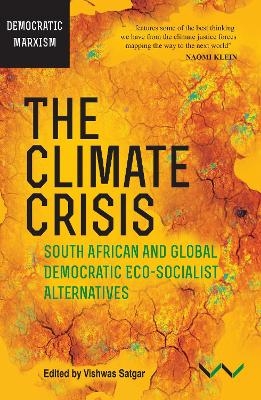
Climate Crisis, the
Wits University Press (Verlag)
978-1-77614-054-1 (ISBN)
Essays that address the question: how can people and class agency change this destructive course of history?
Capitalism's addiction to fossil fuels is heating our planet at a pace and scale never before experienced. Extreme weather patterns, rising sea levels and accelerating feedback loops are a commonplace feature of our lives. The number of environmental refugees is increasing and several island states and low-lying countries are becoming vulnerable. Corporate-induced climate change has set us on an ecocidal path of species extinction. Governments and their international platforms such as the Paris Climate Agreement deliver too little, too late. Most states, including South Africa, continue on their carbon-intensive energy paths, with devastating results. Political leaders across the world are failing to provide systemic solutions to the climate crisis. This is the context in which we must ask ourselves: how can people and class agency change this destructive course of history? Volume three in the Democratic Marxism series, The Climate Crisis investigates eco-socialist alternatives that are emerging. It presents the thinking of leading climate justice activists, campaigners and social movements advancing systemic alternatives and developing bottom-up, just transitions to sustain life. Through a combination of theoretical and empirical work, the authors collectively examine the challenges and opportunities inherent in the current moment. This volume builds on the class-struggle focus of Volume 2 by placing ecological issues at the centre of democratic Marxism. Most importantly, it explores ways to renew historical socialism with democratic, eco-socialist alternatives to meet current challenges in South Africa and the world.
Vishwas Satgar is an associate professor of International Relations at the University of the Witwatersrand, Johannesburg. He is the editor of the Democratic Marxism series, and is the principal investigator for the Emancipatory Futures Studies in the Anthropocene project and a democratic eco-socialist. Mateo Martinez Abarca is a philosopher, activist and writer from Ecuador. He is a PhD candidate in Philosophy at the National Autonomous University of Mexico and a junior researcher at the Center for Social Studies, Universidade de Coimbra, Portugal Vishwas Satgar is an associate professor of International Relations at the University of the Witwatersrand, Johannesburg. He is the editor of the Democratic Marxism series, and is the principal investigator for the Emancipatory Futures Studies in the Anthropocene project and a democratic eco-socialist. Alberto Acosta is an Ecuadorian economist, a professor and researcher in FLACSO-Ecuador and honorary professor at Ricardo Palma University in Lima. He is the former minister of energy and mines, the former president of the Constitutional Assembly and former candidate to the presidency of the republic of Ecuador. He is the author of several books and, above all, a comrade of popular struggles. Brian Ashley is the director of the Alternative Information and Development Centre and the editor of Amandla, a current affairs and new politics project.
Tables, figures and box
Acknowledgements
Acronyms and abbreviations
1 The Climate Crisis and Systemic Alternatives
PART ONE :THE CLIMATE CRISIS AS CAPITALIST CRISIS
2 The Limits of Capitalist Solutions to the Climate Crisis
3 The Anthropocene and Imperial Ecocide: Prospects for Just Transitions
PART TWO: DEMOCRATIC ECO-SOCIALIST ALTERNATIVES IN THE WORLD
4 The Employment Crisis, Just Transition and the Universal Basic Income Grant
5 The Rights of Mother Earth
6 Buen Vivir: An Alternative Perspective from the Peoples of the Global South
7 Challenging the Growth Paradigm: Marx, Buddha and the Pursuit of ‘Happiness’
8 Ubuntu and the Struggle for an African Eco-socialist Alternative
9 The Climate Crisis and the Struggle for African Food Sovereignty
PART THREE: DEMOCRATIC ECO-SOCIALIST ALTERNATIVES IN SOUTH AFRICA
10 The Climate Crisis and a ‘Just Transition’ in South Africa: An Eco-Feminist-Socialist Perspective
11 Energy, Labour, and Democracy in South Africa
12 Capital, Climate and the Politics of Nuclear Procurement in South Africa
13 Climate Jobs at Two Minutes to Midnight
14 Deepening the Just Transition Through Food Sovereignty and the Solidarity Economy
15 Eco-Capitalist Crises in the ‘Blue Economy’: Operation Phakisa’s Small, Slow Failures
CONCLUSION
Contributors
Index
| Erscheinungsdatum | 24.03.2018 |
|---|---|
| Co-Autor | Mateo Martinez Abarca, Vishwas Satgar, Alberto Acosta, Brian Ashley |
| Verlagsort | Johannesburg |
| Sprache | englisch |
| Maße | 152 x 229 mm |
| Themenwelt | Naturwissenschaften ► Biologie ► Ökologie / Naturschutz |
| Sozialwissenschaften ► Politik / Verwaltung | |
| Wirtschaft | |
| ISBN-10 | 1-77614-054-0 / 1776140540 |
| ISBN-13 | 978-1-77614-054-1 / 9781776140541 |
| Zustand | Neuware |
| Informationen gemäß Produktsicherheitsverordnung (GPSR) | |
| Haben Sie eine Frage zum Produkt? |
aus dem Bereich