


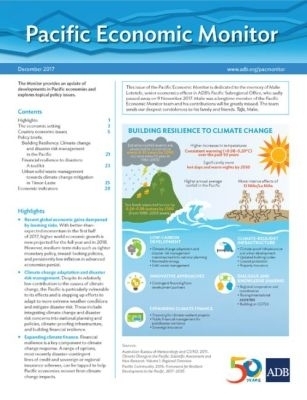
Pacific Economic Monitor - December 2017
Seiten
2017
Asian Development Bank (Verlag)
978-92-9261-026-5 (ISBN)
Asian Development Bank (Verlag)
978-92-9261-026-5 (ISBN)
- Titel z.Zt. nicht lieferbar
- Portofrei ab CHF 40
- Auch auf Rechnung
- Artikel merken
The Pacific is among those parts of the world most vulnerable to weather-related disasters. With climate change bringing additional risks from global sea level rise - and potentially heightening vulnerability to more intense, frequent, and prolonged extreme weather events - Pacific economies are stepping up adaptation efforts to brace for future adverse impacts.
The Pacific is among those parts of the world most vulnerable to weather-related disasters. To illustrate, 5 of the top 15 countries with the highest risk, and 10 of the top 30 facing the largest potential economic losses from disasters, are in the subregion. With climate change bringing additional risks from global sea level rise—and potentially heightening vulnerability to more intense, frequent, and prolonged extreme weather events—Pacific economies are stepping up adaptation efforts to brace for future adverse impacts.
These include climate-proofing vital infrastructure assets, strengthening disaster risk management, and expanding social safety nets to build resilience to disasters. Further, a number of Pacific economies are promoting green urban development to move toward more sustainable green cities. Careful monitoring and planning will also be required to manage important income flows, including fishing license fees and tourism-related revenues, amid climate-related volatilities and to maintain adequate fiscal buffers for disaster response.
The Pacific is among those parts of the world most vulnerable to weather-related disasters. To illustrate, 5 of the top 15 countries with the highest risk, and 10 of the top 30 facing the largest potential economic losses from disasters, are in the subregion. With climate change bringing additional risks from global sea level rise—and potentially heightening vulnerability to more intense, frequent, and prolonged extreme weather events—Pacific economies are stepping up adaptation efforts to brace for future adverse impacts.
These include climate-proofing vital infrastructure assets, strengthening disaster risk management, and expanding social safety nets to build resilience to disasters. Further, a number of Pacific economies are promoting green urban development to move toward more sustainable green cities. Careful monitoring and planning will also be required to manage important income flows, including fishing license fees and tourism-related revenues, amid climate-related volatilities and to maintain adequate fiscal buffers for disaster response.
| Erscheinungsdatum | 24.01.2018 |
|---|---|
| Reihe/Serie | Pacific Economic Monitor |
| Verlagsort | Manila |
| Sprache | englisch |
| Maße | 216 x 279 mm |
| Gewicht | 525 g |
| Themenwelt | Sozialwissenschaften ► Soziologie ► Spezielle Soziologien |
| Wirtschaft ► Volkswirtschaftslehre | |
| ISBN-10 | 92-9261-026-0 / 9292610260 |
| ISBN-13 | 978-92-9261-026-5 / 9789292610265 |
| Zustand | Neuware |
| Informationen gemäß Produktsicherheitsverordnung (GPSR) | |
| Haben Sie eine Frage zum Produkt? |
Mehr entdecken
aus dem Bereich



aus dem Bereich
Bullshit als politische Strategie
Buch | Softcover (2025)
Kohlhammer (Verlag)
CHF 33,55
eine Einführung
Buch | Softcover (2024)
De Gruyter Oldenbourg (Verlag)
CHF 41,90
Antisemitismus und postkoloniale Debatte auf der documenta fifteen
Buch | Softcover (2025)
Campus (Verlag)
CHF 41,95


