


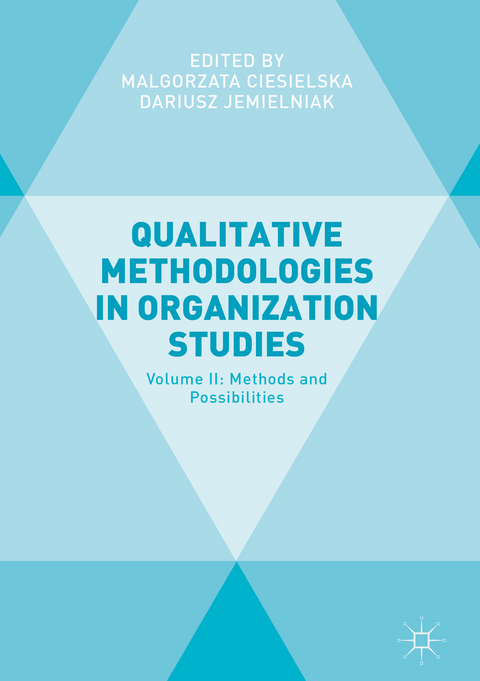
Qualitative Methodologies in Organization Studies (eBook)
264 Seiten
Springer International Publishing (Verlag)
9783319654423 (ISBN)
This book provides a thorough review of tested qualitative methods often used in organization studies, and outlines the challenges and essential requirements of designing a qualitative research project. The methods examined include case studies, observation, interviewing and the repertory grid technique. By highlighting certain key 'rules' for carrying out qualitative research and describing issues that should be avoided, this second volume of Qualitative Methodologies in Organization Studies is essential reading for academics and researchers who wish to understand the current state of qualitative data gathering within organization studies. Those exploring organization studies will find this two-volume collection extremely valuable as it contains robust contributions from highly-skilled authors who are actively researching in this field.
Malgorzata Ciesielska is Senior Lecturer in Organization Studies & HRM at Teesside University, UK, and Associate Editor of Tamara - Journal for Critical Organization Inquiry.
Dariusz Jemielniak is Professor of Management, Head of the Center for Research on Organizations and Workplaces, and Founder of the New Research on Digital Societies group at Kozminski University, Poland.
Malgorzata Ciesielska is Senior Lecturer in Organization Studies & HRM at Teesside University, UK, and Associate Editor of Tamara – Journal for Critical Organization Inquiry. Dariusz Jemielniak is Professor of Management, Head of the Center for Research on Organizations and Workplaces, and Founder of the New Research on Digital Societies group at Kozminski University, Poland.
Foreword 6
Preface 7
Contents 9
Notes on Contributors 11
List of Figures 17
List of Tables 18
1: Case Study 19
1.1 Introduction 19
1.2 Specific Character of the Case Study as Compared to Other Research Methods 20
1.3 Premises of the Case Study Strategy 23
1.4 Types of Case Studies 28
1.5 How to Use Case Study Method in Practice: A Step-by-Step Guide 31
1.5.1 Designing Research as Creating a Chain of Evidence 31
1.6 Conclusions 46
References 47
2: Observation Methods 50
2.1 Introduction 50
2.2 Observational Research Design 51
2.2.1 Research Aims 51
2.2.2 Access to the Field 52
2.2.3 Sampling: What? Who? Where? and When? 53
2.2.4 The Observer 56
2.2.5 Notes Taking 58
2.3 Observation Techniques 58
2.3.1 Direct Participant Observation 59
2.3.2 Direct Non-participant Observation 61
2.3.3 Indirect Observation 63
2.4 New Directions of Observational Research: Sensory Ethnography 65
2.5 Conclusions 67
References 67
3: Fieldwork Techniques for Our Times: Shadowing 70
3.1 Introduction 70
3.2 A History of Shadowing 75
3.3 The Principal’s Shadow 77
3.4 On a Shopping Spree 80
3.5 Shadowing the Screens 83
3.6 Shadowing Compared to Other Field Techniques 85
References 88
4: Interviewing in Qualitative Research 92
4.1 Introduction 92
4.2 Types of Interviews 95
4.3 Preparation of the Interview 102
4.4 Conducting the Interview 106
4.5 Conclusions 112
References 113
5: Focus Group Interviews 114
5.1 Introduction 114
5.2 What Is a Focus Group Interview? 114
5.3 What Does a Focus Group Interview Look Like? 119
5.3.1 Research Planning: Research Sample and Respondent Selection 119
5.3.2 Scenario of an FGI and the Role of the Moderator 124
5.3.3 Inside a Focus Studio 126
5.4 What’s the Purpose of Focus Group Interviews? 128
5.5 Types of Focus Group Interviews 134
5.6 Conclusions: How to Make a Focus Group Interview Successful 141
References 143
6: The Repertory Grid Technique 144
6.1 Introduction 144
6.2 Personal Construct Psychology 145
6.3 The Organization Corollary 149
6.4 The Main Characteristics of Repertory Grid Technique 152
6.5 The Repertory Grid Interview Procedure 153
6.5.1 Topic and Elements 154
6.5.2 Constructs 155
6.5.3 Laddering Down and Pyramiding 156
6.5.4 Laddering Upward and Resistance to Change Techniques 157
6.6 But What About the Numbers? And Some Applications 160
References 164
7: Relational Methods in Organization Studies: A Critical Overview 167
7.1 Introduction 167
7.2 Ontology and Epistemology of Relationality in Organization Studies 168
7.2.1 Relational Methods: The Self-Reflexivity 175
7.2.2 Relational Methods: The Self and the Circumstances 176
7.2.3 Relational Methods: The Self and the Other 179
7.2.4 Relational Methods: The Self, the Other, and the Circumstances 180
7.2.5 Relational Methods: The Other Persons 185
7.2.6 Relational Methods: The Other Persons and the Social/Organizational Phenomena 186
7.2.7 Relational Methods: The Organizational Phenomena (i.e. Structures or Circumstances) 187
7.3 Conclusions 188
References 189
8: Template Analysis in Business and Management Research 194
8.1 Introduction 194
8.2 Thematic Approaches to Qualitative Data Analysis in Organizational Research 195
8.2.1 Styles of Thematic Analysis Used in Qualitative Organizational Research: Methodology Specific and Generic 195
8.2.2 Defining and Organizing Themes in Thematic Analysis 197
8.2.3 Coding in Thematic Analysis 198
8.2.4 The Philosophical Position of Thematic Analysis 199
8.3 Using Template Analysis 200
8.3.1 Familiarization with the Data 201
8.3.2 Preliminary Coding 202
8.3.3 Clustering 203
8.3.4 Developing the Initial Template 204
8.3.5 Modifying the Template and Defining the ‘Final’ Version 205
8.3.6 Using the Template to Interpret the Data 206
8.3.7 Writing-Up 207
8.3.8 Quality Assurance in Template Analysis 208
8.4 Case Study: Cultural Differences and Customer Experiences in the Hospitality Sector 209
8.4.1 Background and Introduction to the Case 210
8.4.2 Template Analysis Procedure 212
8.4.3 Familiarization with the Data and Preliminary Coding 212
8.4.4 Clustering 213
8.4.5 Producing the Initial Template 213
8.4.6 Modifying the Template 214
8.4.7 Developing the Final Template 215
8.4.8 Writing-Up 217
8.4.9 Key Challenges and Learning Points 217
8.5 Conclusion 218
References 219
9: Discourse Analysis 222
9.1 Introduction 222
9.2 Text 223
9.3 Discourse 225
9.4 Dimensions of Discourse 230
9.5 Discourse Analysis 232
9.6 A Practical Example of Discourse Analysis 233
References 236
10: Designing a Qualitative Research Project 238
10.1 Introduction 238
10.2 The Theory and the Problem, or Formulating the Research Question 241
10.3 The Problem and the Method, or Method Selection 248
10.4 The Resources Necessary to Conduct Research 252
10.5 Conclusion 257
References 258
11: What Should Be Avoided During Qualitative Research? 260
11.1 Introduction 260
11.2 Typical Pitfalls in Qualitative Research 261
11.2.1 Research Design 263
11.2.2 Conducting Research 266
11.2.3 Drawing Conclusions and Reporting Research Results 269
11.3 Conclusions 270
References 271
Index 273
| Erscheint lt. Verlag | 11.12.2017 |
|---|---|
| Vorwort | Martyna Śliwa |
| Zusatzinfo | XXI, 264 p. 1 illus. |
| Verlagsort | Cham |
| Sprache | englisch |
| Themenwelt | Wirtschaft ► Betriebswirtschaft / Management ► Marketing / Vertrieb |
| Wirtschaft ► Betriebswirtschaft / Management ► Planung / Organisation | |
| Wirtschaft ► Betriebswirtschaft / Management ► Unternehmensführung / Management | |
| Schlagworte | Action Research • data collection • Interview • reflective analysis • Repertory Grid technique • Research • Research methods • Survey |
| ISBN-13 | 9783319654423 / 9783319654423 |
| Informationen gemäß Produktsicherheitsverordnung (GPSR) | |
| Haben Sie eine Frage zum Produkt? |
 PDF (Wasserzeichen)
DRM: Digitales Wasserzeichen
Dieses eBook enthält ein digitales Wasserzeichen und ist damit für Sie personalisiert. Bei einer missbräuchlichen Weitergabe des eBooks an Dritte ist eine Rückverfolgung an die Quelle möglich.
Dateiformat: PDF (Portable Document Format)
Mit einem festen Seitenlayout eignet sich die PDF besonders für Fachbücher mit Spalten, Tabellen und Abbildungen. Eine PDF kann auf fast allen Geräten angezeigt werden, ist aber für kleine Displays (Smartphone, eReader) nur eingeschränkt geeignet.
Systemvoraussetzungen:
PC/Mac: Mit einem PC oder Mac können Sie dieses eBook lesen. Sie benötigen dafür einen PDF-Viewer - z.B. den Adobe Reader oder Adobe Digital Editions.
eReader: Dieses eBook kann mit (fast) allen eBook-Readern gelesen werden. Mit dem amazon-Kindle ist es aber nicht kompatibel.
Smartphone/Tablet: Egal ob Apple oder Android, dieses eBook können Sie lesen. Sie benötigen dafür einen PDF-Viewer - z.B. die kostenlose Adobe Digital Editions-App.
Buying eBooks from abroad
For tax law reasons we can sell eBooks just within Germany and Switzerland. Regrettably we cannot fulfill eBook-orders from other countries.
aus dem Bereich


