


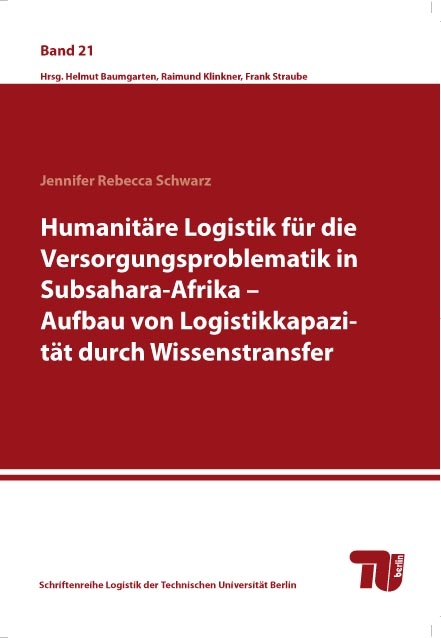
Humanitäre Logistik für die Versorgungsproblematik in Subsahara
Aufbau von Logistikkapazität durch Wissenstransfer
Seiten
2012
Universitätsverlag der TU Berlin
978-3-7983-2444-2 (ISBN)
Universitätsverlag der TU Berlin
978-3-7983-2444-2 (ISBN)
- Keine Verlagsinformationen verfügbar
- Artikel merken
Humanitarian logistics has recently gained significance in research and practice. With up to 80 percent of costs caused by purchasing, transportation and warehousing it is increasingly considered key to efficient and effective disaster management. Particularly the occurrence of epic disasters like the Haiti earthquake in 2010 or the Pakistan flood in 2010 draws global attention to humanitarian logistics due to millions of affected people that rely on humanitarian assistance. 83 percent of the victims of natural disasters occur in developing or emerging countries. Especially the poorest of the poor lack the capability to prepare themselves. The infrastructure in these countries is already insufficient under regular circumstances and often completely destroyed or damaged during the event and therefore not accessible to emergency response teams. This is particularly true for the continent of Africa where about 35 percent of the population is affected by malnutrition and about 80 percent is excluded from health care. At the same time Africa – besides Southeast Asia – is the most disaster prone continent, particularly exposed to droughts, floods and epidemics but also man-made hazards. Under consideration of the given situation in sub-Saharan Africa a research was carried out by a research team at the Berlin University of Technology from 2009 to 2011 in order to identify solutions to enhance the livelihood of the poorest of the poor. The results of this research project have been modified and extended for this dissertation. In the core of this research is the lack of logistics knowledge, taking into consideration country specific factors. It has been found that neither the awareness for nor the importance of humanitarian logistics is commonly known in sub-Saharan Africa. Therefore a two-staged transfer model has been developed, each consisting of four main phase in order to identify and transfer necessary logistics knowledge under consideration of empirical studies as well as country-specific factors for building up humanitarian logistics capacity. The dissertation ends with a case study applying the proposed procedure is approach. Während sich die Anzahl von Naturkatastrophen wie Überflutungen, Dürren und Erdbeben in den letzten 30 Jahren dramatisch erhöht hat, sind vor allem die am wenigsten entwickelten Länder dieser Erde von den Folgen betroffen. Das Konzept der humanitären Logistik, welches die Effizienz und Effektivität der humanitären Hilfe determiniert, ist in diesen Ländern weitestgehend unbekannt. Die Literaturrecherche, Analyse von Sekundärdaten und Befragung von Expertengruppen in Subsashara-Afrika sowie die Durchführung einer Feldstudie in Tansania machten allerdings deutlich, dass neben infrastrukturellen Defiziten insbesondere logistisches Wissen in afrikanischen Entwicklungsländern nur unzureichend vorhanden ist. In der vorliegenden Arbeit werden daher Defizite in der logistischen Aus- und Weiterbildung in Subsahara-Afrika identifiziert, um darauf aufbauend inhaltliche Mindestvoraussetzungen zu formulieren, welche sich an den berufsspezifischen Anforderungen von in der humanitäre Hilfe tätigen Logistikern in Subsahara-Afrika orientieren. Zur Identifikation und zum Transfer des Logistikwissens wird eine Systematik vorgestellt, welche ausgehend von vorhandenen Transfermodellen die Gestaltung des Wissenstransfers auf der ersten Stufe zwischen Entwicklungs- und Industrieländern sowie auf der zweiten Stufe zwischen Entwicklungsländern unter Berücksichtigung der afrikaspezifischen Rahmenbedingungen diskutiert. Am Beispiel Tansanias werden die im Modell identifizierten Transferkomponenten angewandt und Ergebnisse vorgestellt.
| Erscheinungsdatum | 11.12.2017 |
|---|---|
| Reihe/Serie | Schriftenreihe Logistik der Technischen Universität Berlin ; 21 |
| Verlagsort | Berlin |
| Sprache | deutsch |
| Maße | 147 x 210 mm |
| Einbandart | Paperback |
| Themenwelt | Sachbuch/Ratgeber ► Beruf / Finanzen / Recht / Wirtschaft ► Wirtschaft |
| Wirtschaft ► Betriebswirtschaft / Management ► Unternehmensführung / Management | |
| Wirtschaft ► Volkswirtschaftslehre | |
| Schlagworte | Afrika • Entwicklungsländer • Humanitäre Logistik • Logistikkapazität • Subsahara-Afrika • Wissenstransfer |
| ISBN-10 | 3-7983-2444-1 / 3798324441 |
| ISBN-13 | 978-3-7983-2444-2 / 9783798324442 |
| Zustand | Neuware |
| Informationen gemäß Produktsicherheitsverordnung (GPSR) | |
| Haben Sie eine Frage zum Produkt? |
Mehr entdecken
aus dem Bereich



aus dem Bereich
Buch | Hardcover (2025)
Tropen (Verlag)
CHF 39,20
warum wir vor den Tech-Milliardären noch nicht einmal auf dem Mars …
Buch | Softcover (2025)
Suhrkamp (Verlag)
CHF 30,80
zum Stand der Dinge (des Alltags)
Buch | Softcover (2025)
Suhrkamp (Verlag)
CHF 30,80


