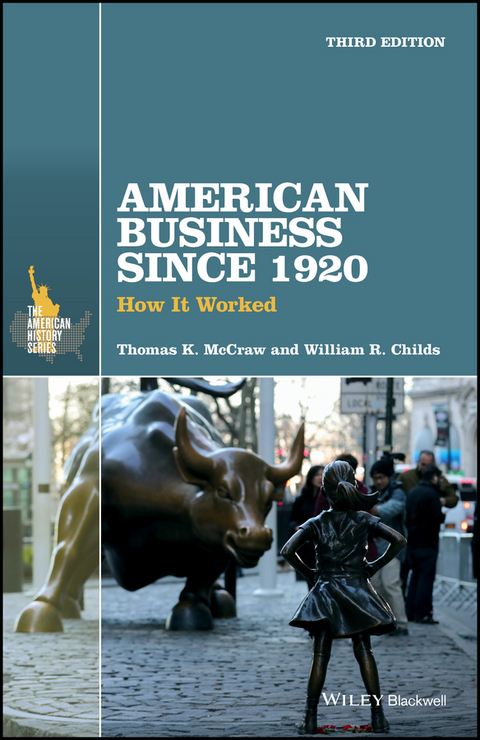
American Business Since 1920 (eBook)
407 Seiten
Wiley-Blackwell (Verlag)
978-1-119-09726-6 (ISBN)
Tells the story of how America's biggest companies began, operated, and prospered post-World War I
This book takes the vantage point of people working within companies as they responded to constant change created by consumers and technology. It focuses on the entrepreneur, the firm, and the industry, by showing-from the inside-how businesses operated after 1920, while offering a good deal of Modern American social and cultural history. The case studies and contextual chapters provide an in-depth understanding of the evolution of American management over nearly 100 years.
American Business Since 1920: How It Worked presents historical struggles with decision making and the trend towards relative decentralization through stories of extraordinarily capable entrepreneurs and the organizations they led. It covers: Henry Ford and his competitor Alfred Sloan at General Motors during the 1920s; Neil McElroy at Procter & Gamble in the 1930s; Ferdinand Eberstadt at the government's Controlled Materials Plan during World War II; David Sarnoff at RCA in the 1950s and 1960s; and Ray Kroc and his McDonald's franchises in the late twentieth century and early twenty-first; and more. It also delves into such modern success stories as Amazon.com, eBay, and Google.
- Provides deep analysis of some of the most successful companies of the 20th century
- Contains topical chapters covering titans of the 2000s
- Part of Wiley-Blackwell's highly praised American History Series
American Business Since 1920: How It Worked is designed for use in both basic and advanced courses in American history, at the undergraduate and graduate levels.
Thomas K. McCraw (d. 2012) was former Professor and Isidor Straus Professor of Business History for the Harvard Business School, where he was instrumental in making Business History an important aspect of the MBA program. McCraw received a Pulitzer Prize in History in 1985 for his book, Prophets of Regulation (1984). He also served as editor of the Business History Review, as associate editor of The Encyclopedia of the United States in the Twentieth Century, and as president and trustee of the Business History Conference. He was a member of the Board of Syndics of Harvard University Press, the Council of the Massachusetts Historical Society, the advisory board of Nomura School of Advanced Management (Tokyo), and the editorial boards of Reviews in American History and Harvard Business Review.
William R. Childs was former History Professor at Ohio State University. He retired from teaching in 2014. Tom McCraw was his advisor at The University of Texas at Austin in the 1970s. After McCraw left for the Harvard Business School in 1978, he remained on Childs' dissertation committee and hired him as a research assistant for his book Prophets of Regulation (1984). In addition to his two books and numerous articles and book reviews, Childs was editor of Essays in Economic and Business History (1995-1998) and has served on the Board of Editors for the Business History Review and Enterprise & Society.
Thomas K. McCraw (d. 2012) was former Professor and Isidor Straus Professor of Business History for the Harvard Business School, where he was instrumental in making Business History an important aspect of the MBA program. McCraw received a Pulitzer Prize in History in 1985 for his book, Prophets of Regulation (1984). He also served as editor of the Business History Review, as associate editor of The Encyclopedia of the United States in the Twentieth Century, and as president and trustee of the Business History Conference. He was a member of the Board of Syndics of Harvard University Press, the Council of the Massachusetts Historical Society, the advisory board of Nomura School of Advanced Management (Tokyo), and the editorial boards of Reviews in American History and Harvard Business Review. William R. Childs was former History Professor at Ohio State University. He retired from teaching in 2014. Tom McCraw was his advisor at The University of Texas at Austin in the 1970s. After McCraw left for the Harvard Business School in 1978, he remained on Childs' dissertation committee and hired him as a research assistant for his book Prophets of Regulation (1984). In addition to his two books and numerous articles and book reviews, Childs was editor of Essays in Economic and Business History (1995-1998) and has served on the Board of Editors for the Business History Review and Enterprise & Society.
In this third edition of Thomas C. McCraw's expansive work, William R. Childs has taken on the challenge of extending its reach into the first years of the 21st Century. The volatile events and issues of these years have made the task a daunting one, but Childs has risen to the occasion. Seamlessly folding new information into old, he has addressed the financial crisis of 2008, the accelerated growth of income inequality, the contentious debates surrounding globalization and financialization, the evolving roles of women and minorities in business, and innumerable other subjects of equal urgency. - Mary A. Yeager, PhD, Professor at UCLA
INTRODUCTION
Past and Present
In 1920, most Americans lived very differently from the way they do now. In that year half of all Americans lived on farms or in very small towns. Many communities remained unconnected to the rest of the country by railways, highways, or telephones. Except for immigrants, most Americans did not travel more than 150 miles from where they were born.
Only one‐third of the nation’s homes had electricity in 1920. Cooking, cleaning, and laundry tasks consumed 70 hours a week. Today, after one of the greatest social changes in human history, that total has plunged to 15 hours because of the availability of such appliances as electric refrigerators, microwave ovens, washers and dryers, vacuum cleaners, dishwashers, garbage disposals, and fast food and take‐out restaurants.
In 1920 no Americans had a TV, computer, or cell phone, let alone an iPad or smart watch. They did not email, text‐message, or purchase retail goods and invest in the stock market online or with their cell phones. They did not take the family to eat at McDonald’s or any other restaurant chain. They did not fly in airplanes, draw cash from ATMs, or use credit cards. There were no malls or supermarkets (the shopping cart was not invented until 1937). Most Americans did not graduate from high school, given the pressure to find a paying job in their mid‐teens; today 85 percent graduate from high school. Only 1 person in 30 graduated from college in 1920; today 1 in 4 do so.
In 1920 care of children, the elderly, and the ill took place in the home; doctors often made “house‐calls.” Deaths from pneumonia, tuberculosis, cholera, diphtheria, measles, influenza, and typhoid fever ran at more than ten times the current rates. Premodern sanitary conditions held forth in many areas. Only 1 in 5 households had an indoor flush toilet. Controlling the size of families was difficult, as reliable birth control methods (other than abstinence) were unavailable or illegal. Most of these conditions true for America in the 1920s still exist for a majority of the world’s population.
Nearly four decades would pass before most Americans and some consumers in other nations enjoyed modern products such as refrigerators. In the invention, development, manufacturing, and marketing of such products, American firms led the way. By 1960, the year John F. Kennedy was elected president, 96 percent of American homes had electric refrigerators, but only 41 percent of French and 30 percent of English and Italian homes had them. That Europeans caught up to Americans by the end of the century suggests how ubiquitous the American‐style refrigerator had become.
The Story Told Here
The story of American business since 1920 logically divides into six periods: the 1920s; the Depression of the 1930s; the New Deal and World War II; the postwar era; the 1980s to the 2000s; and the Financial Crisis of 2007–2008 and the Great Recession of 2007–2009. In the chapters to follow, particular individuals, firms, and industries are highlighted in the era in which they made the most impact, even though their beginnings might have come earlier or they may remain important today.
Many of the chapters to follow take the vantage point of entrepreneurs working at firms in American industries, showing from the inside how businesses operated. The “overview” chapters describe and analyze the social, cultural, and political contexts of the evolving American capitalist system within which the entrepreneurs made management decisions. As the story unfolds over the twentieth century and into the twenty‐first, the internationalization of American business and comparisons between American‐style capitalism and other nations’ political economies become more prominent.
Trends
Four potent trends in American business since 1920 underpin the narrative that follows. None proceeded without temporary setbacks, but all kept moving forward:
- The relentlessness of change. All capitalist economies share this characteristic, but it applies with special force to the United States, where it is accurate to speak of relentlessly accelerating relentlessness. After 1920 the tempos of economic change grew faster, and then faster still. No generation in human history before 1920 has experienced more rapid and relentless change than have the generations following.
- A growing empowerment of consumers and entrepreneurs. Here the main driving force was the increase in per‐capita incomes by a factor of six from 1920 to 2014. This unprecedented rise in the nation’s affluence was accompanied by a profound shift in the nature of jobs. In 1920, 30 percent of the population worked on farms; today, 1.5 percent do so. In 1920, almost 30 percent of the population labored in goods‐producing industries such as mining, construction, and manufacturing; today the percentage is 12.6. Jobs in service industries such as retail sales, banking, restaurants, medical services, house cleaning, music teachers, etc. comprised nearly 40 percent of all jobs in the 1920s; today 80 percent of Americans work in the service sector. Together these two big changes – sharply rising incomes and radical redeployments in jobs away from agriculture and production toward services – brought tremendous gains in both consumer power and entrepreneurial opportunity. To cite just one example from early in the story: with the advent of motor vehicles, millions of Americans enjoyed a new sense of freedom and vast opportunities to start new automobile‐related businesses such as taxis, buses, and delivery services.
The evolution of electronic media stimulated the growing empowerment of consumers and entrepreneurs as well. This growth began with AM radio in the 1920s, continued with FM radio and black and white television in the 1940s, accelerated with color television in the 1960s, and high definition television (HDTV) and digital cable in the 1990s and early 2000s, and today advances with streaming online content accessible by laptops and cell phones. Meanwhile, a small government project created in the 1980s – the Internet – led to the World Wide Web in the 1990s. Products and services competed for the consumer, and especially with the privatization of the Net in 1995, undreamed of opportunities beckoned the entrepreneur.
This growing empowerment extended to groups previously excluded from complete participation in the capitalist system. In large measure because of national government responses to political pressure in the 1960s and 1970s, women and minorities exerted more influence as consumers and entrepreneurs during the latter decades of this story.
- An increasing tension between centralized and decentralized decision making in business, and the general triumph of decentralization. Constant decision making lies at the heart of business. Every hour of every day, millions of decisions are made within companies. But by whom? On what basis? In whose interest? During and after the 1920s, as many companies grew ever larger, tensions about decision making became increasingly complicated. The best‐run firms began to develop effective ways to push authority downward to the person best informed to make a particular decision, regardless of where in the hierarchy that person might rank. This was a gradual and often painful lesson for managers to learn, as many stories in this book will show. Companies whose leaders failed to learn the lesson not only suffered, but often perished. In the latter twentieth century, the tensions increased as financial considerations began to influence entrepreneurs to change the way they made business decisions. More and more the focus fell on making short‐term profits, rather than developing long‐range strategies that would ensure the emergence of useful new goods and services.
- Progress toward controlling the dark side of business, so that the system did not destroy itself from within. Competition can bring out the best and worst of human actions. The pressure to make profits often tempts managers to use every advantage, and that sometimes results in unethical and illegal behavior toward their competitors, workers, and consumers. New laws and regulations typically emerge after the exposure of serious problems, rarely in anticipation of them. The American economy is a mixed economy in which most businesses are privately owned and markets are the dominant form of coordination, but there is some government spending on oversight and regulation in order to promote social aims. There is in American business–government relations a constant tension between promoting business and regulating business. Governments promote entrepreneurship through enforcing contract law and supporting infrastructures (transportation, communications, and banks). In economies and societies embracing constant change, governments must always play catch‐up in their efforts to regulate business. In the years since the 1930s to the 1980s, US regulators did a fairly good job of reining in bad behavior without stifling entrepreneurship. The regulatory regime was not perfect, however, and in the 1970s government restraints began to loosen over a variety of industries. That loosening led to some positive results – more consumer choice and entrepreneurial activity in telecommunications and airlines – but also to the Savings and Loan Crisis of the 1980s and the Financial Crisis of 2007–2008.
A Matter of Size
Almost every...
| Erscheint lt. Verlag | 30.11.2017 |
|---|---|
| Reihe/Serie | The American History Series |
| The American History Series | The American History Series |
| Sprache | englisch |
| Themenwelt | Geisteswissenschaften ► Geschichte ► Regional- / Ländergeschichte |
| Geschichte ► Teilgebiete der Geschichte ► Wirtschaftsgeschichte | |
| Wirtschaft ► Betriebswirtschaft / Management ► Planung / Organisation | |
| Wirtschaft ► Betriebswirtschaft / Management ► Unternehmensführung / Management | |
| Schlagworte | Amazon.co • American business • American business after World War II • American business during World War II • American business in the 20th century • American business in the late 20th century • American franchises • American History • American success stories • Business & Management • Business & Society • business during the Great Depressions • business success stories • ebay • Economics • economics in the 20th century • famous American corporations • famous business owners • Ford • General Motors • Geschichte • Geschichte der USA • Geschichte u. Zeitgeschichte des 20./21. Jahrhunderts • Google • History • life after the Great War • McDonalds • post-World War 1 business • Procter? Boeing • rca • successful American companies • successful businesses • successful business models • The 1920s • the 1930s • the 1950s • The 1960s • the New Deal and American business • Twentieth Century & Contemporary History • USA /Geschichte • USA /Wirtschaft, Volkswirtschaft • us history • Wirtschaft • Wirtschaft u. Gesellschaft • Wirtschaft u. Management |
| ISBN-10 | 1-119-09726-6 / 1119097266 |
| ISBN-13 | 978-1-119-09726-6 / 9781119097266 |
| Informationen gemäß Produktsicherheitsverordnung (GPSR) | |
| Haben Sie eine Frage zum Produkt? |
 EPUB (Adobe DRM)
Kopierschutz: Adobe-DRM
Adobe-DRM ist ein Kopierschutz, der das eBook vor Mißbrauch schützen soll. Dabei wird das eBook bereits beim Download auf Ihre persönliche Adobe-ID autorisiert. Lesen können Sie das eBook dann nur auf den Geräten, welche ebenfalls auf Ihre Adobe-ID registriert sind.
Details zum Adobe-DRM
Dateiformat: EPUB (Electronic Publication)
EPUB ist ein offener Standard für eBooks und eignet sich besonders zur Darstellung von Belletristik und Sachbüchern. Der Fließtext wird dynamisch an die Display- und Schriftgröße angepasst. Auch für mobile Lesegeräte ist EPUB daher gut geeignet.
Systemvoraussetzungen:
PC/Mac: Mit einem PC oder Mac können Sie dieses eBook lesen. Sie benötigen eine
eReader: Dieses eBook kann mit (fast) allen eBook-Readern gelesen werden. Mit dem amazon-Kindle ist es aber nicht kompatibel.
Smartphone/Tablet: Egal ob Apple oder Android, dieses eBook können Sie lesen. Sie benötigen eine
Geräteliste und zusätzliche Hinweise
Buying eBooks from abroad
For tax law reasons we can sell eBooks just within Germany and Switzerland. Regrettably we cannot fulfill eBook-orders from other countries.
aus dem Bereich