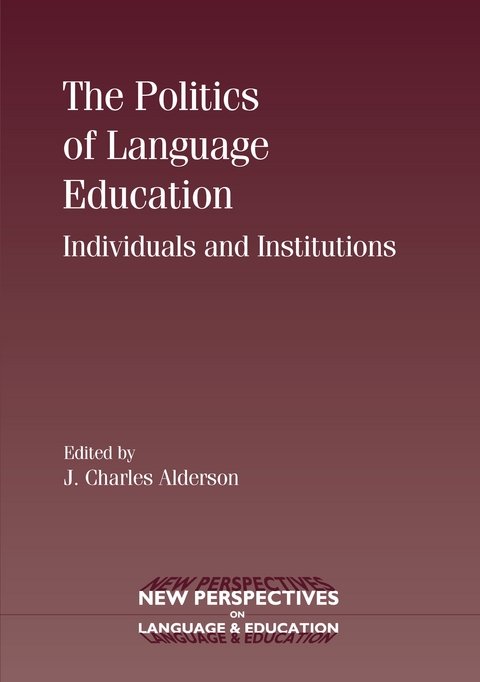
The Politics of Language Education (eBook)
Multilingual Matters (Verlag)
978-1-84769-144-6 (ISBN)
This book highlights the importance of micropolitics in shaping language education policy, development and projects. It discusses background theory to understanding micropolitics, issues surrounding the research and publication of political behaviour by individuals and institutions, and presents case studies from a range of different contexts.
Politics can be a very important influence on educational developments and their deployment. However, this volume is different from other volumes since it looks, not at the macropolitics and the ideological agendas of nations and multinational or global organisations, but rather focuses on micropolitics, the agendas and motivations of individuals within organisations, and on their actions. Micropolitics can be seen as ways of manoeuvring within institutions which are themselves not political, but commercial, financial and educational. Indeed, politics with a small p includes not only institutional politics, but also personal politics, which can influence language education both in daily matters, and in projects for innovation and change. The aim of this edited book is to begin a debate about the nature and role of micropolitics, to contribute to a better understanding of language education, change and resistance to change, and the processes of language education.
lt;p>Charles Alderson is Professor of Linguistics and English Language Education at Lancaster University, UK. He was Director of the Revision Project that produced the IELTS test; Scientific Coordinator of DIALANG (www.dialang.org); Academic Adviser to the British Councilâ??s Hungarian English Examination Reform Project; and is former co-editor of the international journal Language Testing and the Cambridge Language Assessment Series (Cambridge University Press). He has taught and lectured in over 50 countries world-wide, been consultant to numerous language education projects, and is internationally well-known for his teaching, research and publications in language testing and assessment, programme and course evaluation, reading in a foreign language and teacher training.
Chapter One: Setting the scene - J Charles Alderson
Chapter Two: Professional advice vs political imperatives - Alan Davies
Chapter Three: Micropolitical issues in ELT project implementation - Tom Hunter
Chapter Four: The politics of ELT projects in China - Ron Kerr
Chapter Five: Teaching immigrants the language of the host community: two object lessons in the need for continuous policy development - David Little and Barbara Lazenby Simpson
Chapter Six: The commercialization of language provision at university - Glenn Fulcher
Chapter Seven: Micropolitics in multinational language assessment systems - Mark Crossey
Chapter Eight: Challenges and constraints in language test development - Gary Buck
Chapter Nine: The politics of examination reform in Central Europe - Karmen Pižorn and Edit Nagy
Chapter Ten: Language educational policies within a European framework - Neus Figueras
Chapter Eleven: The micropolitics of research and publication - J Charles Alderson
| Erscheint lt. Verlag | 27.2.2009 |
|---|---|
| Reihe/Serie | New Perspectives on Language and Education | New Perspectives on Language and Education |
| Verlagsort | Bristol |
| Sprache | englisch |
| Themenwelt | Schulbuch / Wörterbuch ► Lektüren / Interpretationen |
| Geisteswissenschaften ► Sprach- / Literaturwissenschaft ► Sprachwissenschaft | |
| Sozialwissenschaften ► Pädagogik ► Bildungstheorie | |
| Wirtschaft ► Betriebswirtschaft / Management ► Unternehmensführung / Management | |
| Schlagworte | Change • Educational Development • Institutional Politics • language education • micropolitics • Politics • Resistance to change |
| ISBN-10 | 1-84769-144-7 / 1847691447 |
| ISBN-13 | 978-1-84769-144-6 / 9781847691446 |
| Informationen gemäß Produktsicherheitsverordnung (GPSR) | |
| Haben Sie eine Frage zum Produkt? |
 PDF (Adobe DRM)
Kopierschutz: Adobe-DRM
Adobe-DRM ist ein Kopierschutz, der das eBook vor Mißbrauch schützen soll. Dabei wird das eBook bereits beim Download auf Ihre persönliche Adobe-ID autorisiert. Lesen können Sie das eBook dann nur auf den Geräten, welche ebenfalls auf Ihre Adobe-ID registriert sind.
Details zum Adobe-DRM
Dateiformat: PDF (Portable Document Format)
Mit einem festen Seitenlayout eignet sich die PDF besonders für Fachbücher mit Spalten, Tabellen und Abbildungen. Eine PDF kann auf fast allen Geräten angezeigt werden, ist aber für kleine Displays (Smartphone, eReader) nur eingeschränkt geeignet.
Systemvoraussetzungen:
PC/Mac: Mit einem PC oder Mac können Sie dieses eBook lesen. Sie benötigen eine
eReader: Dieses eBook kann mit (fast) allen eBook-Readern gelesen werden. Mit dem amazon-Kindle ist es aber nicht kompatibel.
Smartphone/Tablet: Egal ob Apple oder Android, dieses eBook können Sie lesen. Sie benötigen eine
Geräteliste und zusätzliche Hinweise
Buying eBooks from abroad
For tax law reasons we can sell eBooks just within Germany and Switzerland. Regrettably we cannot fulfill eBook-orders from other countries.
aus dem Bereich