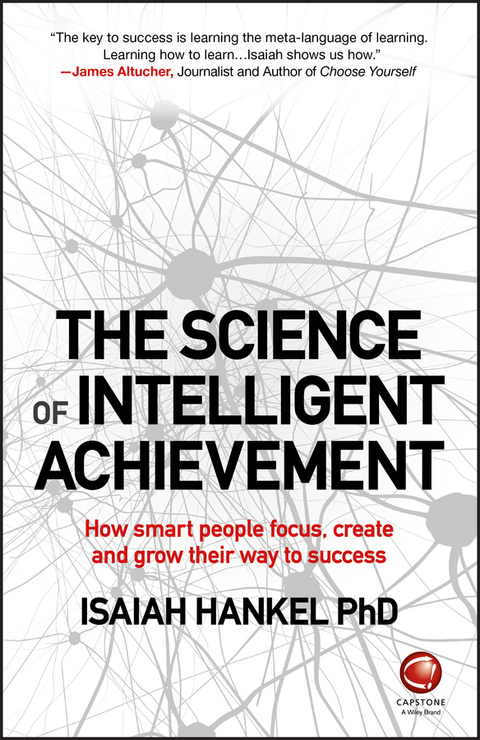
The Science of Intelligent Achievement (eBook)
John Wiley & Sons (Verlag)
978-0-85708-772-0 (ISBN)
The Science of Intelligent Achievement teaches you the scientific process of finding success through your most valuable assets:
· Selective focus - how selective are you with who and what you let into your life?
· Creative ownership - how dependent are you on others for your happiness and success?
· Pragmatic growth - how consistently and practically are you growing daily?
First, this book will show you how to develop your focus by being very selective with where you spend your mental energy, If you've failed to reach an important goal because you were distracted, misinformed, or overcommitted, then you know the role focus and selectivity play in achievement, Second, you will learn how to stop allowing your happiness and success to be dependent on other people and instead, start taking ownership over your life through creative work, Finally, you will learn the art of changing your life through pragmatic decisions and actions, Self-improvement is not the result of dramatic changes, Instead, science has shown that personal and professional change is initiated and sustained by consistent, practical changes, To grow, you must leverage the power of micro-decisions, personality responsibility, and mini-habits, Your own biology will not let you improve your life in any other way,
What do you currently value? What are working to attain? Have you been taught to value your job title or your relationship with some other person above all else? Have you been convinced that the most valuable things in life are your paycheck, the number of people who say 'hello' to you at the office, and the number of people who say 'I need you' at home? Or, have you become so passive in what you value that you let anyone and anything into your life, as long as whatever you let in allows you to stay disconnected from the cold hard truth that when things really go wrong in your life, the only person who will be able to fix it and the only person will be responsible for it is you, If so,,,welcome to fake success, Passivity, dependence, and the sacrifice of practical thinking and personal responsibility to fuzzy, grandiose ideals and temporary feelings - these are markers of fake success,
Intelligent Achievement, on the other hand, is not a moving target, It's not empty either, Instead, it's sturdy, full, and immovable, It's not something that's just handed to you, It's not something you're nudged to chase or coerced into wanting, Intelligent Achievement comes from within you, It's a collection of values that are aligned with who you are-values you have to protect and nurture, These values do not increase your dependence on other people and things, Instead, they relieve you of dependence, This kind of achievement is something that you have a part in building from the ground up-you know what's in it-you chose it, someone else didn't choose it for you,
Achieving real success means you must focus, create, and grow daily, The Science of Intelligent Achievement will show you how,
Isaiah Hankel is the founder and CEO of Cheeky Scientist, a career training company that specialises in helping PhDs and other advanced degree holders transition into corporate careers, He is also a managing partner of Expert Cytometry, a technology company that specialises in flow cytometry-based cancer research, Through these ventures, Isaiah has spoken and trained on career development, employee management, entrepreneurship, focus, and motivation at many of the worlds largest companies including Merlin Entertainment, Merck, MedImmune, T-Mobile, Pfizer, and Amgen, He has also been invited to speak at top institutions including the University of Oxford, the University of Cambridge, the UK Cancer Research Center, Marie Curie Institute France, Harvard Medical School, MIT, Stanford University, and the St, Jude Childrens Research Hospital, In addition to his consulting work, Isaiahs personally branded website (IsaiahHankel,com) attracts employees and entrepreneurs across all industries and levels with his scientific approach and tangible methodology to the pursuit of purpose, focus, and professional growth, Isaiah has developed a membership and training program under the Cheeky Scientist umbrella named the Cheeky Scientist Association, which now has over 2,500 active members worldwide, He has also developed a membership and training program under the Expert Cytometry umbrella named the Flow Cytometry Mastery Class, which has over 1,000 active members worldwide, Through his training programs, Isaiah has developed corporate sponsorships with ThermoFisher, Beckman Coulter (a Danaher company), MedImmune, Regeneron, Merck, and the SickKids Foundation, Isaiahs first book, Black Hole Focus: How Intelligent People Can Create a More Powerful Purpose for Their Lives, has sold over 11,000 copies internationally, He has been featured as an expert on mental focus, behavioral psychology, and career development in The Guardian, Fast Company, and Entrepreneur Magazine, He has delivered corporate presentations to over 30,000 people in the US and internationally, including over 300 workshops and keynotes worldwide in the past 5 years,
Smart strategies for pragmatic, science-based growth and sustainable achievement. The Science of Intelligent Achievement teaches you the scientific process of finding success through your most valuable assets: Selective focus how selective are you with who and what you let into your life? Creative ownership how dependent are you on others for your happiness and success? Pragmatic growth how consistently and practically are you growing daily? First, this book will show you how to develop your focus by being very selective with where you spend your mental energy. If you've failed to reach an important goal because you were distracted, misinformed, or overcommitted, then you know the role focus and selectivity play in achievement. Second, you will learn how to stop allowing your happiness and success to be dependent on other people and instead, start taking ownership over your life through creative work. Finally, you will learn the art of changing your life through pragmatic decisions and actions. Self-improvement is not the result of dramatic changes. Instead, science has shown that personal and professional change is initiated and sustained by consistent, practical changes. To grow, you must leverage the power of micro-decisions, personality responsibility, and mini-habits. Your own biology will not let you improve your life in any other way. What do you currently value? What are working to attain? Have you been taught to value your job title or your relationship with some other person above all else? Have you been convinced that the most valuable things in life are your paycheck, the number of people who say 'hello' to you at the office, and the number of people who say 'I need you' at home? Or, have you become so passive in what you value that you let anyone and anything into your life, as long as whatever you let in allows you to stay disconnected from the cold hard truth that when things really go wrong in your life, the only person who will be able to fix it and the only person will be responsible for it is you. If so welcome to fake success. Passivity, dependence, and the sacrifice of practical thinking and personal responsibility to fuzzy, grandiose ideals and temporary feelings these are markers of fake success. Intelligent Achievement, on the other hand, is not a moving target. It's not empty either. Instead, it's sturdy, full, and immovable. It's not something that's just handed to you. It's not something you're nudged to chase or coerced into wanting. Intelligent Achievement comes from within you. It's a collection of values that are aligned with who you are values you have to protect and nurture. These values do not increase your dependence on other people and things. Instead, they relieve you of dependence. This kind of achievement is something that you have a part in building from the ground up you know what's in it you chose it, someone else didn't choose it for you. Achieving real success means you must focus, create, and grow daily. The Science of Intelligent Achievement will show you how.
Isaiah Hankel is the founder and CEO of Cheeky Scientist, a career training company that specialises in helping PhDs and other advanced degree holders transition into corporate careers. He is also a managing partner of Expert Cytometry, a technology company that specialises in flow cytometry-based cancer research. Through these ventures, Isaiah has spoken and trained on career development, employee management, entrepreneurship, focus, and motivation at many of the worlds largest companies including Merlin Entertainment, Merck, MedImmune, T-Mobile, Pfizer, and Amgen. He has also been invited to speak at top institutions including the University of Oxford, the University of Cambridge, the UK Cancer Research Center, Marie Curie Institute France, Harvard Medical School, MIT, Stanford University, and the St. Jude Childrens Research Hospital. In addition to his consulting work, Isaiahs personally branded website (IsaiahHankel.com) attracts employees and entrepreneurs across all industries and levels with his scientific approach and tangible methodology to the pursuit of purpose, focus, and professional growth. Isaiah has developed a membership and training program under the Cheeky Scientist umbrella named the Cheeky Scientist Association, which now has over 2,500 active members worldwide. He has also developed a membership and training program under the Expert Cytometry umbrella named the Flow Cytometry Mastery Class, which has over 1,000 active members worldwide. Through his training programs, Isaiah has developed corporate sponsorships with ThermoFisher, Beckman Coulter (a Danaher company), MedImmune, Regeneron, Merck, and the SickKids Foundation. Isaiahs first book, Black Hole Focus: How Intelligent People Can Create a More Powerful Purpose for Their Lives, has sold over 11,000 copies internationally. He has been featured as an expert on mental focus, behavioral psychology, and career development in The Guardian, Fast Company, and Entrepreneur Magazine. He has delivered corporate presentations to over 30,000 people in the US and internationally, including over 300 workshops and keynotes worldwide in the past 5 years.
Foreword
Preface: A Fool's Guide to Fake Success
Acknowledgments
About the Author
Introduction: What is Intelligent Achievement?
Part 1: Selectivity
Chapter 1. Why Mental Energy is Your Most Valuable Asset
Chapter 2. How Busyness Leads to Burnout and Manipulation
Chapter 3. The Infection Known as "Other People's Opinions"
Chapter 4. How Small-Minded People Block Big Goals
Chapter 5. Scientific Proof that 50% of Your Friendships are Fake
Chapter 6. How to Deal With Negative People Without Becoming Negative
Chapter 7. Why You Need to Go on a Relationship Fast
Chapter 8. Automaticity, Scaling, and the Rise of Mental Loops
Chapter 9. Tracking Emotions and Predicting Feelings
Chapter 10. How to Label and Close Your Brain's Open Loops
Chapter 11. Keep it and Clarify it, or Delete it from Your Life Completely
Part 2: Ownership
Chapter 12. Where Millennials and Baby Boomers Meet
Chapter 13. "Entre-Employee" and Temp-Staffer are the Only Career Tracks Left
Chapter 14. Content Marketing is Ownership
Chapter 15. Leveraging Walt Disney's Secret System of Creativity
Chapter 16. Finding Your Voice and Letting the Right Audience Pick You
Chapter 17. Why a Good Story Will Make You More Money Than a Great Product
Chapter 18. The Magic of Turning Your Message into a Magnet
Chapter 19. How to Build up Your Virtual Rolodex
Chapter 20. Developing and Automating a Message-Driven Content
Chapter 21. Turning Your Message into a Minimum Viable Product
Chapter 22. What Happens When Your MVP Meets Your Market?
Chapter 23. How to Create a Non-Sleazy Sales Page That Converts
Chapter 24. The Addiction of Vanity Analytics and How to Really Use Social Media
Chapter 25. The Laws of Convergence, Replication, and Accelerated Returns
Part 3: Pragmatism
Chapter 26. Turning Pain into Productivity Through Pragmatism
Chapter 27. One Non-Negotiable is Worth a Thousand To-Dos
Chapter 28. The Real Theory of Relativity and The Law of Relaxed Productivity
Chapter 29. Avoiding Drama, FOMO, and "Blind Spot Ignorance"
Chapter 30. Preventing the Eight Deadly Productivity Pitfalls
Chapter 31. Is Everyone a Narcissist Now?
Chapter 32. Seeing Through the Victim Illusion
Chapter 33. How Decision Fatigue Reduces Willpower
Chapter 34. Hacking and Stacking Mini-Habits to Success
Chapter 35. Leveraging Boredom and Filling the Mental Void
Conclusion. A Practical Guide to Intelligent Adventure
Epilogue: Legacy
Bonus: Achieving Alignment
Index
"throws up plenty of little nuggets for improving life and generating wealth." (Global Payroll Association, May 2018)
"This is a good read full of personal insights from the author, but also ideas we can all adopt." (FT Adviser, May 2018)
3
The Infection Known as “Other People's Opinions”
It is not advisable to venture unsolicited opinions. You should spare yourself the embarrassing discovery of their exact value to your listener.
—Ayn Rand
A few years ago, I had to get emergency surgery after a negative health diagnosis (see the Preface for the backstory). After the diagnosis, there was no time to think.
My life sped up. Things started happening at warp speed, and I couldn't catch up. I was thrown into a vicious conveyer belt of mandatory action by a team of medical specialists.
After my tests, labs, and surgery, however, things slowed down. Now, there was plenty of time to think—too much time, perhaps. There was also plenty of time to ask for advice.
As often happens during these kinds of traumatic events, I felt a deep sense of loss and confusion. Clearly, I was doing something wrong in life for this to happen…right? Where did I mess up? What did I need to change? Why was I being punished? I needed answers and I needed answers now.
To find the answers I needed, I asked all my family members and friends for their advice. I went to a variety of therapists, psychiatrists, and counselors. Some of them had very strong opinions on what I was doing wrong and how I should change my life, while others just agreed with whatever I suggested, told me that “it was just bad luck,” or kindly admitted that they had no advice to give.
While talking to others was helpful, looking to them to guide me was a mistake. Instead of centering me, everyone's various opinions pulled me apart. Their emotional responses to my emotional situation made me—you guessed it—more emotional. It wasn't until I decided to listen to myself that things started to get better.
Once I took some time for myself—and listened—the answers came. In fact, the answers were always present. There was a small voice inside of me the whole time telling me exactly what I needed to change. The voice told me that I needed to start being more selective. More selective in what I gave my attention to, who I gave my energy to, and certainly, whose advice I listened to.
You Know What's Best For You
Other people's opinions are like viruses. They infect you. No matter who you are or how strong you may be, other people affect your emotions and behavior.
These feelings and actions circulate through social networks in patterns similar to that seen in epidemiological models of the flu virus.
A scientific study published in 2010 in the Proceedings of the Royal Society estimated that every positive person you let into your life increases your chances of being positive by 11 percent, but every negative person you let into your life doubles your chances of becoming negative.1
Yet most people will let just about anyone into their lives. Most people are too free with those they let in and what they take in from these people vis‐à‐vis listening to their blather.
They passively let negative people share their limiting beliefs and limiting opinions like, “Your goals are impossible. Only a fool would try to do that.” Or, “Your goals are so easy. Anyone can do that.”
As counter‐intuitive as it seems, most people make better decisions when they don't ask for other people's opinions.
Did you get that? Because it's a vital point. You'll do better when you listen to your inner voice, period.
This is because what you want in life is strongly affected by what other people want in life. Just seeing or hearing about what someone else wants, makes you want it too. Other scientific studies reported in the Journal of Personality and Social Psychology show that people who watch someone else pursue a goal are more likely to pursue the same one.2
In fact, those same studies show that people who simply read about another person pursuing a goal are more prone to seek it, too. Likewise, when you hear advice about what other people want for you, you're more likely to want the same thing. Their advice influences what you want. It can change your motivation, often for the worse.
You Are Biologically Wired to Copy Others
You can't solve a personal problem with someone else's answer. You can't figure out what your limits are by using other people as a yardstick. Most people, when faced with adversity, run to their friends and families to ask for help.
What should I do? They ask them. Or, even worse: What do I really want? Who am I? Other people can't answer these questions. You need to find these answers yourself.
The problem is that you've been conditioned to value other people's opinions more than your own. You've been trained to want to be like other people, to think like them. Not only are you taught to listen to other people, you're also biologically wired to copy their behavior.
Mirror neurons in your brain automatically cause you to copy your surroundings.
For decades, scientists have studied the powerful psychological factors that drive you to fit in with your environment and the people in it. These include groupthink,3 negativity bias,4 and the chameleon effect.5 As a result, you are a walking imitation. You are a natural follower.
Our proclivity for going along with the herd can work to our detriment. Scientific research shows that people who are lied to are more likely to lie and cheat.6 Similar research shows that having an obese friend increases your chances of becoming obese by 171%7 and having a smoker in your family increases your chances of smoking by 61%.8 And the influence of others can impact our brain health just as readily.
Negative Opinions Can Rot Your Brain
The first step to having a breakthrough in life is to start ignoring other people's opinions. When it comes to friendly advice, you must learn to be highly selective. This holds particularly true when the advice is negative. Scientific studies reported by Stanford University News show that exposure to negativity lasting 30 minutes or more peels away neurons in your hippocampus, the part of your brain responsible for problem‐solving.9
Yes, negative opinions can literally rot your brain.
You might think that allowing negative people to “vent” at you or trying to make them feel better is virtuous. But, in the end, it does not make you a better person. Instead, it reduces your mental energy levels and hurts your performance.
One study examined 120 participants who were asked to talk with or ignore a negative person.10 After four minutes of interaction, each participant was given a thought exercise that required solid concentration. The participants who ignored the negative people performed better on the thought exercises than those who engaged with the negative people.
Other studies show that always feeling obligated to make other people happy is incredibly destructive. It can lead to burnout,11 reckless behavior,12 and even suicide.13 There is nothing noble about listening to unsolicited opinions, especially unsolicited negative opinions.
Still not convinced? Here's a summary of how negative opinions and negativity can slowly ruin your life:
- 100% chance you will become more negative for each negative person you let into your life.14 In contrast, each positive person you let into your life increases your chances of becoming positive by only 11%.
- Double your odds of unhappiness.15 Put another way, one negative friend doubles your chances of becoming unhappy.
- 50% higher risk of dying young.16 People who give in to worries and demands from negative relationships have a 50% increase in the risk of dying early.
- 34% more likely to have heart problems. Negative relationships boost heart disease risk by 34%.
- Poverty.17 Negativity is linked to poverty and reduced brain activity.
- Brain damage.18 Listening to a negative person for just 30 minutes peels away neurons in your hippocampus, the part of your brain that's responsible for problem solving.
- Reduced creativity.19 People who work for a negative boss are far less creative than those who work for a positive boss.
- Depression and anxiety.20 Complaining about your problems increases your risk of developing both clinical depression and anxiety.
- Low self‐esteem.21 Listening to or watching negative people interact lowers your self‐esteem and makes you more neurotic.
- Poor performance.22 Engaging with negative people prior to performance tests, rather than ignoring them, decreases test scores.
- Increased pain.23 Negativity overrides the effect of pain medication in surgery patients.
- Loss of sleep.24 Negativity enhances the repercussions of poor sleep.
- Early death.25 People who use negative emotional language have higher rates of mortality.
You know what's best for your life more than other people do. Sure, there's value in learning from others, and you should never be afraid to solicit advice from wise individuals. But there's nothing to be gained from taking in unsolicited opinions, especially when they're negative.
There's a difference between being informed and being...
| Erscheint lt. Verlag | 30.11.2017 |
|---|---|
| Sprache | englisch |
| Themenwelt | Sachbuch/Ratgeber ► Beruf / Finanzen / Recht / Wirtschaft ► Bewerbung / Karriere |
| Sachbuch/Ratgeber ► Gesundheit / Leben / Psychologie ► Lebenshilfe / Lebensführung | |
| Wirtschaft ► Betriebswirtschaft / Management | |
| Schlagworte | achievement • achieving potential • achieving success • Black Hole Focus • boosting productivity • BUILDING BUSINESS RELATIONSHIPS • building relationships • Business & Management • Business Self-Help • career development • career investment • Career Planning • developing focus • Erfolg • finding fulfillment • Getting Things Done • high-performing people • how to be practical • how to deal with negative people • how to focus • How to Succeed • improving performance • Isaiah Hankel • Leadership Training • making connections • manipulative people • maximising efficiency • maximizing efficiency, getting results • mental clarity • Narcissist • narcissists • Negative People • Networking • Ownership • owning yourself • Personal development • personality assets • personal responsibility • practicality • Pragmatism • pragmatist • Productivity • professional development • professional relationships • Ratgeber Wirtschaft • secret of success • selectivity • self-improvement • self reliance • Soft Skills • The Science of Intelligent Achievement: How smart people achieve real success through selectivity, ownership and pragmatism • thinking better • Wirtschaft /Ratgeber • Wirtschaft u. Management |
| ISBN-10 | 0-85708-772-X / 085708772X |
| ISBN-13 | 978-0-85708-772-0 / 9780857087720 |
| Informationen gemäß Produktsicherheitsverordnung (GPSR) | |
| Haben Sie eine Frage zum Produkt? |
 EPUB (Adobe DRM)
Kopierschutz: Adobe-DRM
Adobe-DRM ist ein Kopierschutz, der das eBook vor Mißbrauch schützen soll. Dabei wird das eBook bereits beim Download auf Ihre persönliche Adobe-ID autorisiert. Lesen können Sie das eBook dann nur auf den Geräten, welche ebenfalls auf Ihre Adobe-ID registriert sind.
Details zum Adobe-DRM
Dateiformat: EPUB (Electronic Publication)
EPUB ist ein offener Standard für eBooks und eignet sich besonders zur Darstellung von Belletristik und Sachbüchern. Der Fließtext wird dynamisch an die Display- und Schriftgröße angepasst. Auch für mobile Lesegeräte ist EPUB daher gut geeignet.
Systemvoraussetzungen:
PC/Mac: Mit einem PC oder Mac können Sie dieses eBook lesen. Sie benötigen eine
eReader: Dieses eBook kann mit (fast) allen eBook-Readern gelesen werden. Mit dem amazon-Kindle ist es aber nicht kompatibel.
Smartphone/Tablet: Egal ob Apple oder Android, dieses eBook können Sie lesen. Sie benötigen eine
Geräteliste und zusätzliche Hinweise
Buying eBooks from abroad
For tax law reasons we can sell eBooks just within Germany and Switzerland. Regrettably we cannot fulfill eBook-orders from other countries.
aus dem Bereich